Showing posts sorted by relevance for query deer. Sort by date Show all posts

Friday, January 11, 2019

2019 New Year's Day Buck


On January 1 about 4:30 PM, I spotted the buck during a neighborhood walk. Those antlers were the biggest I've seen in a residential area. I wondered What kind of deer I recorded? Based on several sources that indicate loads of white-tailed deer in Texas, and confirming concentrations in Central Texas, I'd say he was a white-tail buck. Also, he resembles several pix I've run across in websites. From "What Kind of Deer Are in Texas?":
Two species of deer are native to Texas’s vast and varied countryside: the white-tailed deer (Odocoileus virginianus) and the mule deer (O. heminous). … one of the largest populations of whitetails in the country: close to four million. … White-tailed deer, the most widely distributed and evolutionarily ancient deer in North America, get their common name from the snowy underside of their tails, which they prominently flash when alarmed.

The Texas whitetail (O. v. texanus) occupies the broadest range, found across most of the central and western portions of the state. … Compared to whitetails, mule deer -- named for their outsized ears -- have a much smaller native range in Texas. … According to Texas Parks & Wildlife, the state likely harbors between 150,000 and 250,000 mule deer.
Visit "A QUICK GUIDE TO DIFFERENTIATE MULE DEER FROM WHITE-TAILED DEER" for good content and side-by-side pictures to contrast these two deer types.

"5 Facts About Texas Deer That You May or May Not Know" states that 3.6 million white-tailed deer are in Texas (as of November 2017 publication). Regarding size, "South Texas produces the biggest white-tailed deer, due to the protein in the brush that the deer eat there." (The three white-tail deer in the group picture resemble my neighborhood buck.)
I wondered about antlers. "How Do Deer Antlers Grow?" provided rudimentary info.
Deer antlers are growths of bone that deer and similar animals produce for mating season. Only male deer produce antlers, and few deer keep their antlers for long periods. Contrary to popular belief, the size of the antlers and the number of points do not indicate the age of the deer.
I wondered further: How fast do antlers grow? What happens to shed antlers? More details about the velvety fuzz on antlers?

For a really in-depth read, visit "About Deer Antlers". Interesting factoid—"antler growth is one of the fastest known types of tissue growth in mammals, and a deer’s antlers can grow at a rate of 1/4 inch per day".

From "What Happens to a Male Deer's Antlers in the Winter?"
they eventually drop off sometime between December and March -- not always at the same time -- and are left behind. The skull bleeds and scabs over, healing so the antlers can grow back in the spring. In the meantime, the antlers that he shed are eaten by smaller animals like squirrels, who benefit from whatever calcium remains.
"White-tailed Deer" provides more details about antlers.
antlers are shed each year after breeding season and must be replaced with a new set grown the following year. … Shedding takes place from mid-January to mid-April, but most mature bucks in good physical condition have dropped their antlers by the end of February.

Unlike horns, antlers are solid bone and are grown only by members of the deer family.
For very detailed descriptions of the antler process, accompanied by stunning images of bucks' heads, visit "Whitetail Deer Antler Growth Process". As for velvety antlers:
Most northern bucks will have completed their antler growth by the 10th of August, … For the next 20-25 days the antlers will harden. During this time … the velvet covering the antlers shrinks as the blood flow slows. Sometime in late August through mid-September most bucks will peel the velvet from their antlers.
I thought about additional curiosities about deer, such as speed, odd head noises, and jumping.

"How Fast Does a Whitetail Deer Run?" states "White-tailed deer can sprint at speeds of up to 30 miles per hour."

Have you been close enough to hear deer snort or make other weird head noises? "Bleats to Grunts – Deer Sounds and What They Mean" contains lots of authoritative content and videos.

Wonder about deer jumping capabilities? A company that sells fence kits describes the relationship between deer vision and fence jumping. From "FACTS ABOUT DEER AND FENCES: WHY DEER JUMP":
They have real trouble seeing the fence top. Deer see best in the yellow, deep blue and certain ultraviolet portions of the spectrum, …. In addition, deer have limited depth perception. Their eyes are on the sides of their heads (for wrap-around peripheral vision to spot predators), so their binocular vision is sacrificed and their 3D sense (especially for nearby objects) is weak. Thus, they have difficulty telling where your barely visible deer fence leaves off and the trees or sky begin.
Another company that sells fence parts also describes deer vision and fence jumping. From "How High Does a Deer Fence Need To Be?":
Deer can jump an average of 8’ high, but will not risk the jump if they are uncertain because they have poor vertical vision … both plastic deer fencing and PVC-coated steel hex web mesh deer fence poorly reflect these wavelengths.
For more info about fences and other means to resolve deer problems in your area, the following sites provide suggestions. (The fourth website more emphasizes using plants than fences.)
I myself don't see deer sauntering near my own home, and have very little in the way of a salad bar that attracts deer. The buck was a happy accidental spotting to start my year off.

For more articles about deer, enter "deer" in the search box at the upper left of this window. Or find and click "deer" link at Partial Index of Keywords section (just below Popular Posts section). BTW, additional deer videos are available at my YouTube channel.

Saturday, May 9, 2020

Deer Mama 2 B's


Best wishes to all the mamas and mamas-to-be! (This upcoming Mother's Day inspired me to create and publish this article and video.)

I recorded some deer 4/21. I noticed one that I was able to keep in view looked belly-rounded. Made a mental Post-It to look up doe pregnancy for possible time of year commonality. One of my curiosities was what a pregnant doe looked like.

My inquiry for Google images for "pregnant does" yielded images of pregnant women, no deer at all, guessing Google interpreted my image inquiry as pregnancy does and don'ts. Image Googling "pregnant deer" yielded lots of pregnant deer. (Whoa! Some images astounded me!) A Google image hit for "what does a pregnant deer look like" yielded similar images, many overlapping the previous image results.

Spotted and recorded some snippets of does 5/7. Most of the does looked svelte, but one or two looked slightly distended. Re-viewing the 4/21 clip helped with visual comparisons. My video includes both pregnant and non-pregnant does.

Curious about doe pregnancy and fawn birth? Lead-ups to the process? "How Long Are Deer Pregnant? [Gestation Period For Deer]" explains deer season regarding "rutting", mating, doe gestation, and a table of various deer types and number of days for pregnancy.

What's rutting? Why do we talk about being in a rut, a bad thing? Why does it seem that rutting is so often associated with deer?
"In a Rut - Breeding Season Behaviors in Deer" explains:
The term "rut" is often used to describe a boring, monotonous routine or a trench worn in the ground by a wheel. However, if you hang around much in white-tailed deer hunting circles, chances are that it means something completely different. Many people use the term rut only in reference to the peak of the breeding season, but it really applies to a much more extended period of time. The rut refers to all behaviors and activities associated with the breeding season.
Additional resources:

"Spotting" Whitetail Deer Fawns" states, "A doe goes into estrus in the fall, which means whitetail deer fawns are normally born sometime between late April and early July."

"Understanding Deer" provides more details about mom and fawns:
Spring and summer is the time of year deer give birth to their young. A deer may have between one and three babies, two being most common. Fawns are born from April though June. They are born with their eyes open and fully furred.
"HOW TO TELL IF THAT FAWN REALLY NEEDS YOUR HELP???" provides still more details, including emphasis to post-birth behavior.
As early as April, but most often in May and June, you may find a White-tailed Deer fawn curled up in your lawn, garden, bushes, or nearby field or trees. You may think it has been abandoned, but most of the time this is not the case. White-tailed does spend a small portion of the pre-dawn hours looking for a quiet, secluded spot to place their fawn(s) that are three weeks of age and under, as they will not be able to keep up with the doe’s pace.
For blog articles pertaining to deer, use search feature at the upper left of th4e website. For videos, go to my YouTube link for deer playlist (Oh, deer!)

Tuesday, October 22, 2019

Better'n a Baker's Dozen of Deer


A few days ago on a morning walk, the sun was pretty bright out, making me think conditions wouldn't be good for using my camera. For about the first half hour, I spotted some deer here and there, but contrasts not good. Happily, a load of deer came into view in shade. Within six minutes, I snagged three separate clips within 500 feet that I thought interesting.

Baker's Dozen
So many deer came into view in my first clip, I wondered how many I recorded. Upon viewing the clip several times, I'm more than 90 percent sure I have 14. My title refers to baker's dozen. I don't believe the term is used much anymore, but I wanted to refresh my recollection of its meaning. From "baker's dozen:"
a group of 13; a dozen plus one: from the former practice among bakers and other tradespeople of giving 13 items to the dozen as a safeguard against penalties for short weights and measures.
One doe, which I feature in the second video segment, caught my eye for smudge-like markings on her flank and shoulder. In the third clip, five deer are prominent. At the very start, however, a faraway sixth one ambles at the extreme right part of the clip. Blink and you miss it!

During viewing and editing, I noticed these deer all had taupe coloration but some were smaller than others. When I "shot" deer earlier in the year, fawns were more tawny and had white spots. More on the spotting later.

Coloration
Taupe and tawny each have 5 letters, starting with "ta". I wanted to clarify the color distinctions.
From "Taupe Color":
intermediate shade between dark brown and gray, which shares similar attributes of both colors. However, taupe does not describe a single color, rather, it is used to describe a vast range of colors from dark tan to brownish gray.
From "tawny":
A color adjective, tawny describes something that is a mix of yellow, orange, and brown colors. … Tawny comes from the Anglo-Norman word, taune, which means tanned.
It turns out that colors change during the year. In viewing some of my videos of deer from earlier in the year, does also look tawny. View deer/fawn segments at "Critter Shootin' Near Mid-June 2019" and "Fawnzies and Deering Does" (from July).

"Whitetail Deer Facts & Trivia, Information & Photos" is loaded with good deer info to begin with. Surprising is that the coat colors change throughout the seasons, like getting dye-jobs year around.
The whitetail's coat will change with the seasons, from reddish brown in the spring and summer when vegetation is growing to grayish brown in the winter. This helps the deer to stay camouflaged all year round. The change in color happens quickly, usually in 1 or 2 weeks.
Fawn Spots
From "More Information: When Do Fawns Lose Their Spots?":
Fawns maintain their white spots for 90 to 120 days after birth; quite useful for their survival. These spots eventually fade away from their body after that time frame. Once gone, a shiny brownish fur replaces it. A thicker coat replaces the previous coat of the fawn as the white spots slowly fade. The purpose of the thicker coat is for them to survive the winter.
Antler Starts
Another feature that piqued my interest with these clips was absence of antlers or forehead nubs. I wondered when male deer started developing them. From "Managing for Age in White-tailed Deer"
Male deer begin growing their first set of antlers at about one year of age. They will grow a new set of antlers yearly. With proper nutrition equal, antlers will get larger each year until about six years of age.

For more articles about deer, enter "deer" in the search box at the upper left of this window. Or find and click "deer" link at Partial Index of Keywords section (just below Popular Posts section). BTW, additional deer videos are available at my YouTube channel.

Saturday, November 30, 2019

Short Pre- TDay Deer Tracking


How short was the tracking? About 16 minutes and 1/4 mile of deer path. Followed a pack of deer and shot five clips on 11/23, the Saturday before Thanksgiving.

I found it amusing that the first clip showed decorative spider webbing among the foliage. That resident actually managed to remove it before Thanksgiving day. (I appreciated the web decoration serving as a visual cue for timeframe.)

During my deer pack follow, additional items of interest were a couple of balloon arrangements. One was a sitting turkey (on a straw cushion), another one was a group of smiling jack o'lanterns beside a sitting turkey.

Interestingly, the jack-o'lanterns were dual-purposed, having been around for Halloween and kept in place for Thanksgiving.

While I reviewed and edited items for creating my video for including the inflatable balloons, I decided to also work in a couple of deer images from just before Halloween. One pic has a fawn and doe seemingly playing peekaboo with each other, to the right of a Halloween skeleton.

The other pic is a composite of a buck. Lucky for me, I happened to have had my camera with me during this car trip. BTW, almost all my image captures are on foot. (Video clip frames vary slightly from the stills shown here.)
My video featuring the deer pack includes the following sections:
  1. Web-strung foliage at a house, deer pack ambling away
  2. A close deer trio moving from my left to right
  3. Pack starting to cross street and apparently doubling back halfway
  4. Pack deliberately trotting across street right to left
  5. Pack ambling away
  6. Halloween/Thanksgiving pic potpourri near 11/23 timeframe
The potpourri section includes a few Halloween and Thanksgiving images for timeframe reference. (I really wanted to include the timeframe-proximate regal buck and peekaboo deer.)

For more articles about deer, enter "deer" in the search box at the upper left of this window. Or find and click "deer" link at Partial Index of Keywords section (just below Popular Posts section). BTW, additional deer videos are available at my YouTube channel.

Thursday, July 18, 2019

Fawnzies and Deering Does


It took only about half an hour to capture does and fawns one morning (June 23). Two does and their twin fawns were two separate families. One of the does of twins had a Sharpie-pen-like horizontal mark at its left flank. One additional doe had a single fawn near it. One snippet showed two fawnless does. This season, I have rarely missed spotting deer during neighborhood strolls (multiple times weekly.)

Feed Me!

A previous video I'd uploaded included a clip of a doe standing one hind hooves to reach some tree leaves (~5 minute mark). In this blog's video, I managed to capture a mom feeding her young'uns. Or maybe it's more like the young'uns insisting to Mom, "Feed me! Feed me!"

Thinking of the, uh, food order, my mind meandered to the entertaining musical version of "Little Shop of Horrors". Audrey II, the mutant plant, is terrifying and amusing at the same time when "requesting" food.

Piqued About Fawns?

Numerous sources inform about youthful spots, importance of not touching these babies, and fast maturity.
An interesting way to obtain fawn info is entering a curiosity question about them in Google, such as "how much do fawns weigh at birth". Google displays loads of questions and answers.

One evening in 2005, I'd spotted a fawn lying among jasmine. Hadn't thought of any other time to work the pic into previous article. Not likely it is still around.

"Whitetail Deer Facts & Trivia, Information & Photos" says, "Few whitetail deer live more than 5 years in the wild. Some whitetails have been found to be up to 11 years old in the wild, and domesticated deer have lived up to 20 years."

More recently than way back then, I spotted, recorded, and blogged about a buck we spotted New Year's Day. It had several points on its antler; was older than a juvenile.

For more articles about deer, enter "deer" in the search box at the upper left of this window. Or find and click "deer" link at Partial Index of Keywords section (just below Popular Posts section). BTW, additional deer videos are available at my YouTube channel.

Tuesday, January 31, 2023

2022 Deer Near Here And Dere


The deer slide show is a video of thumbnail images from the playlist video clips, recorded during walks in 2022. Twelve of the sessions were in October through December.

I spotted and recorded a few gangs of does, a few gangs of bucks, and some usual frequent subjects. Could be these gangs were the same bunch spread over a few shoots.

I used my Canon PowerShot ELPH 190 IS, no tripod for stability, often standing without support to lean on.

The following table includes clickable links to the YouTunr deer videos. (Playlist link)

The following table includes clickable links to the YouTunr deer videos. (Playlist link)

#
Date Description Additional info Duration [m:ss]
1
Feb 22Bucks 0:49
2
June 11Bucks, does, fawnsshort fuzzy antlers3:43
3
July 30Buckslonger fuzzy antlers3:22
4
Aug 1Bucks 0:44
5
Aug 7Bucks 2:02
6
Aug 13Does, fawn, bucks 8:02
7
Oct 4Does 0:55
8
Oct 8Bucks, doesfuzzless antlers3:08
9
Oct 29Does 1:56
10
Oct 30BuckMost regal2:41
11
Oct 31Buck 1:06
12
Nov 10Buck, mostly (also squirrel cameo)Squirrel seen twice, doe in background near end4:52
13
Nov 13Does and buclsBuck chases does2:31
14
Nov 16Does 1:16
15
Nov 23Buck and doeMutual disinterest2:30
16
Nov 27Does 1:10
17
Dec 22Buck 1:51
18
Dec 30Does 0:28

Read more deer blog articles.

Wednesday, June 26, 2019

Critter Shootin' Near Mid-June 2019


Previously, I blogged "Lotsa Bloomin' Mid-May Near Mid-year 2019", regarding a neighborhood stroll—flora and fauna images from May 16, 17, 18. This neighborhood stroll video includes only animals; the walk took less than an hour. What a collection of critters!
  1. Cooper's Hawk and mockingbird
  2. Doe and two fawns
  3. Red June bug
  4. Doe and two fawns (Initially unsure if a second family or the same one.)
  5. Caterpillar (June bug larva)
The Cooper's Hawk perched atop a foliage-free branch group. A mockingbird kept dive-bombing it. Trying to keep the camera steady at the distance and zoom challenged me.

I wasn't sure that the doe and fawns were the same family until reviewing the video clips. In the second footage of deer, they were much more energetic than in the first footage.

The June bug might have already been dead; I didn't want to prod it to find out. Incidentally, I'd uploaded the bug to LinkedIn with request for ID. The color and pose didn't resemble any of the three olivy green/brown June bugs I pic'd last year ("So How Cute ARE June Bugs?"). Maybe I should have ensured the reddish bug had its total back upward.

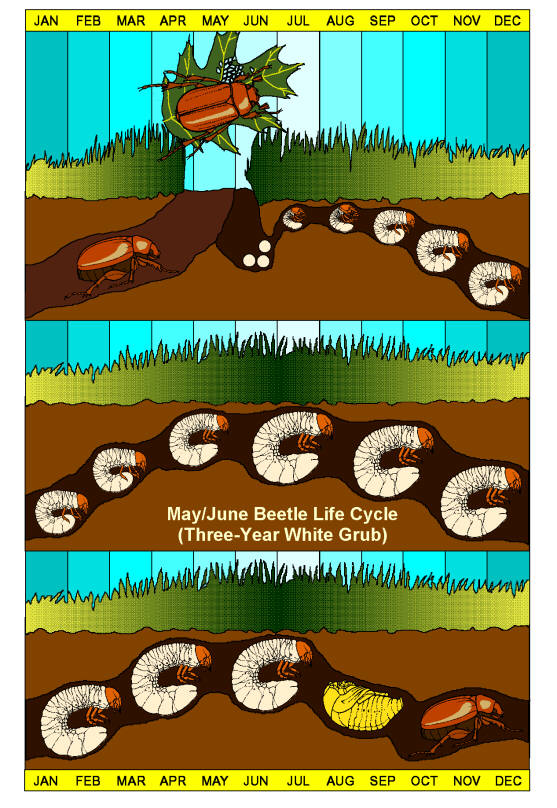
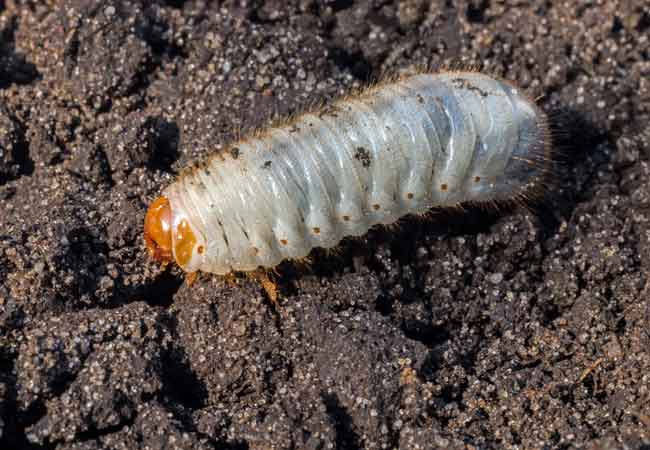
The caterpillar resembled several that I'd shot in April. The undulation movement intrigued me, as well as its prolegs. It took some poking around Google images to find some that resemble my "capture"; I finally found enough info to declare the critter a June bug larva. "Life Cycle Process of a June Bug" shows a basic diagram. "Turfgrass - May/June Beetle Grubs" links to a January-through-December image. Grubs don't sound good to have around. "How To: Get Rid of June Bugs", section "PREVENT DAMAGE FROM GRUBS" has a large image with caution and recommendation: "grubs that will get your grass. Lose the larvae …". Another anti-grub resource: "Grub Worm Identification and Treatment".

This year has been very good for abundant blooms, new-growth plants, and wildlife. View some via the index. Also, I'll be posting more strolling image items to share.

For more articles about deer, enter "deer" in the search box at the upper left of this window. Or find and click "deer" link at Partial Index of Keywords section (just below Popular Posts section). BTW, additional deer videos are available at my YouTube channel.

Thursday, January 30, 2020

Looking Back for 2019 Blogging

As part of looking back on 2019, I also cast a backward look toward my entire blogging experience. More on the farther-back look (10+ years, from September 2009 to 2019) in Looking Back for All-time Blogging". The table shows stats for 2019 for each of the 24 articles (twice a month)—word count, topic, and graphics type. Links to each article are at the Blog Archive index (lower right side of blog window.)

Word Count

The Word Count column shows number of words for each of the articles in 2019.

High: 1701, Dec 30, 2019 ("Assessing My Christmas 2019 Lemon Meringue Pie")
Low: 114, Oct 12, 2019 ("Halloween Scenes Around")
Average 568.0 (all word counts added and divided by 24)
Median 540.5 (midpoint between high and low word count)

Topic

My most-viewed  topic was a toss-up between deer (5) and plantlife (5), followed closely by buglife (4). This was an extraordinary year for deer; I did not write at all about any in previous years. Maybe 2018's rains brought on all sorts of eatin's that attracted loads of deer and spawned fawns. The topic tally is as follows, from most to least:

deer, 5
plantlife, 5
buglife, 4
how-to, 3
food, 2
parody, 2
avian, 1
music, 1
seasonal, 1

Graphics Type

Videos and pix accompanied more than half the articles. Shot lots of deer, plantlife, and buglife. Plants were various, indicating 2018's rains were good to them. Buglife included mostly cicadas, amazingly, a prolific year for them.

Last June, I started creating and uploading videos that didn't originally accompany articles. I called them "Eye-caught Snippets", totaling 13 by near the end of December. I did incorporate some of the snippets into article-associated videos.

Thursday, December 29, 2022

End of 2022 Re-viewing Bur Oak, Deer Bookends


Earlyish December, I returned to the scene of the bur oak tree that I visited the day before Halloween. I spotted an unusual-looking acorn, even weirder than typical walnut-sized with dreadlock-look cap. The shell was cracked open, but the unit still together.

I took it home and stored it, intending to open it up some time in the near future. Close to Christmas, I returned to the tree to take its pic and look for more acorn specimens.

On the day after I recorded indoor clips of me examining those acorns, I went out for a walk a few hours later. I spotted a buck and decided to record it leisurely chomping on acorns (too small to be bur oak acorns). Recalling that I had a deer clip from the same day as my late November bur oak tree recording, I dabbled with the thought of integrating bur oak and deer into a blog topic.

The late-November bur oak tree was actually an accidental encounter. I had initially spotted and recorded a group of does, at least half dozen. Upon tracking them from left to right, I spotted some bur oak acorns on the ground. (This tree and sample specimens are noticeable in "Bur Oak Trees Spotted and Acorns Piqued" (video, article).

My video contrasts a few of the specimens from the same tree. Does comprise the front bookend to the bur oak acorn re-viewing, and the buck serves as the back bookend. Ruminate over a few sleek ruminants that are rather common in my neck of the woods. As for the bur oak acorn samples, the latest one that I opened up broke up in three sections, but not cleanly. (One specimen that I collected resembles a Star Wars bb-8 astromech droid, Rosetta asteroid or bun do.


"Bur Oak Acorn, Walnut-sized Nut" (primer bur oak acorn info)
"Bur Oak Trees Spotted and Acorns Piqued"
"End of 2022 Re-viewing Bur Oak, Deer Bookends"


Monday, November 30, 2020

2020 Buckity October and November

I'd spotted loads of bucks in October and November this year. I'd created several short YouTube videos of them and included links to them in playlists "Eye-caught Snippets" and "Oh, deer!". In the last few days, I decided these October and November bucks warranted their own playlist.

As I'd run across so many bucks recently, I became curious enough to Google about bucks and antlers, particularly about growth spurts.

From "Antler Growth Cycle":

Antlers grow rapidly from their pedicle (base) while in velvet during the spring and summer, as fast as 3/4 inch/week for yearlings and 1 1/2 inches per week for adults during peak growth ... Growth rate slows dramatically during late summer while mineralization of the antler is completed.
From "Whitetail Deer Antler Growth Process"
over a course of 120 days from late March through early August, a mature buck can grow in excess of 200 inches of bone on his head

This site includes lot of pix showing antlers by time of year. The video link points to "Whitetail Deer Antler Growth Timeline". Note the looks for October and November.

"Time Lapse Antler Growth of Whitetail Deer - See How Fast Antlers Grow" is another visually informative video.

Tuesday, August 25, 2020

Gopher Plant aka Silver Spurge aka Euphorbia Rigida

The plant had mystified me when I first spotted it in May 2019. Since then, I'd taken a few videos and stills of it, and a couple from a different site. Earlier this year, I stumbled across a YouTube video that included a snippet and ID (Euphorbia rigida) of the suspect plant. Google search results for "silver spurge euphorbia rigida" also show several plants that resemble my images.

In poring over additional web info, I concluded the intriguing plant is a gopher plant, aka silver spurge, aka Euphorbia rigida. (That scientific term causes me to think it best to copy/paste it, as I might easily mistakenly spell euphoria instead of Euphorbia.)

Some enlightening sites:

"Euphorbia rigida Also Known As Gopher Plant Rigid Spurge" shows a gallery that includes several pix with leaf formations that are similar to my images. It also explains one of its plant terms:

Rigid spurge? Sounds like more of a social disease than a great garden plant. ... The upright stems are clothed in long, pointed, powder-blue, deer-resistant leaves. In very early spring, the ends of each stem are adorned with yellow bracts similar to a miniature poinsettia.

Bract? From Garden Word of the Day site for "Bracts": "Bracts are specialized or modified leaves. ... The presence of bracts, or lack thereof, can help you identify plants."

Gopher Plant Care: Learn How To Grow Euphorbia Rigida provides overview and info about the plant's name.

It belongs to the Euphorbia genus, named after Euphorbus, a Greek physician who is credited for introducing the Euphorbian plants. ... Native to the Mediterranean and Middle East regions, the gopher plant is a low-maintenance plant-type and a drought-resistant evergreen.

Euphorbia Rigida or Gopher Plants also provides overview of the plant. The explanation for why "gopher plant": "The same milky sap that causes irritation to humans also repels rodents and small mammals like gophers, hence the plant's name."

The video includes stills and clips that I took 5/23/2019, 6/1/2019, 8/6/2019, 3/18/2020, and 8/2/2010. Near the end, a four-footer makes a guest appearance, with a few other hoofers making cameos. BTW, deer hooves are special, according to "Hooves make everything deer do possible".

Saturday, November 5, 2016

Envying Animals, Part 2--Non-senses

My previous article "Envying Animals, Part 1--Vision, Hearing, Sense of Smell" was about envying animal characteristics pertaining to three senses. This article is about envying animal non-sense (grin) characteristics. Obvious capabilities are flight and living underwater without requiring mechanical devices. Other marvelous animal capabilities are ability to leap tall objects in a single bound, tails for tools and communication, and ability to hide in plain sight.

Flight
Has anyone ever, from youngster age on up, ever NOT wished for ability for self-propelled flight? For animals, we have birds, bats, and flying insects. We have aircraft and other machines that fly. Legendary fantasy flyers, such as European dragons, flying monkeys, Pegasus, and flying creatures from Avatar tantalize the fancy for flight. We have fantasy superheroes with wings or jet packs, and some who originate from other dimensions or planets.

Especially impressive are birds that can fly very long distances without stopping. From "These amazing little birds just broke the world record for nonstop flight": "These amazing little birds just broke the world record for nonstop flight … common swifts are capable of flying for 10 months without once touching land".

Underwater Living
Wouldn't it be great to breathe underwater without using a snorkel or scuba tank? Or deal with holding breath? Or worry about running out of air? Wonder about fish aquatic environment? "How do fish breathe under water?" explains: "Fish use their gills to breathe by extracting oxygen from the surrounding water."

High Jumps (Able to Leap Tall Objects in a Single Bound)
I think it'd be cool to be able to jump heights that cats, squirrels, and deer can in relation to their body lengths.
On a related note, "Top 10 Best Jumper Animals!" depicts animals that exhibit astounding horizontal as well as vertical jumping abilities.

Tail Uses
We humans lack tails. I envy dogs for having tails for conveying emotion. I envy prehensile-tailed animals for their ability to use their tails like an additional hand.
  • "Why Do Dogs Wag Their Tails?" state "Dogs use their tails to communicate strong emotions such as agitation, annoyance and anger as well as happiness."
  • "Animals With Prehensile Tails: Gripping Facts and Pictures" describes numerous animals that use their tails as tools. "They can curl their tail around objects such as branches and hold on to those objects for balance. … The Silky Anteater and the northern and southern tamandua have prehensile tails, which assists them in climbing trees or holding on to branches or other objects."
Hiding in Plain Sight—Camouflage, Mimicry
Some animals have their own cloaking devices, some for seeing without being seen, and some for making them seem to be something they're not.
Hanging Out in Groups—Swarm Behavior
I envy and marvel about some animals that can swarm without colliding into other members. Think about swarms of bees, flocks of birds, and schools of fish. From "Swarm behaviour": "a collective behaviour exhibited by entities, particularly animals, of similar size which aggregate together, perhaps milling about the same spot or perhaps moving en masse or migrating in some direction. … From a more abstract point of view, swarm behaviour is the collective motion of a large number of self-propelled entities."

I can only imagine if aliens observe humans going 'round and 'round a race track collectively, but collide into others. Also, consider what alien observers might infer if they saw a sporting event—migration into a stadium, rituals and movements in the center that correlate with group motions and vocalizations, and migration out of the stadium.

Some Human Advantages Over Animals
Despite my envy of several animals' characteristics, in some areas (and more), we humans excel animals:
  • Speech and communication, as in spoken and written language
  • Human bipedalism that helps with seeing and assessing environments, and leaves hands free to do other things
  • Unlike a goodly number of animals, no need to eat on the run, such as pursuing live prey for a meal or chomping on animal on the hoof. Also seldom needing to fret of predators in hot pursuit to make a meal out of us.

Wednesday, February 26, 2020

Buck Bookended at 2019 End


At the end of 2019 (December, to be more specific), I shot three bucks. Two were within minutes of each other on the 9th, and the final one on the 29th. What do I mean about "bookended"? The first buck bookend for 2019 turns out to be "2019 New Year's Day Buck"(article, video).

Throughout the year, I'd spotted numerous deer--lots of does and fawns, but few bucks. One other buck ambled into view on October 28 (image also near the end of "Short Pre- TDay Deer Tracking" video). I was lucky that I had my camera with me, although I wasn't prepared enough to shoot video of him.

Thus far in 2020, have not captured many images/videos for animals and plants. Might be a combination of so far of not getting out a lot this year, and less flora and fauna activity compared to last year.

Friday, December 31, 2021

2021 Christmas Decorations Tour

In late 2020, I'd posted "Pre-pandemic Neighborhood Christmas Decorations--Yea, 2019" with video link. I didn't even bother to collect images for 2020 Christmas.

Why 2019 Christmas decorations? Partly because I had pix that I didn't get around to organizing. Another reason is my mental contrasting what I've seen this year to what I'd taken pix of last year. Seems this year I've seen fewer balloons (varieties and quantity).

As I recorded this week's visuals, I sensed subduedness similar to last year in decorations. One site seems to physically epitomize the mood, although maybe coincidental. I recognized many of the inflatables, rearranged in different areas than 2019. However, two had been deflated since a day or two before Christmas. Several inflatables were airless even on Christmas day, the day I thought would most likely display festive, jolly puffiness.

I had picked Christmas day and day after to capture sights. It was good I captured a few on the 25th. By the next day, two were already removed. As of today, I noticed more empty spots. Maybe the unseasonably warm conditions have inspired people to remove wintry sights.

The 2019 tour video differs a bit from this year's tour video. In 2019, I took still pix at 16 sites, some in the day time, some at night. This year, I recorded clips from 26 sites, all during daylight. Seems the most dominant decorations include Santa, deer/reindeer, decorated-tree balloons or adorned trees, snowmen, and baby penguins.

As I started organizing my project clips, I initially felt the pandemic pall colored my perception of the decorations. As I continued the process, my spirits lifted. In comparing my 2021 captures to my 2019 (pre-pandemic) captures, I notice more and varying images, not fewer. Hope you enjoy the ride and sights! May 2022 be more joyous than 2020 and 2021!

Tuesday, December 31, 2024

2024 Christmas Decorations Tour

My previous video and article included decorations for Halloween, Thanksgiving, and even a smattering for Christmas. For this touring, I saw a few decorations that served dual-holiday purposes, the residents having creatively adorned them. Got most of the images from a few days of drive-byes. Surprisingly, seems fewer places had decorations than previous years.

Most decorations I imaged were inflatable balloons, which included Santa, snowmen, reindeer, penguins, a few dogs, live white-tail deer, ... Many goodies images were of candy canes and red/white or green/white round mints.

One video section includes a collection of Halloween/Christmas visuals that I culled from other clips. Look for these items in the neighborhood sections among the more obvious Christmas-theme figures. Happy touring! Also look for Halloween/Christmas in my blog and YouTube channel.

Thursday, December 12, 2019

Creating a YouTube Playlist Really Fast

In 2012, I wrote my previous blog articles WRT creating YouTube playlists with YT newbies in mind. (I'd been more of a newbie back then.) My newer method streamlines the process to minimal steps and window hopping.

Long ago, I set up playlists for music selections that reflect blog article topics. Keeping the playlists up-to-date have been problematic because of some owners removing videos or changing the public status to private. After having occasionally revisiting playlists and updating them, I no longer prioritize URL replacements.

What prompted me to revisit creating YT playlists? Two incentives: Replicating a set of cartoons on a VHS tape that didn't list the entire contents, and wanting to create recent thematic playlists for videos I'd created over time.

Scroll to near the end of this article for the playlist-creation procedure.

VHS-tape Cartoons

I had a VHS tape of cartoons ("Woody Woodpecker and Friends") that I wanted to be able to view without risking wearing out the VCR. The set info on the box is not very helpful; it lists only 12 of the 22 stories. I looked high and low on the web for the full listing. Neither VHS tape nor DVD version is available for sale. The closest info I found were both from WorldCat.org, which lists libraries that have them, no place close to home.

From one "Woody Woodpecker & Friends—"Diamond Entertainment Two hours of classic cartoons, 2003, DVD"

From another "Woody Woodpecker & Friends"—Distributed by Diamond Entertainment Corp., ©2000."

I finally resorted to playing the entire tape over two days, jotting down the titles, main characters, copyright year, in play order. I found all of the cartoons on YouTube. The playlist I created reflects the VHS tape's videos and order, but better quality. For two of the stories, I included links to additional versions because of quality issues—Robinhood Makes Good and Greedy Humpty Dumpty.

Thematic Playlists

Do you have a sizable collection of your own videos? Maybe some that are about similar topics? Create playlists with themes in mind. Set up the play order, and change them whenever you want.
This year, I started posting videos that did not correlate with same-name blog articles. I called them "Eye-caught Snippets" and put them into a playlist. More recently, I decided to create playlists for bugs , deer, and kitchen doings.

Creating the YouTube Playlist Really Fast

Assumptions are that you are familiar with YouTube and have a YouTube account.

Hint: Before starting the playlist process, first create a list that has columns for title and link. The list helps with easy navigation to the video and adding it to the playlist.
  1. Log in to YouTube.
  2. Navigate to a video.
  3. Click the Save button. (You must be logged in so you can save.)
  4. When the playlist window opens, click the playlist you want to save the selection to.
    (If you don't have a playlist for this purpose yet, click "New playlist", and follow the prompts.)
  5. Click the "X" at the upper right to complete the save process.
  6. Open a second YouTube window, click the Playlist tab, and select the playlist you're working on.
    Occasionally refresh the list to confirm the added item.
  7. Repeat the actions for navigating to a video and saving it until you're done.

Previous how-to's for creating a YouTube playlist

Friday, April 30, 2021

Thread-leaf Agave in Fall 2020--Emerging Stalk and Buds

Also view "Thread-leaf Agave in Fall 2020--Blooms, Bees, and Beyond" video (13:30 runtime).

Early October 2020, I spotted an agave with an emerging stalk (about 7' high). Also, the ballish shape of the leaves ("rosette") caught my eye. I've seen numerous agaves sprout stalks in spring. By the time I identified the plant as a thread-leaf agave, I found info about the stalk emergence and timing:

From "Thread-leaf Agave
Agave filifera subsp. schidigera
"

At maturity, in late summer, it produces a flower stalk that reaches eight feet or more with attractive purple blossoms that occur on the upper part of the stalk.

From "Agave Filifera Care: Growing Thread-Edge Agave Plants"

When mature, Filifera will bloom by sending up a 6’ to 8’ foot long flower spike from the center of a rosette. There is no set time of year for this event to occur.

Incidentally, for excellent images and descriptions, visit "Agave filifera (Thread Leaf Agave)" and "Plant Highlight: Agave filifera".

I visited the plant several times during October and November, taking pix and recording videos. In readying for images and video clips, I decided to create two videos. This video (with October images) features the start of the emerging stalk and progressively denser bud clusters. (I even captured a gathering of deer.)

First Impression (Incorrect), Queen Victoria Agave

Initially, i thought the agave was a Queen Victoria agave. The base was ball-shaped, with short, arced leaves such the pic at "Queen Victoria Agave". In 2012, I had spotted a newly planted one with a small plastic ID stake. So cute that I took couple of pix and made a composite. 

I noticed when poring through online images that the somewhat spherical base ("rosette") had thread-like fibers, and that the leaves were pointy like yucca leaves. It turns out that my subject plant is a thread-leaf agave, aka filifera. 

Websites that Show Both Queen Victoria and Thread-leaf Agaves

November Observations of Thread-leaf Agave

The other video (with November images) features blooms, bees, and post-bees, with noticing the increasing leftward lean of the stalk. (The closing section shows comparisons of the lean over time.) I recently strolled to the site and saw bare ground, as though the plant was never there.

The article WRT November 2020 agave images contrasts the filifera to a close relative, the schidigera, both part of the Asparagaceae family.


Saturday, April 29, 2023

Birds-spied Views

This month I scoured though my collection of images and videos about birds and bees. After awhile, I decided to split the topics to "Birds-spied Views" and "Bees N Blooms".

The video includes hawks, mockingbirds, owls, cardinals, cedar waxwings, and turkey vultures. Some are perched, in flight, swooping. on foot, or combined spottings.  I shot the targets from 2019 through part of 2023.

Full-version Videos Available

Most of the clips in the video represent excerpts of full-version YouTube videos in my YouTube channel under the VIDEOS tab. Some clips are newly edited from initial recordings and part of the compilation. Refs:


Related:"Bees N Blooms" article | video, "Glancing Back at 4/2023 Birds N Bees YT Clips"

Tuesday, March 19, 2019

Bur Oak Acorn, Walnut-sized Nut

I spotted the curious-looking bur oak acorn just before Halloween. The acorn had a bushy cap, like a short-dreadlocks hairstyle. The acorn itself seemed about the size of a walnut. After I took it home, I found that the cap easily detached. The composite shows the acorn and cap with measuring stick.
I needed help with IDing the acorn; I made a composite picture with measuring stick, the acorn, and some live oak acorns for acorn-size comparisons.
Mama mia! Like imagining a bunch of munchins grouped near Jabba the Hutt!

I posted the comparison image to LinkedIn with a request for ID help. A LinkedIn connection kindly IDed it as a bur oak acorn and provided a link that redirected to Etsy’s “Popular items for burr oak acorns”. What an eyeful!

TexasSmartScape’s “Bur Oak Details” provides a general-interest description suitable for would-be tree owners. The acorn size info confirms largeness—“The acorns can be up to 2 inches in size”. The cap description is “thick mossy”.

"What Is This Thing? Bur oak acorn cap" goes into great detail about the cap. The site shows some pictures of size variations of one tree’s acorns and leaves. (Other comparison pictures show acorns and caps for bur oak against some other oaks.)
gargantuan, monster acorn caps from the bur oak tree (Quercus macrocarpa) … weird because of the shaggy ornamentation encircling the cap. … Caps in the southern portion have long fringe hairs while others at the far north of its range are much smaller and barely have any shag at all. … The shagginess and the size of the cap are the reason for one of the tree's other common names: mossy-cup oak. … The Latin name macrocarpa translates to "large fruit." The acorns of bur oak are the largest of all the native oaks.

"How to Identify Oaks Using Acorns" was helpful in identifying the smallish acorns I collected in the yard. These are shiny, stripey, and sleek, and matched pictures of live oak acorns on the site.

Although I also have Texas red oak trees (Quercus buckleyi)—or trees closely related to them, the site’s pictures of red oaks' acorns more resemble the nuts I’ve seen in spring sproutings. (I’d actually transplanted a few over the years. I kid about squirrels burying such nuts and forgetting about them later.)

“How to Identify Oaks by the Acorns” is another source for identifying oaks by their acorns. The websites’ approaches are different, but helpful with content and images.

Are you ambitious enough to try to process acorns for consumption? “Foraging for Acorns: Identification, Processing + Acorn Recipes” is loaded with how-to information.

November 30, 2022: Four years later, encounter with oak bur trees, leaves, and acorns, not merely a solo acorn. Visit "BurOakTreesSpottedAndAcornsPiqued". Also view the video.


"Bur Oak Acorn, Walnut-sized Nut" (primer bur oak acorn info)
"Bur Oak Trees Spotted and Acorns Piqued"
"End of 2022 Re-viewing Bur Oak, Deer Bookends

Wednesday, November 30, 2022

Bur Oak Trees Spotted and Acorns Piqued


The first time I saw a bur oak acorn (late 2018), I wasn't sure what it was. I wrote "Bur Oak Acorn, Walnut-sized Nut", and included my nutshell description: "The acorn had a bushy cap, like a short-dreadlocks hairstyle. The acorn itself seemed about the size of a walnut."

At that time, I had only a lone acorn sample. This time around, I struck a bonanza of two trees and loads of leaves and acorns

Coincidentally, that acorn find was almost exactly four years ago, also around Halloween. Weirdly, it was the ONLY bur oak I'd ever seen, and didn't think to look for a nearby tree. This time, I spotted some bur oak acorns on the ground (bushy caps and all) during my hunt for Halloween decorations "2022 Halloween Nearby Tour". The acorns' tree was nearby, and laden with more acorns.

After taking some videos of the tree, I took some of the ground samples home. Another day, I returned, staged a few more samples, and took more pix. Ideas for my video and blog article percolated over time. Besides showing and describing the tree and acorns, I wanted to compare the new find with the 2018 acorn I had found and kept.

I discovered that the newer acorn's cap didn't easily detach; I needed to use a screwdriver to pry it off. Side by side, the older acorn was smaller than the bigger one. (I THINK the 2018 acorn hasn't changed much after four years.)


In any case, I became curious to look up more info WRT bur oak trees, acorns, and leaves. "Tree of the Week: Bur Oak" provided loads of info. One most interesting item was at 3:17 mark--"Produce good seed crop every 2 to 3 years". I'd passed by those houses numerous times over years and never spotted anything bur oak till late last month and early this month! Those acorns were a bonanza!

Shortly after running across the October 30 tree, I wanted to examine and record samples I brought home. Also, the acorns piqued me to examine them more closely than I did with the sole acorn from 2018. My video emphasizes one of the October 30 acorns and the one from 2018.

I became curious about the 2018 acorn's innards. I found a slit along its axis and carefully cracked it open with a metal nutcracker. Interesting! It was like shelling a peanut. I removed the whole kernel from one of the shell halves. The kernel had wrapping like peanuts do. The kernel was seamed. I used the nutcracker to gently split the kernel.

I wondered about the newer acorn's innards. That acorn was slightly larger than the older one. It also had a slit along its axis. The shell split open, but the kernel also split into two halves, initially clinging to their respective half shells. The kernel halves didn't look like neat half sections, but cramped multiple sections. Using the nutcracker was ineffective in further separating the sections. However, I didn't apply lots of muscle.

View the video for the following details:

October 30 tree, leaves, acorns
Views of samples handlings
Views of old (2018) and newer (2022) acorns for contrasts
Splitting and opening up of older and newer acorns
November 27 (Site B) tree, leaves, and acorns

More sources with loads of images and info. besides "Tree of the Week: Bur Oak" :