Showing posts with label deer. Show all posts

Tuesday, January 31, 2023

2022 Deer Near Here And Dere


The deer slide show is a video of thumbnail images from the playlist video clips, recorded during walks in 2022. Twelve of the sessions were in October through December.

I spotted and recorded a few gangs of does, a few gangs of bucks, and some usual frequent subjects. Could be these gangs were the same bunch spread over a few shoots.

I used my Canon PowerShot ELPH 190 IS, no tripod for stability, often standing without support to lean on.

The following table includes clickable links to the YouTunr deer videos. (Playlist link)

The following table includes clickable links to the YouTunr deer videos. (Playlist link)

#
Date Description Additional info Duration [m:ss]
1
Feb 22Bucks 0:49
2
June 11Bucks, does, fawnsshort fuzzy antlers3:43
3
July 30Buckslonger fuzzy antlers3:22
4
Aug 1Bucks 0:44
5
Aug 7Bucks 2:02
6
Aug 13Does, fawn, bucks 8:02
7
Oct 4Does 0:55
8
Oct 8Bucks, doesfuzzless antlers3:08
9
Oct 29Does 1:56
10
Oct 30BuckMost regal2:41
11
Oct 31Buck 1:06
12
Nov 10Buck, mostly (also squirrel cameo)Squirrel seen twice, doe in background near end4:52
13
Nov 13Does and buclsBuck chases does2:31
14
Nov 16Does 1:16
15
Nov 23Buck and doeMutual disinterest2:30
16
Nov 27Does 1:10
17
Dec 22Buck 1:51
18
Dec 30Does 0:28

Read more deer blog articles.

Monday, November 30, 2020

2020 Buckity October and November

I'd spotted loads of bucks in October and November this year. I'd created several short YouTube videos of them and included links to them in playlists "Eye-caught Snippets" and "Oh, deer!". In the last few days, I decided these October and November bucks warranted their own playlist.

As I'd run across so many bucks recently, I became curious enough to Google about bucks and antlers, particularly about growth spurts.

From "Antler Growth Cycle":

Antlers grow rapidly from their pedicle (base) while in velvet during the spring and summer, as fast as 3/4 inch/week for yearlings and 1 1/2 inches per week for adults during peak growth ... Growth rate slows dramatically during late summer while mineralization of the antler is completed.
From "Whitetail Deer Antler Growth Process"
over a course of 120 days from late March through early August, a mature buck can grow in excess of 200 inches of bone on his head

This site includes lot of pix showing antlers by time of year. The video link points to "Whitetail Deer Antler Growth Timeline". Note the looks for October and November.

"Time Lapse Antler Growth of Whitetail Deer - See How Fast Antlers Grow" is another visually informative video.

Saturday, May 9, 2020

Deer Mama 2 B's


Best wishes to all the mamas and mamas-to-be! (This upcoming Mother's Day inspired me to create and publish this article and video.)

I recorded some deer 4/21. I noticed one that I was able to keep in view looked belly-rounded. Made a mental Post-It to look up doe pregnancy for possible time of year commonality. One of my curiosities was what a pregnant doe looked like.

My inquiry for Google images for "pregnant does" yielded images of pregnant women, no deer at all, guessing Google interpreted my image inquiry as pregnancy does and don'ts. Image Googling "pregnant deer" yielded lots of pregnant deer. (Whoa! Some images astounded me!) A Google image hit for "what does a pregnant deer look like" yielded similar images, many overlapping the previous image results.

Spotted and recorded some snippets of does 5/7. Most of the does looked svelte, but one or two looked slightly distended. Re-viewing the 4/21 clip helped with visual comparisons. My video includes both pregnant and non-pregnant does.

Curious about doe pregnancy and fawn birth? Lead-ups to the process? "How Long Are Deer Pregnant? [Gestation Period For Deer]" explains deer season regarding "rutting", mating, doe gestation, and a table of various deer types and number of days for pregnancy.

What's rutting? Why do we talk about being in a rut, a bad thing? Why does it seem that rutting is so often associated with deer?
"In a Rut - Breeding Season Behaviors in Deer" explains:
The term "rut" is often used to describe a boring, monotonous routine or a trench worn in the ground by a wheel. However, if you hang around much in white-tailed deer hunting circles, chances are that it means something completely different. Many people use the term rut only in reference to the peak of the breeding season, but it really applies to a much more extended period of time. The rut refers to all behaviors and activities associated with the breeding season.
Additional resources:

"Spotting" Whitetail Deer Fawns" states, "A doe goes into estrus in the fall, which means whitetail deer fawns are normally born sometime between late April and early July."

"Understanding Deer" provides more details about mom and fawns:
Spring and summer is the time of year deer give birth to their young. A deer may have between one and three babies, two being most common. Fawns are born from April though June. They are born with their eyes open and fully furred.
"HOW TO TELL IF THAT FAWN REALLY NEEDS YOUR HELP???" provides still more details, including emphasis to post-birth behavior.
As early as April, but most often in May and June, you may find a White-tailed Deer fawn curled up in your lawn, garden, bushes, or nearby field or trees. You may think it has been abandoned, but most of the time this is not the case. White-tailed does spend a small portion of the pre-dawn hours looking for a quiet, secluded spot to place their fawn(s) that are three weeks of age and under, as they will not be able to keep up with the doe’s pace.
For blog articles pertaining to deer, use search feature at the upper left of th4e website. For videos, go to my YouTube link for deer playlist (Oh, deer!)

Wednesday, February 26, 2020

Buck Bookended at 2019 End


At the end of 2019 (December, to be more specific), I shot three bucks. Two were within minutes of each other on the 9th, and the final one on the 29th. What do I mean about "bookended"? The first buck bookend for 2019 turns out to be "2019 New Year's Day Buck"(article, video).

Throughout the year, I'd spotted numerous deer--lots of does and fawns, but few bucks. One other buck ambled into view on October 28 (image also near the end of "Short Pre- TDay Deer Tracking" video). I was lucky that I had my camera with me, although I wasn't prepared enough to shoot video of him.

Thus far in 2020, have not captured many images/videos for animals and plants. Might be a combination of so far of not getting out a lot this year, and less flora and fauna activity compared to last year.

Friday, January 31, 2020

Looking Back for All-time Blogging

I started blogging in fall 2009. The table shows how number of articles and word count vary from then till the end of 2019. The scattergraph shows data points representing all the word counts of each article from first to last. A thick swath between 400 and 600 words indicates my favored word-count range. The word-count graph with year labels is another way to view word-count densities.

 
Closer Look at Word Counts

The high-word count graph shows more year-to-year variation than low-word counts. (The average and median don't look veer from each other by much.)

The all-time article word count stats:

High: 1701, Dec 30, 2019 ("Assessing My Christmas 2019 Lemon Meringue Pie")
Low: 114, Oct 12, 2019 ("Halloween Scenes Around")
Average 638 (all word counts added and divided by 258)
Median 587.0 (midpoint between high and low word count)

Coincidentally, 2019's stats match high and low word counts. However, 2019's average (568.0) and median (540.5) run lower. Explanation? High amount of videos and pictures in the articles that year. Also, becoming more involved with videos that are not associated with articles. More details farther down.

Another word-count related graph shows 1000+ word-counts more in the last half of my blogging history.


Topic

A somewhat challenging task I slogged through in preparing for this article was assigning a topic type. I've had stages of writing about recipes, info, music, some how-tos. When I started assigning labels, I had a conflict on whether a food recipe was food or how-to. After I tallied items, I found "food" to be a huge bucket, so I separated them between food and food recipe. As for "misc", I didn't see how to call them anything else.


A couple of standout categories by year are "plantlife" for 2013 and "buglife" for 2017.

Of the 24 articles in 2013, my "plantlife" topic was composed of my 16-week series about a triplet of century plants. I took pix when I first spotted them, and returned weekly for subsequent pix until the last one's demise. (Start with "Century Plant Triplets--Stalk Starts".

Of the 24 articles in 2017, most "buglife" articles were about insects, spiders, and cicadas. I titled 16 of them with a "Leggy Bugs". Open the links at the Blog Archive index (lower right side of blog window) for 2017 to view various buglife titles.

Graphics Type

Images show changing trends over time for topics, graphic type accompaniments. Word counts and number of blogs by the year might not be easy to infer. From 2014 on, I decided to publish twice a month, a pace of 24 annually. That quota contrasts with my annual output in 2010 (36), 2011 (12), and 2013 (32).


Initially had no or few images. Without giving much thought, I started providing images (some drawings, some stills), later providing videos. Several of my blogs include both images and video links.

My video toe-dipping year started in 2013 (1). I skipped doing any in 2014, and put out a paltry 3 in 2015. My 2016 and 2017 articles each included 9 video accompaniments. Although my articles for 2018 included only five video accompaniments, pix abounded aplenty.

Most Popular Article and Accompanying Video

My most popular article is "Stuck Blender Blade?", from October 2015, which might have cleared 4600 views by the end of 2019. Funny thing is that I created and uploaded the video, about three weeks later. By 2019 end, it was just 13 views shy of 24000. (It apparently cleared it late Jan 1 or sometime Jan 2.)

The Blogger stats for articles that match YT titles don't synchronize well for popularity—pretty much only the blender blade topic. Blogger views and YouTube view counts can vary wildly from each other.

More into YouTube

Last June, I started creating and uploading videos that didn't originally accompany articles. I called them "Eye-caught Snippets", totaling 13 by near the end of December. I did incorporate some of the snippets into article-associated videos. I'd consider most of the snippet videos topic buckets to be "deer", "buglife", or "plantlife".

Links to each article are at the Blog Archive index (lower right side of blog window.)

Thursday, January 30, 2020

Looking Back for 2019 Blogging

As part of looking back on 2019, I also cast a backward look toward my entire blogging experience. More on the farther-back look (10+ years, from September 2009 to 2019) in Looking Back for All-time Blogging". The table shows stats for 2019 for each of the 24 articles (twice a month)—word count, topic, and graphics type. Links to each article are at the Blog Archive index (lower right side of blog window.)

Word Count

The Word Count column shows number of words for each of the articles in 2019.

High: 1701, Dec 30, 2019 ("Assessing My Christmas 2019 Lemon Meringue Pie")
Low: 114, Oct 12, 2019 ("Halloween Scenes Around")
Average 568.0 (all word counts added and divided by 24)
Median 540.5 (midpoint between high and low word count)

Topic

My most-viewed  topic was a toss-up between deer (5) and plantlife (5), followed closely by buglife (4). This was an extraordinary year for deer; I did not write at all about any in previous years. Maybe 2018's rains brought on all sorts of eatin's that attracted loads of deer and spawned fawns. The topic tally is as follows, from most to least:

deer, 5
plantlife, 5
buglife, 4
how-to, 3
food, 2
parody, 2
avian, 1
music, 1
seasonal, 1

Graphics Type

Videos and pix accompanied more than half the articles. Shot lots of deer, plantlife, and buglife. Plants were various, indicating 2018's rains were good to them. Buglife included mostly cicadas, amazingly, a prolific year for them.

Last June, I started creating and uploading videos that didn't originally accompany articles. I called them "Eye-caught Snippets", totaling 13 by near the end of December. I did incorporate some of the snippets into article-associated videos.

Saturday, November 30, 2019

Short Pre- TDay Deer Tracking


How short was the tracking? About 16 minutes and 1/4 mile of deer path. Followed a pack of deer and shot five clips on 11/23, the Saturday before Thanksgiving.

I found it amusing that the first clip showed decorative spider webbing among the foliage. That resident actually managed to remove it before Thanksgiving day. (I appreciated the web decoration serving as a visual cue for timeframe.)

During my deer pack follow, additional items of interest were a couple of balloon arrangements. One was a sitting turkey (on a straw cushion), another one was a group of smiling jack o'lanterns beside a sitting turkey.

Interestingly, the jack-o'lanterns were dual-purposed, having been around for Halloween and kept in place for Thanksgiving.

While I reviewed and edited items for creating my video for including the inflatable balloons, I decided to also work in a couple of deer images from just before Halloween. One pic has a fawn and doe seemingly playing peekaboo with each other, to the right of a Halloween skeleton.

The other pic is a composite of a buck. Lucky for me, I happened to have had my camera with me during this car trip. BTW, almost all my image captures are on foot. (Video clip frames vary slightly from the stills shown here.)
My video featuring the deer pack includes the following sections:
  1. Web-strung foliage at a house, deer pack ambling away
  2. A close deer trio moving from my left to right
  3. Pack starting to cross street and apparently doubling back halfway
  4. Pack deliberately trotting across street right to left
  5. Pack ambling away
  6. Halloween/Thanksgiving pic potpourri near 11/23 timeframe
The potpourri section includes a few Halloween and Thanksgiving images for timeframe reference. (I really wanted to include the timeframe-proximate regal buck and peekaboo deer.)

For more articles about deer, enter "deer" in the search box at the upper left of this window. Or find and click "deer" link at Partial Index of Keywords section (just below Popular Posts section). BTW, additional deer videos are available at my YouTube channel.

Tuesday, October 22, 2019

Better'n a Baker's Dozen of Deer


A few days ago on a morning walk, the sun was pretty bright out, making me think conditions wouldn't be good for using my camera. For about the first half hour, I spotted some deer here and there, but contrasts not good. Happily, a load of deer came into view in shade. Within six minutes, I snagged three separate clips within 500 feet that I thought interesting.

Baker's Dozen
So many deer came into view in my first clip, I wondered how many I recorded. Upon viewing the clip several times, I'm more than 90 percent sure I have 14. My title refers to baker's dozen. I don't believe the term is used much anymore, but I wanted to refresh my recollection of its meaning. From "baker's dozen:"
a group of 13; a dozen plus one: from the former practice among bakers and other tradespeople of giving 13 items to the dozen as a safeguard against penalties for short weights and measures.
One doe, which I feature in the second video segment, caught my eye for smudge-like markings on her flank and shoulder. In the third clip, five deer are prominent. At the very start, however, a faraway sixth one ambles at the extreme right part of the clip. Blink and you miss it!

During viewing and editing, I noticed these deer all had taupe coloration but some were smaller than others. When I "shot" deer earlier in the year, fawns were more tawny and had white spots. More on the spotting later.

Coloration
Taupe and tawny each have 5 letters, starting with "ta". I wanted to clarify the color distinctions.
From "Taupe Color":
intermediate shade between dark brown and gray, which shares similar attributes of both colors. However, taupe does not describe a single color, rather, it is used to describe a vast range of colors from dark tan to brownish gray.
From "tawny":
A color adjective, tawny describes something that is a mix of yellow, orange, and brown colors. … Tawny comes from the Anglo-Norman word, taune, which means tanned.
It turns out that colors change during the year. In viewing some of my videos of deer from earlier in the year, does also look tawny. View deer/fawn segments at "Critter Shootin' Near Mid-June 2019" and "Fawnzies and Deering Does" (from July).

"Whitetail Deer Facts & Trivia, Information & Photos" is loaded with good deer info to begin with. Surprising is that the coat colors change throughout the seasons, like getting dye-jobs year around.
The whitetail's coat will change with the seasons, from reddish brown in the spring and summer when vegetation is growing to grayish brown in the winter. This helps the deer to stay camouflaged all year round. The change in color happens quickly, usually in 1 or 2 weeks.
Fawn Spots
From "More Information: When Do Fawns Lose Their Spots?":
Fawns maintain their white spots for 90 to 120 days after birth; quite useful for their survival. These spots eventually fade away from their body after that time frame. Once gone, a shiny brownish fur replaces it. A thicker coat replaces the previous coat of the fawn as the white spots slowly fade. The purpose of the thicker coat is for them to survive the winter.
Antler Starts
Another feature that piqued my interest with these clips was absence of antlers or forehead nubs. I wondered when male deer started developing them. From "Managing for Age in White-tailed Deer"
Male deer begin growing their first set of antlers at about one year of age. They will grow a new set of antlers yearly. With proper nutrition equal, antlers will get larger each year until about six years of age.

For more articles about deer, enter "deer" in the search box at the upper left of this window. Or find and click "deer" link at Partial Index of Keywords section (just below Popular Posts section). BTW, additional deer videos are available at my YouTube channel.

Thursday, July 18, 2019

Fawnzies and Deering Does


It took only about half an hour to capture does and fawns one morning (June 23). Two does and their twin fawns were two separate families. One of the does of twins had a Sharpie-pen-like horizontal mark at its left flank. One additional doe had a single fawn near it. One snippet showed two fawnless does. This season, I have rarely missed spotting deer during neighborhood strolls (multiple times weekly.)

Feed Me!

A previous video I'd uploaded included a clip of a doe standing one hind hooves to reach some tree leaves (~5 minute mark). In this blog's video, I managed to capture a mom feeding her young'uns. Or maybe it's more like the young'uns insisting to Mom, "Feed me! Feed me!"

Thinking of the, uh, food order, my mind meandered to the entertaining musical version of "Little Shop of Horrors". Audrey II, the mutant plant, is terrifying and amusing at the same time when "requesting" food.

Piqued About Fawns?

Numerous sources inform about youthful spots, importance of not touching these babies, and fast maturity.
An interesting way to obtain fawn info is entering a curiosity question about them in Google, such as "how much do fawns weigh at birth". Google displays loads of questions and answers.

One evening in 2005, I'd spotted a fawn lying among jasmine. Hadn't thought of any other time to work the pic into previous article. Not likely it is still around.

"Whitetail Deer Facts & Trivia, Information & Photos" says, "Few whitetail deer live more than 5 years in the wild. Some whitetails have been found to be up to 11 years old in the wild, and domesticated deer have lived up to 20 years."

More recently than way back then, I spotted, recorded, and blogged about a buck we spotted New Year's Day. It had several points on its antler; was older than a juvenile.

For more articles about deer, enter "deer" in the search box at the upper left of this window. Or find and click "deer" link at Partial Index of Keywords section (just below Popular Posts section). BTW, additional deer videos are available at my YouTube channel.

Wednesday, June 26, 2019

Critter Shootin' Near Mid-June 2019


Previously, I blogged "Lotsa Bloomin' Mid-May Near Mid-year 2019", regarding a neighborhood stroll—flora and fauna images from May 16, 17, 18. This neighborhood stroll video includes only animals; the walk took less than an hour. What a collection of critters!
  1. Cooper's Hawk and mockingbird
  2. Doe and two fawns
  3. Red June bug
  4. Doe and two fawns (Initially unsure if a second family or the same one.)
  5. Caterpillar (June bug larva)
The Cooper's Hawk perched atop a foliage-free branch group. A mockingbird kept dive-bombing it. Trying to keep the camera steady at the distance and zoom challenged me.

I wasn't sure that the doe and fawns were the same family until reviewing the video clips. In the second footage of deer, they were much more energetic than in the first footage.

The June bug might have already been dead; I didn't want to prod it to find out. Incidentally, I'd uploaded the bug to LinkedIn with request for ID. The color and pose didn't resemble any of the three olivy green/brown June bugs I pic'd last year ("So How Cute ARE June Bugs?"). Maybe I should have ensured the reddish bug had its total back upward.

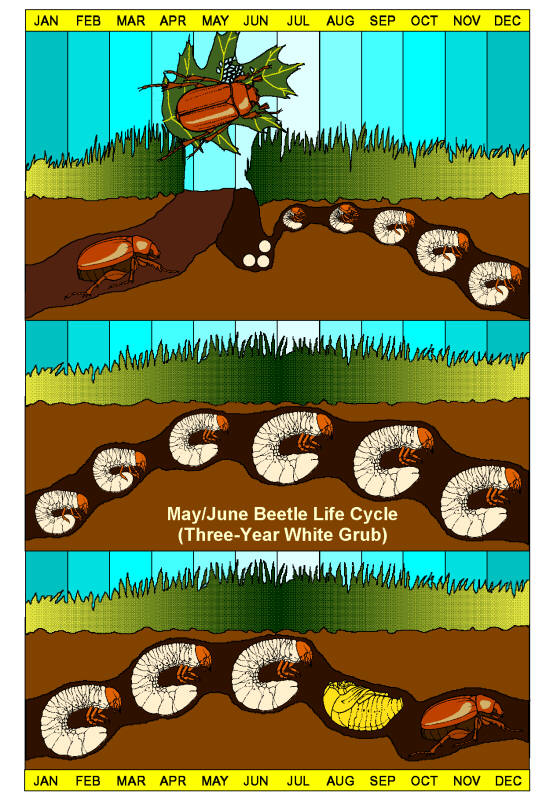
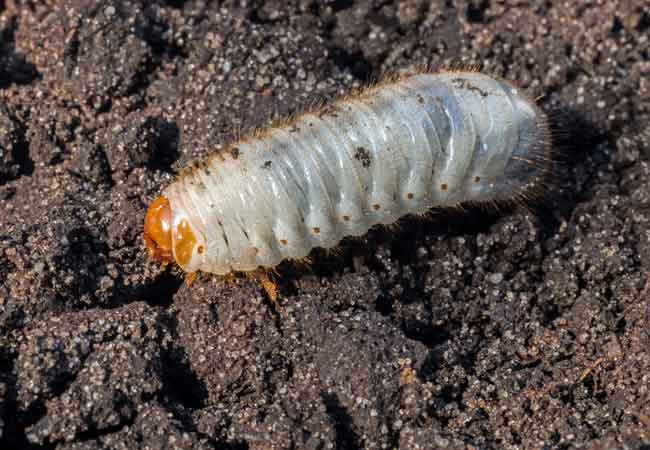
The caterpillar resembled several that I'd shot in April. The undulation movement intrigued me, as well as its prolegs. It took some poking around Google images to find some that resemble my "capture"; I finally found enough info to declare the critter a June bug larva. "Life Cycle Process of a June Bug" shows a basic diagram. "Turfgrass - May/June Beetle Grubs" links to a January-through-December image. Grubs don't sound good to have around. "How To: Get Rid of June Bugs", section "PREVENT DAMAGE FROM GRUBS" has a large image with caution and recommendation: "grubs that will get your grass. Lose the larvae …". Another anti-grub resource: "Grub Worm Identification and Treatment".

This year has been very good for abundant blooms, new-growth plants, and wildlife. View some via the index. Also, I'll be posting more strolling image items to share.

For more articles about deer, enter "deer" in the search box at the upper left of this window. Or find and click "deer" link at Partial Index of Keywords section (just below Popular Posts section). BTW, additional deer videos are available at my YouTube channel.

Friday, January 11, 2019

2019 New Year's Day Buck


On January 1 about 4:30 PM, I spotted the buck during a neighborhood walk. Those antlers were the biggest I've seen in a residential area. I wondered What kind of deer I recorded? Based on several sources that indicate loads of white-tailed deer in Texas, and confirming concentrations in Central Texas, I'd say he was a white-tail buck. Also, he resembles several pix I've run across in websites. From "What Kind of Deer Are in Texas?":
Two species of deer are native to Texas’s vast and varied countryside: the white-tailed deer (Odocoileus virginianus) and the mule deer (O. heminous). … one of the largest populations of whitetails in the country: close to four million. … White-tailed deer, the most widely distributed and evolutionarily ancient deer in North America, get their common name from the snowy underside of their tails, which they prominently flash when alarmed.

The Texas whitetail (O. v. texanus) occupies the broadest range, found across most of the central and western portions of the state. … Compared to whitetails, mule deer -- named for their outsized ears -- have a much smaller native range in Texas. … According to Texas Parks & Wildlife, the state likely harbors between 150,000 and 250,000 mule deer.
Visit "A QUICK GUIDE TO DIFFERENTIATE MULE DEER FROM WHITE-TAILED DEER" for good content and side-by-side pictures to contrast these two deer types.

"5 Facts About Texas Deer That You May or May Not Know" states that 3.6 million white-tailed deer are in Texas (as of November 2017 publication). Regarding size, "South Texas produces the biggest white-tailed deer, due to the protein in the brush that the deer eat there." (The three white-tail deer in the group picture resemble my neighborhood buck.)
I wondered about antlers. "How Do Deer Antlers Grow?" provided rudimentary info.
Deer antlers are growths of bone that deer and similar animals produce for mating season. Only male deer produce antlers, and few deer keep their antlers for long periods. Contrary to popular belief, the size of the antlers and the number of points do not indicate the age of the deer.
I wondered further: How fast do antlers grow? What happens to shed antlers? More details about the velvety fuzz on antlers?

For a really in-depth read, visit "About Deer Antlers". Interesting factoid—"antler growth is one of the fastest known types of tissue growth in mammals, and a deer’s antlers can grow at a rate of 1/4 inch per day".

From "What Happens to a Male Deer's Antlers in the Winter?"
they eventually drop off sometime between December and March -- not always at the same time -- and are left behind. The skull bleeds and scabs over, healing so the antlers can grow back in the spring. In the meantime, the antlers that he shed are eaten by smaller animals like squirrels, who benefit from whatever calcium remains.
"White-tailed Deer" provides more details about antlers.
antlers are shed each year after breeding season and must be replaced with a new set grown the following year. … Shedding takes place from mid-January to mid-April, but most mature bucks in good physical condition have dropped their antlers by the end of February.

Unlike horns, antlers are solid bone and are grown only by members of the deer family.
For very detailed descriptions of the antler process, accompanied by stunning images of bucks' heads, visit "Whitetail Deer Antler Growth Process". As for velvety antlers:
Most northern bucks will have completed their antler growth by the 10th of August, … For the next 20-25 days the antlers will harden. During this time … the velvet covering the antlers shrinks as the blood flow slows. Sometime in late August through mid-September most bucks will peel the velvet from their antlers.
I thought about additional curiosities about deer, such as speed, odd head noises, and jumping.

"How Fast Does a Whitetail Deer Run?" states "White-tailed deer can sprint at speeds of up to 30 miles per hour."

Have you been close enough to hear deer snort or make other weird head noises? "Bleats to Grunts – Deer Sounds and What They Mean" contains lots of authoritative content and videos.

Wonder about deer jumping capabilities? A company that sells fence kits describes the relationship between deer vision and fence jumping. From "FACTS ABOUT DEER AND FENCES: WHY DEER JUMP":
They have real trouble seeing the fence top. Deer see best in the yellow, deep blue and certain ultraviolet portions of the spectrum, …. In addition, deer have limited depth perception. Their eyes are on the sides of their heads (for wrap-around peripheral vision to spot predators), so their binocular vision is sacrificed and their 3D sense (especially for nearby objects) is weak. Thus, they have difficulty telling where your barely visible deer fence leaves off and the trees or sky begin.
Another company that sells fence parts also describes deer vision and fence jumping. From "How High Does a Deer Fence Need To Be?":
Deer can jump an average of 8’ high, but will not risk the jump if they are uncertain because they have poor vertical vision … both plastic deer fencing and PVC-coated steel hex web mesh deer fence poorly reflect these wavelengths.
For more info about fences and other means to resolve deer problems in your area, the following sites provide suggestions. (The fourth website more emphasizes using plants than fences.)
I myself don't see deer sauntering near my own home, and have very little in the way of a salad bar that attracts deer. The buck was a happy accidental spotting to start my year off.

For more articles about deer, enter "deer" in the search box at the upper left of this window. Or find and click "deer" link at Partial Index of Keywords section (just below Popular Posts section). BTW, additional deer videos are available at my YouTube channel.