Showing posts with label yucca. Show all posts

Tuesday, June 23, 2020

Pretty Tall Sotols, Part 1

Love that YouTube suggested the thumbnail with bees and yellowy, clustered cheeto-shaped blooms.


How tall are sotols? They're distinctly tall. Ones that I've seen tend to be at least as tall as street lights. And they're pretty, especially with flower/flowery stalks/spikes!

Sotols have relatives that confuse the casual observers. Before I dug into sotols, I'd blogged about a yucca that some friends had suggested was a sotol. The leaves that radiate from base areas for both kinds of plants look similar. Overview websites provide introductions to sotols and similar plants, the first two also advocating sotols in xeriscaping.
Dasylirion texanum and Dasylirion wheeleri Habitat and Overall Contrast

In researching sotols, I kept encountering the scientific names Dasylirion texanum and Dasylirion wheeleri. My initial information about habitat and leaf features come from Monrovia, a plant seller.

"Texas Sotol Dasylirion texanum" states "Native to Texas Hill Country. ... Stiff, spiny, sharp-edged green leaves, to 23 [sic] feet long and 1 inches wide".

Note: After having poked around numerous sites, I'd concluded the text should have said "2-3 feet".

"Silver Desert Spoon Dasylirion wheeleri" states "Native to West Texas, Arizona, and northern Mexico. ... Spiky, fairly stiff, bluish gray leaves to 3 feet long and less than 1 inches wide".

I'm guessing these neighborhood specimens I've found are texanum because they're native to Hill Country, whereas the wheeleri WRT Texas is West Texas. Maybe if the specimens were bought and transplanted plants, they likely came from from plant sellers. Texanums would likely be cheaper and less effort to transport to Central Texas than wheeleris.

Anyway, the two Monrovia pages include images in leaf and leafhead contrasts. (I'm using "leafhead" to mean the part of the plant where the leaves grow from. The actual technical term is caudex.) Texanums' leafhead centers seem to grow from ground level, and wheeleris' leafhead centers look to radiate leaves in a spherical shape above the ground. Tiling the images side by side, the color difference stands out.

Succinct leaf descriptions come from Southern Living's "sotol": "Slender, green leaves with spiny margins form a symmetrical, rounded rosette" (Dasylirion texanum) and "Twisting, curling, ribbon-like, blue-green foliage" (Dasylirion wheeleri).

Plant Lust's "Dasylirion wheeleri" describes the twist with visuals—"the end of each leaf forms a little cowlick curl...like Elvis used to have .... If you are having trouble imagining this, think of a giant, blue-braided Afro."

More About Dasylirion texanum and Dasylirion wheeleri Foliage

From "The Genus Dasylirion Family Asparagaceae (formerly Agavaceae)":
The arching leaves (of Dasylirion texanum) may grow to four feet long. They are green to grayish green, slender and flexible with teeth along the margins. The unbranched flower spike can be fifteen feet tall. The top two to three feet of the spike is densely covered by small creamy white to yellow flowers.

Slender, three foot long, spiny, blue-gray leaves (of Dasylirion wheeleri) form a dense rosette at the top of the stem. Slender flower stalks of white flowers can grow to ten feet long or more.
A Dasylirion wheeleri characteristic that Dasylirion texanum doesn't have: "Desert Spoon, Desert Sotol, Wheeler Sotol, Grey Sotol" states "The (Dasylirion wheeleri) leaves ... are spoon-like at the base, giving the genus the common name of "desert spoon". "Dasylirion wheeleri - Spoon Yucca" succinctly describes wheeleri leaves and spoon association: "The 3 foot long narrow leaves are blue-gray color with sharp serrated margins and a spoon shaped base that gives the plant one of its common name."

From "Introduction to Dasylirions (Sotols)":
It (Dasylirion wheeleri) is immediately recognizable by its pale blue, usually somewhat twisted, flat, heavily armed, very stiff and narrow 3'-4' leaves that end in a brownish tassel. It is called a desert spoon because if the leaf if removed in its entirety the base of the leaf is spoon-shaped where it was attached to the caudex/stem. The leaves come off the caudex in a strikingly symmetrical pattern forming a perfect sphere of viciously sharp but ornamental leaves.

This species (Dasylirion texanum) is not unlike Dasylirion wheeleri but distinctly a pale green color and the leaves are not twisted. Otherwise it is a very similar plant in both shape and size, and nearly as cold tolerant. Some populations, particularly in the very dry areas, are significantly smaller than most other Dasylirions having leaves only up to 2.5'-3' long.
Specimens in My Video that I'm Mostly Certain of Species

The sotol pix and videos I recorded were in late spring and early summer of 2018, 2019, and 2020.

A, newly planted plant starting to bloom
B, two sets of bloomed plants at a business
C, plant and more recently spotted plant with heavily bloomed stalk
D, plants with focus on bloomed stalks, some sagging, loads of bees
E, plant with heavily bloomed stalk
Leafheads and closer-in looks of leaves for C, D, and E, followed by one compilation image.

A and B leafhead grouping images indicate Dasylirion texanum because of the leaves radiating from the ground. C's leafheads look spiky (sunburst-like) with mild leaf twistiness, seemingly more wheeleri than texanum. (My two-year old composite shows "Texas", but I'm not totally convinced for either texanum or wheeleri.) D's leaves seem to radiate from the ground (texanum characteristic), although the color doesn't seem bright green, like E.

My sotol content became so laden that I broke it up into two sections. Think of record side A (hit side) and side B (flip side). My flip side article "Pretty Tall Sotols, Part 2" includes info with less emphasis on physical characteristics, and additional links tor deeper digging.

Pretty Tall Sotols, Part 2

"Pretty Tall Sotols, Part 1" emphasizes mostly the plants' physical characteristics. (Video: "Pretty Tall Sotols") This article includes secondary info: sotol as alcohol and resemblance to yucca. On the periphery of sotols, having viewed numerous videos with bees around blooms, I wondered long bees live. The final section includes additional resources.

Sotol, the Alcohol

People use agave plants to produce tequila. Sotol alcohol comes from sotol plants. "You’ve Probably Never Heard of Sotol, the Craft Cocktail World’s Best Kept Secret" describes the product and process that an Austin company uses.
Sotol is made from the desert plants Dasylirion wheeleri and Dasylirion texanum (known as sotol in Spanish), which are harvested in the wild. ... This liquor is most closely associated with the Mexican states Chihuahua, Durango and Coahuil, although there are now distillers in Texas producing sotol.

Only around one liter can be extracted from a single plant compared to the six liters extracted from a single plant during the tequila making process. Furthermore, sotol distillation takes place in a column still instead of a pot.
Sotol and Elata Yucca Resemblance

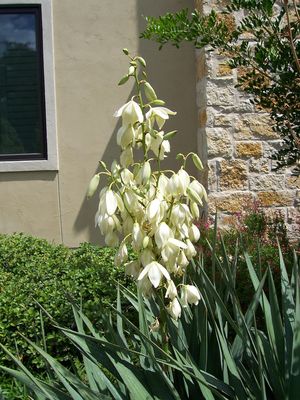
About two years ago, I wrote "Spiky-head, Multi-branch, Blooming Yucca (Elata/Soaptree)". Sending an image out, I'd asked for help IDing it. Some people IDed it as a yucca, and some guessed sotol. Note the spiky leafhead in the articles image that resembles images of sotols leafheads. Yuccas' bloomy stalks have bell-shaped flowers. Sotols' bloomy stalks have yellowy, clustered cheeto-shaped blooms.

A Bee Thought in My Bonnet

Some of my video clips showed blooming sotol stalks with loads of hovering bees. The footage was from June of 2019; I wondered how long bees live. "What Is the Life Span of a Honey Bee?" provides the following longevity info:
Drone bees (male bees hatched from unfertilized eggs) live for around eight weeks. Sterile worker bees tend to live for up to six weeks during summer and five months or more during winter. However, the queen bee, the only fertile bee in the colony, can live for several years.
Sites that Display Pages for Both Dasylirion Texanum and Dasylirion Wheeleri

Several of the resources have separate pages for Dasylirion texanum and Dasylirion wheeleri. Descriptions range from similar style and content publishing to left-hand-doesn't-know-what-the-right-hand-is-doing published content.

Mortellaros' two pages have nearly identical between the species, as though one person used one paragraph and tweaked a copied paragraph into the other page. Thankfully, they use different pictures. Also they do differentiate between texanum and wheeleri blooms and flower gender.

Texanum ("Yucca, Sotol Dasylirion texanum"): "Numerous small greenish-white flowers .... The Sotol Yucca is dioecious, meaning the flowers are either male or female on the single plant."

Wheeleri ("Yucca, Blue Sotol Dasylirion wheeleri"): "Numerous small white flowers .... The Blue Sotol Yucca is dioecious, meaning the flowers are either male or female on the single plant."

Additional Dasylirion texanum and Dasylirion wheeleri by same-resource sites:

>Resource
Resource texanum wheeleri
World of SucculentsDasylirion texanum- Texas Sotol/Dasylirion wheeleri - Desert Spoon/
Wildflower.orgDasylirion texanumDasylirion wheeleri
Texas A & MTexas Sotol, Green SotolDesert Spoon, Desert Sotol, Wheeler Sotol, Grey Sotol
WikipediaDasylirion texanumDasylirion wheeleri
Flickr (images)dasylirion texanumdasylirion wheeleri
Plant Delights Nursery (images)Dasylirion texanum coll. #A1T-028 Texas SotolDasylirion wheeleri 'Apache Junction'

Emphasis on Dasylirion Texanum
Emphasis on Dasylirion wheeleri
Entertaining and Informative YouTube Videos
  • "Texas Sotol Flower Spike Timelapse"
    Time lapse shows night-vision views; bees buzz around 1:37 mark.
  • "Sotol and bees"
    Sign says wheeleri. See spiky leaves, bees around 30-second mark.
  • "Sotol (Desert Spoon)"
    Good views of leaves are at 3:02 mark—grayish green, spines 90 degrees from leaf axis. About 6 minutes in, shows a good cross-section of the leafhead and "spoons" at base end of leaves.

Sunday, December 31, 2017

Yucca End-of-2017 Miscellany


This article caps off this year of my yucca writings as follows:
  1. Yucca's Two Same-Year Stalk Bloom Cycles (contrasting a soft-leaf yucca's two stalks that bloomed within months of each other—one in July, and one in the fall)
  2. Yuccas as Succulents
  3. Relationship Among Yuccas, Agaves, and Asparagus
Yucca's Two Same-Year Stalk Bloom Cycles

The video provides visual progression contrasts between the two stalks. The first stalk's cycle lasted 22 days, and the second cycle lasted 12 days. I placed side-by-side images of two days (first stalk) and one day (second stalk) of the cycles for most of the video. The progressive yellowing of the leaves in the second stalk (right side) becomes more evident day by day.

The video also includes some recent post-bloom images. The stalks are bare of blooms, the leaves seemingly lifeless and having surrendered their nutrients to the two cycles of blooms. The successive images show stalks no longer upright, apparently leaning to the side, then succumbing to gravity. In the December 8 images, snow lightly blankets the leaves.

Yuccas as Succulents From "Super Succulents for Your Garden"
Some of our favorite plants are succulents – hens and chicks, agave, yuccas, aloes and more. ... The highlight of these plants (yuccas) is a tall flower stalk covered in cream-colored blooms that can reach anywhere from a few feet up to 30 feet tall, depending on the species.
From "Soft Leaf Yucca: 21 Important Facts On The Attractive Succulent"
A sought-after succulent, the yucca, adds a very tropical feel and a distinct look to your garden.
Relationship Among Yuccas, Agaves, and Asparagus

From "What Is the Difference Between a Yucca and an Agave?"
Both yucca and agave plants belong to the family of Agavaceae. The Yucca plant derives from the genera subtype ''Yucca,'' featuring about 40 species, whereas the agave belongs to the genera subtype ''Agave,'' which features around 300 species.
From "Why agave stalks look a bit like asparagus spears"
There's a reason agave stalks look a bit like asparagus spears. The plants belong to the Asparagceae family.
From "FAMILY ASPARAGACEAE"
Agavoideae is a subfamily of monocot flowering plants in the family Asparagaceae, order Asparagales. It has previously been treated as a separate family, Agavaceae. The group includes many well-known desert and dry zone types such as the agave, yucca, and Joshua tree.

Wednesday, December 27, 2017

Soft-Leaf Yucca's Second Stalk (Recurvifolia)


This yucca originally sprouted a stalk that I took daily pictures of for 22 days ("22-Day Cycle of Soft-Leaf Yucca (Recurvifolia)", YouTube video). This article is about its second stalk. The blooming and decline cycle lasted about half as long as the first stalk's, which I will contrast (mostly with video) in the next article.

I spotted bugs for half the days—September 30, October 1 through 4, and October 6. Some might be on more than one day's picture. Most look to be leaf-footed bugs, and an occasional spider.

Before I prepared the images I made for this article's video, I thought the yucca might be a weeping yucca:

"Yucca, Weeping
Yucca, Soft Leaf
Yucca recurvifolia
"
Weeping Yucca begins as a uniform rosette shrub, growing upward on a single trunk reaching heights of five to six feet before falling over its own weight. New trunks will sprout where the main trunk makes contact with the ground, making it a multi-trunk shrub. … The flower stalk can grow up to five feet above the foliage, displaying a large cluster of white to pale yellow bell-shaped flowers in the early spring that last into the summer.
The description looked good regarding height, multiple stalks, and flower shapes. However, blooming occurred only in July, then again for a very short time in the fall. I also noticed Mortellaro Nursery's image shows the blooms not quite resembling those of my images. Mortellaro's blooms look somewhat splayed, while many of my subject yucca's blooms resemble upside-down tulips.

My next yucca article, besides contrasting the yucca's first and second stalk, will also include some "leftover" succulent info.

Thursday, November 30, 2017

22-Day Cycle of Soft-Leaf Yucca (Recurvifolia)


I took daily pictures of a neighborhood yucca that, coincidentally, totaled 22, same as "22-Day Cycle of Twist-Leaf Yucca (Rupicola)". The soft-leaf yucca has bell-shaped blooms and soft, flat leaves, as you can see in the YouTube video. Closer views of blooms start on July 9 (day 6). I did not create closer views for the final two days.

Bug alert for July 11 (very wee, without additional zoom image), 15, 17, 18, 20, 21. and 23. Weirdly, I found many of the bugs in the pictures after I spotted them during full-screen playback inspections. I got pretty good with creating and inserting new images of bugs in blooms. Most look like bugs that I wrote about in "Leaf-footed Bug Visitor".

Visit some recurvifolia-themed sites:

"Yucca recurvifolia"
Yucca recurvifolia, commonly known as the Curve Leaf Yucca, Weeping Yucca or Pendulous Yucca, is native to southeastern USA. Yucca recurvifolia is synonymous with Yucca gloriosa var. tristis, Yucca gloriosa var. recurvifolia or Yucca pendula. … Recurvifolia is derived from the Latin recurvo meaning ‘bend back’ and folium meaning ‘leaf’.
"Yucca recurvifolia Soft Leaf Yucca"
Soft Leaf Yucca is generally a single stem in youth and can become multi trunked with age. The growth habit is rosette in youth, with age the plant can become tree like. This Yucca will bloom late summer to fall, the flowers are creamy white and bell shaped and are borne on 3-5' spikes.
"Monrovia 3.58-Gallon Soft Leaf Yucca"
Succinct info:
Common Name Soft Leaf Yucca
Botanical Name Yucca recurvifolia
Sure, it's a sales page, I do like it for basic info and the clickable image, which you can pan and zoom for gleaning great visual details. Another site that has a good image that resembles my July subject is at Mortellaro's Nursery.

Matt Anders Landscaping Blog
"Soft Leaf Yucca"
Many soft leaf yuccas are a single trunk shrub but I’ve seen a few that have formed miltiple [sic] trunks. They bloom from summer to late fall, usually June through October. Once in bloom the they will sprout a 1/2? to 1? stem covered with white bell shaped flowers hanging downward.
The yucca that I took daily pictures of in July surprised me by sprouting a second stalk a couple of months after the 22-day cycle. More on that, along with an accompanying video in the next article.

Friday, November 24, 2017

22-Day Cycle of Twist-Leaf Yucca (Rupicola)


This yucca was the first one I'd been able to take daily pictures for its entire 22-day cycle, April 28 through May 19. All previous twist-leaf yuccas (rupicola) didn't survive. Deer chewed off stalks and blooms within four days of bloom beginnings. Closer views of blooms start on May 6 (day 9). I did not take close-ups of blooms for the final three days.

In rewatching my video, I spotted an ant. I hunted down the original image. It was a pleasant surprise to see not only one, but two ants. Click image for larger composite.

Click for an even closer look.

Specific to the Twist-Leaf Yucca (Yucca Rupicola)

From Lady Bird Johnson Wildflower center page for "Yucca rupicola":
New leaves are straight but become twisted with age. Flowering stalks often over 5 feet tall, bearing a cluster of bell-shaped, white flowers with petals up to 2 1/2 inches long and an inch wide, appearing from April to June.
Scroll past "Plant Database" fill-in section. Also, click the gallery link and scroll down to view images. Several of the bloom pictures resemble close-ups that are in my video.
From "Twist-leaf Yucca, Twisted-leaf Yucca, Twisted Yucca":
Its narrow, undulate, olive-green leaves twist as they age; the leaf margins can be yellow, orange or red, with minute sharp teeth. Rupicola means "lover of rock."
Dave's Garden "Twistleaf Yucca, Twist-leaf Yucca, Twisted-leaf Yucca, Rock Yucca, Texas Yucca" has very succinct info, but includes great pix!

General Yucca Links
 Overview of Yuccas
 New Mexico State Flower
Extensive Yucca Info, Some with Pix or Links to Pix for Specific Yuccas
Other Yucca Items to Pique Curiosity