Thursday, June 30, 2022

Pt 1 Cooky Pressing Choco Chip Cooky Dough, Not One-at-a-Time Dolloping


Cooky press users, use your press to pump out chocolate chip dough by using a DIY funnel made from the top of a food bottle. Dough scoopers and other one-at-a-time dollopers, you can reduce the tedium and repetitive travel between dough bowl and pan. Squeeze the press trigger, pinch/deposit dollop, move to another spot on pan, repeat.

Rec: Use cake mix cooky dough for ease and doability. View the video for the recipe start to finish and guidance for making and using your own funnels.

At the end of April, I published "Low-effort Choco Chip Cake Mix Cookies", my go-to cooky dough recipe using cake mix, oil, eggs, and chocolate chips. The actual base dough is without chips, and suitable for using a cooky press.

For thIs recipe, I've replicated most of the dough. I varied on using mini chocolate chips for one batch, and regular chocolate chips for the other. Notice side-by-side contrast for size and quantity between them.

Funnelling Cooky Dough with Cooky Press

At the end of May, I published "Pt 1 Revisiting Simplest Scratch Oatmeal Cookies, Plain and Chocochip Batch". By the time I got to dollopingthe second pan, I wearied of scooping, and used an icing spatula to shape mostly squares. An idea for less tedious dolloping percolated—a funnelly attachment.

The main process difference from my previous cake mix cooky dough recipe is dispensing, using a cooky press and funnels made from tops of food bottles. Each DIY funnel shape has a larger end that fits between a cooky press dough tube and screw-on collar, with the narrow end aimed toward the pan.

Cooky Press, in Case You Don't Have One But Might Consider One

Typical cooky presses come with stenciled disks (often seasonal themes) for fast, consistent-size dough dispensing. Chocolate chips are no-gos because they're oversized for the stencil openings. BTW, cooky press mechanisms tend not to be strong enough for oatmeal cooky doughs or similarly thick doughs.

Seems many cooky presses resemble each other for looks and functions. I myself have "wilton preferred press cookie press", but don't remember when I got it. Some disks look different than ones I have.

Two articles with images/videos that show my use of cooky press:

Some resources for cooky presses:

If you get really hot to trot on speed and ease, electric cooky presses are available.

Calories and Sodium

This recipe's numbers are very similar to the ones in "Low-effort Choco Chip Cake Mix Cookies". The yield for that recipe was 40 (from using a scoop and icing spatula for dolloping).

This recipe using DIY funnels for dispensing yielded 55 cookies, 28 in the first half batch, and 27 in the second half batch. The caloric totals deviated from the previous recipe because, this time, I adopted nutrition table info from the chocolate chip package.

Actually, another wrinkle is having obtained 28 cookies in the mini chips batch and 27 in the regular chips batch. If I'd been smarter about the eventual dolloping, I would have eked out one more dollop for the latter batch.

Dividing the dough for 2 batches:
Calories = 2715/2 = 1357 C for each half batch
Sodium = 3020/2 = 1510 mg for each half batch

Mini chocolate chip cookie yield: 28
Calories: 1357 + 567 = 1924 divided by 28 cookies = 69C/cooky
Sodium: 1510mg/28 cookies = 54mg/cooky

Regular chocolate chip cooky yield: 27
Calories: 1357 + 530 = 1887 divided by 27 cookies= 70C/cooky
Sodiurm 1510mg/27 cookies = 56mg/cooky

For the regular chocolate chip cookies, if I had squeezed out 28 instead of 27, calculations would have been easier. In any case, the numbers would have been 67C and 54mg sodium.


"Pt 1 Cooky Pressing Choco Chip Cooky Dough, Not One-at-a-Time Dollopin"

"Pt 2 Cooky Pressing Choco Chip Cooky Dough, Closer Looks"

"Low-effort Choco Chip Cake Mix Cookies"

View more cooky recipes.

Tuesday, May 31, 2022

Pt 2 Revisiting Simplest Scratch Oatmeal Cookies, Closer Looks at Process


"Pt 1 Revisiting Simplest Scratch Oatmeal Cookies, Plain and Chocochip Batch" describes the different methodology of the recipe I had blogged about almost 10 years ago. The ingredients are the same for half the batch. For the other half batch, I've added four ounces of chocolate chips.

The newer recipe effort is less labor intensive than in 2012. Back then, I used a manual pastry blender, and measuring-tablespoon-and-rubber-spatula method to dispense the dollops. This time, I used a tilt-head mixer, helpful for saving on elbow grease, and a cooky scoop for dispensing most of the dollops. Also, I weighed the doughs with a newly acquired Ozeri digital scale,

Tilt-head Mixer

I bought a Cuisineart tilt-head mixer in 2016. It took some getting used to, but am sure glad I have it. (No longer inclined to use dough/pastry blender to mix dough.) It seems that KitchenAid and Cuisineart get a lot of consumer attention.

Digital Kitchen Scale

For many years, I've used a Braun kitchen scale, several times daily. I started wondering what other scales were out there. A few years ago, I had given a couple of relatives digital scales that had nice features. Glad I poked around the web! Newer ones are plentiful, and surprisingly inexpensive. The Ozeri digital scale I have is great for precision and ease of use. The Braun is now relegated to non-food weighs. Hard to believe the search finds for Braun kitchen scales for prices.

Cooky Dough Dispensing Using Scoops

"Cookie Scoop Sizes" and "Uses for Cookie Scoops" inform for flexibility in using scoops for various cooky sizes, and for more uses than just cookies. These sites' info don't totally coincide with each other. For instance, my cooky scoop holds 4 teaspoons dough; the bowl diameter measures 1 3/8" diameter.

"Uses for Cookie Scoops" indicates that #60 scoop's volume is 1 tablespoon and bowl diameter is 1 3/8", and #50 scoop volume is 4 tsp and bowl diameter is 1 5/8". OTOH, "Uses for Cookie Scoops" doesn't list #50 size, but lists #60 cookie scoop as holding 1 tablespoon and one teaspoon of dough, and the bowl diameter as 1 3/8".

I had long thought of my scoop as holding 1 1/2 T. One day I did a test with mashed potatoes. Golly! The scoop level-filled one tablespoon and one teaspoon! I can't get too excited. The difference of 1/2 teaspoon I can chalk up to imperfect leveling.

Additional Cooky Dough Dispensing Thoughts

Even with a reasonably convenient way to dispense dough with a scoop, by the time I got to the oatmeal chocolate chip dough, I didn't look forward to scooping more dense dough. I flattened this batch, then cut it gently with a icing spatula. I shaped a few scraps together into scoopable dollops.

I mused a possible better way to cut for future dense cooky batches. I then recalled I had bought a device that resembled an ice tray.

The plan would be to spray oil into the pan's parts, flatten the dough into the pan, and press the divider into the dough. I could then separate the rectangular shapes from the pan and distribute them into cooky pan. Not sure I'd try baking an entire batch without considering dough amounts and baking times.

Anomalous Brown Sugar

I have had the same container of dark brown sugar for what seems like several years. I think it's made its appearance in several blog article, particularly in the method of resoftening. I think I have it down now. For that matter, when I started this oatmeal recipe, I became apprehensive that I didn't have enough on hand. The "brick" weighed 9.3 ounces. My recipe needed 1 1/3 cups.

After I did the brown sugar resoftening process (microwave "brick" with water till crumbly), I was surprised I had leftover sugar after I packed the needed amount. The "Convert Cups of Sugar to Ounces" calculator showed that if I had been short, it wouldn't have been by much!

I have something of a love-hate relationship with brown sugar. Baked stuff does seem to taste better with it than with white sugar. And I have run across info that says brown sugar helps make for soft cookies. Yum! However, I hate that it gets bricky!

Maybe mylar food bags can help keep the brown sugar soft, but I'm not sure I'd buy in quantity like I see for sale. (I thought about mylar bags because my Ozeri scale came with a couple of small, wierdly-new-to-me bags, which I researched, discovering they seem hugely available.)


"Pt 1 Revisiting Simplest Scratch Oatmeal Cookies, Plain and Chocochip Batch"

"Pt 2 Revisiting Simplest Scratch Oatmeal Cookies, Closer Looks at Process"

"Simplest Scratch Oatmeal Cookies"

View more cooky recipes.

Pt 1 Revisiting Simplest Scratch Oatmeal Cookies, Plain and Chocochip Batch

Almost 10 years ago, I blogged "Simplest Scratch Oatmeal Cookies". At that time, I included a few images, not having learned to make movies yet. My methodology was simpler but more labor intensive.

Back then, I used a manual pastry blender, and measuring-tablespoon-and-rubber-spatula method to dispense the dollops. This time, I used a tilt-head mixer, helpful for saving on elbow grease, and a cooky scoop for dispensing most of the dollops. (For the chocolate chip batch, I took a shortcut, flattening the dough, then dividing it with an icing spatula for most of the dollops.)

This oatmeal cooky recipe uses the minimal amount of ingredients, for those who want a nekkid cooky that has lots of oatmeal. The ingredients are simple—oatmeal, flour, baking soda, oil, eggs, and brown sugar. As a bonus, I include information for resoftening a brown sugar brick into its spoonable form.

Because I like chocolate chips in many of my cookies, I split the dough into two parts, plain oatmeal in one batch, and addition of four ounces of chocolate chips in the other batch. Tasty results, somewhat delicate. The yield was 25 for each batch. (Deviating from only scooping when dolloping the chocolate chip batch probably affected the number of cookies.)

Chocolate chips in 25 cookies: ¾ C (4 oz) contains 806 C/Cup for 604 among 25 cookies, so, 24 additional calories each chocochip oatmeal cooky. 88 + 24 → 112 C. No sodium.

Bottom line: Oatmeal-only cookies, 88 C each; oatmeal chocochip cookies, 112 C each

View the video for detailed info and process to bake the two kinds of oatmeal cookies. The process shown is not real-time, but you can see visual changes to the ingredients over time—mainly the dough increasingly dense. So glad to have my Cuisineart tilt-head mixer!

Note: Oops, I forgot to mention the oven temperature. Preheat oven 350, maybe near the end of dough mixing time(s). Baking time is about 10 minutes per batch.


"Pt 1 Revisiting Simplest Scratch Oatmeal Cookies, Plain and Chocochip Batch"

"Pt 2 Revisiting Simplest Scratch Oatmeal Cookies, Closer Looks at Process"

"Simplest Scratch Oatmeal Cookies"

View more cooky recipes.

Saturday, April 30, 2022

Low-effort Choco Chip Cake Mix Cookies


How low effort are these cookies? Only four ingredients, for starters. The cake mix itself conveniently includes the flour, sugar, and leavening. (I prefer yellow cake mix because of the psychological color of eggs and butter, but other mixes also work.) You mix eggs and oil together, mix in the powder, and fold in the chips. Dispense, bake, cool.

The video shows still images and clips for the steps. Note: The cookies are doable using a pastry blender, but a tilt-head mixer cuts down on elbow grease.

One instruction I've seen in many cooky recipes is chilling the dough, from an hour to a few days. Fuggetaboutit for my recipe! Another skippable item is parchment paper. Cake mix cookies have never stuck to my baking pans, except once when I tried using a Trader Joe's cake mix.

One other item I took a leap of faith in skipping--pressing the dough dollops flat, sometimes using fingers, other times using a glass. Without extra help, the dollops (using 1 1/2 T cooky scoop, level fill) expanded and spread during baking, but not too wide.

Dough Dispensing

A cooky scoop works same as a spring-release ice cream scoop, but faster than tablespoon-and-spatula method of scoop cough with one hand and push with spatula using the other hand.

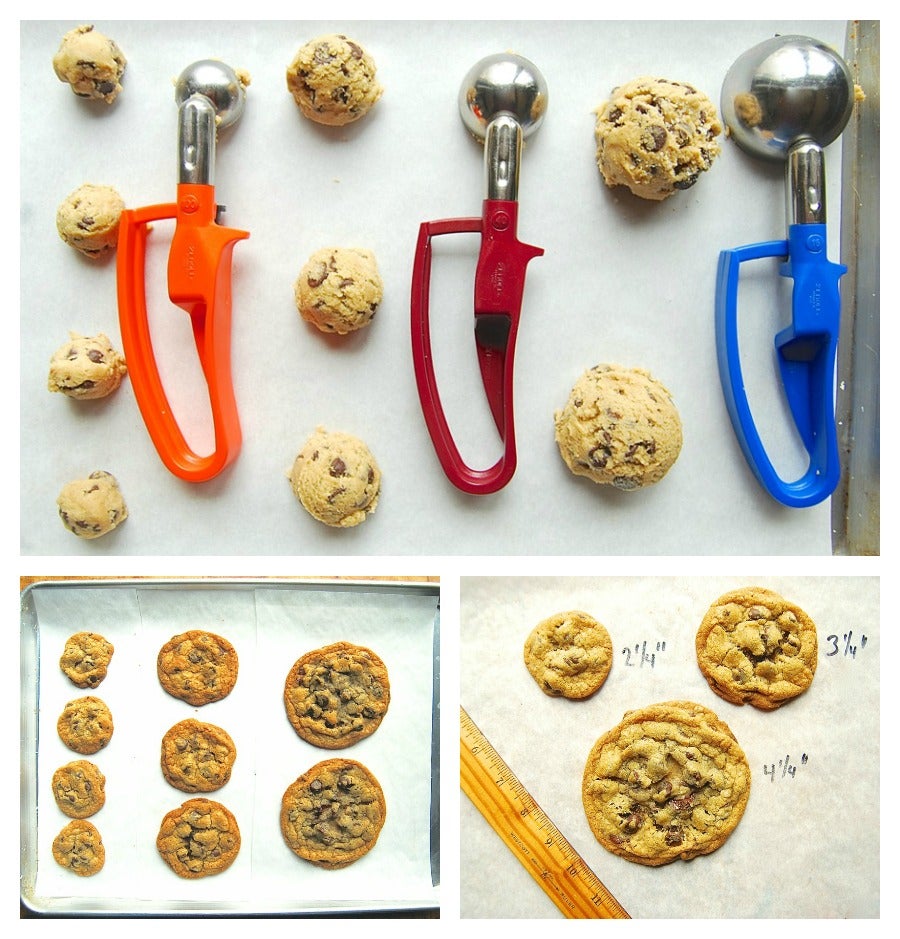
After I had baked the cookies, I searched on the web for fast dollop dispensing. "The fastest way to scoop drop cookies" showed me that I've been really pokey. When she used two spoons, she dispensed 15 cookies in 1:34. When she used a 1-teaspoon cooky scoop, she dispensed 15 in 54 seconds. BTW, she shows her 1-teaspoon baked cooky as a 2 1/4" wide. My baked cookies were about as wide, but taller, I think. YMMV.

My smoothing dough against a spatula to flatten the dough before dispensing was slow. Method 1 (using side of bowl for flattening dough) in "How to Scoop Cookie Dough" shows a more streamlined method. Method 2 is much slower with 2nd hand handling. Useful info is seeing that the dough handler uses food gloves, which seems to help keep fingers dough-free.

View the image of different dollops and scoops, accompanied by helpful info for size and capacity. Another good resource for cooky scoops is "12 Best Cookie Scoops in 2022 – Reviews and Buying Guide", which also includes a table that summarizes brands and characteristics. "How to use baking cookie scoop [ Cake Decorating For Beginners ]" provides good info about five portion scoops for batters and various cooky types. The size numbers refer to the number of scoops obtainable from a quart-size container.

Baking and Results

The yield was 40 cookies. Tasty, soft, chewy! I wondered why they were perfect for softness and chewiness, compared to some of my other chocolate chip cooky variations. The web listed several results WRT chewy cookies. One suggested ingredient was cornstarch. Not much, but enough to affect dough. "From What Does Cornstarch Do in Cookies? (Plus Simple Substitutes to Use in a Pinch)":

Cornstarch isn’t used as a thickening agent in cookies, but it does have a very important purpose. When a recipe calls for cornstarch, it’s basically going to be there to help provide structure. ... Certain types of cookies are meant to be very chewy, and cornstarch is a common ingredient in those.

The cake mix box did list cornstarch. I also recall a trend awhile back of cake mix companies touting the addition of pudding mix. A main ingredient of pudding is cornstarch. Another ingredient some sites list for chewy cookies is brown sugar. The box did not list that. Thus, I infer that the cornstarch contributed to the texture.

Calories and Sodium

These rich-tasting cookies are 98 calories each, fewer than the 139 each in "Triple Choco Granola Cereal Cookies".


"Pt 1 Cooky Pressing Choco Chip Cooky Dough, Not One-at-a-Time Dollopin"

"Pt 2 Cooky Pressing Choco Chip Cooky Dough, Closer Looks"

"Low-effort Choco Chip Cake Mix Cookies"

View more cooky recipes.

Monday, April 25, 2022

Triple Choco Granola Cereal Cookies

I've long wanted to make a granola variety chocolate chip cookies using H-E-B Select Ingredients Triple Chocolate Granola. That cereal is yummy, and cookies sound like a handy way to skip the bowl of milk. Not a milk-and-cookies type myself, maybe others might take a shine to the idea. Poking around the web, one prospective recipe was "Granola Cereal Cookies".

The list of ingredients looked reasonably short and simple. Some comments looked like good suggestions for deviation, such as using granulated sugar instead of brown sugar, and oil instead of butter. I'm more partial to granulated sugar; easy to pour. As for oil for fat, butter is twice to triple the cost of oil for similar quantity. (Butter seems to be the most common fat for cooky recipes.)

I further deviated by reducing the sugar. I figure the cereal already has plenty of it. As the cereal is already a finished product, I also skipped the vanilla and additional chocolate chips. The video is a slide show for baking these chocolatey chippy granola cookies. The process is intended for those who have cooky preparation experience. You should know about recipe utensils and equipment, ingredients, recipe steps, and reading between lines. Note: The cookies are doable using a pastry blender, but a tilt-head mixer cuts down on elbow grease.

Dough Dispensing

I used a 1 1/2T cooky scoop. The first panful took 7 minutes, the subsequent cookies much longer. A few dollops tended to fall apart upon dispensing--not enough dough to act as "glue". Or too much cereal for dough amount. Adjustment for future batches would be to lessen the amount of cereal by maybe 3/4 C.


Baking and Results

The yield was 39 cookies. They were tasty, but crunchier than I preferred. Also, small pieces tended to crumble off upon chompdown. A main reason for crunchiness is baking at higher temperature and longer than necessary. Cookies continue to bake with residual heat from the goodies and also the pan. I baked at 375 for 11 minutes each batch. Google search results for "why are my cookies hard when they cool" provide insight. I'm leaning more towards temperature and time being the reasons for my outcome. Adjustment for future batches would be to set the oven for 350, and bake between 9 1/2 to 10 minutes.

Calories and Sodium

I was mildly surprised to see the cookies calculated for 139 calories each. I chalk that high number to the granola cereal already loaded with calories. Also, dispensing might have been easier if I had more dough base or less cereal. Maybe I could have squeezed out a few more cookies for the session for the same total calories.


I've made numerous batches of cookies over years. Want to see more?

Wednesday, March 30, 2022

Pt 2 Overhead Wraparound Tunic (Not Poncho, Cape, Cloak)


My emphases in "Pt 1 Overhead Wraparound Tunic from 60" x 24" Fleece Piece" were fleece and the making of my tunic. This article provides additional resources about the material. I also include resources regarding my initially intended project—poncho or cape.

Maybe my approach should have been to research those garments BEFORE I bought the fleece. Ponchos and capes seem easy to make; however, they require huge amounts of fabric, unlike the more compact tunic that I wound up with.

Fleece Resources

"This Fleece is not that fleece ? Then What is Fleece?" describes the fabric and features. The site explains uses and differences in types, depending on material origin. Nearer the end of article, the do's and don'ts are good advice, many reiterating tips in other sites I've cited.

"How to Sew with Fleece, Useful Sewing Information for a Beginner" delivers excellent info in q/a format. Turns out that I didn't need to prewash, machine dry, and press my fleece before working on it, per "Should I pre-wash the fleece?" section.

"Working With Fleece" includes close-in images and provides advice for novices and experienced stitchers:

Always use a good quality, general purpose thread such as Gutermann Sew-All and a universal / standard point needle, size: 90/14. ... Fleece does not fray too easily, so neatening seams is not essential, but you can neaten with a regular or three step zigzag stitch, if required. ... However, you may find because of the stretchy nature of fleece, that the fabric edge will curl and wave. ...

"12 Tips for Sewing With Fleece" provides information for fleece and working with it. The following tips differ from non-fleece material:

  • Stay stitching
  • Sewing two edges together and keeping the seam flat, accompanied by pictures
  • Stitch length of 3 (.12) to 5 (.2) Millimeter, IOW, range of 5 to 6 threads to the inch
  • Reducing machine tension

The tips look most useful for more complicated clothing than a simple cape (one seam); I skipped the new-needle advice.

Related video WRT staystitching how-to and why: "Stay Stitch for Beginners | Uses & how-to with seamstress Angela Wolf"

"16 Tips for Sewing with Fleece" is similar to the 12-tip site, with additional tips and more explanation. Good for reiterating bits of advice.

"Sew/Serge A Professional Looking Fleece Blanket in 45 Minutes" caught my eye for fleece use and possible project. The techniques are more advanced and the sewing machine more complicate than I have. It does provide good info about sewing two pieces that have rounded corners, then clipping. The finished edge looks really nice!

Capes, Ponchos, Cloaks, Oh My!

I was able to find resources contrasting cape/poncho and cape/cloak. It's possible that ponchos and cloaks differ enough that they might not pop up in consciousness at the same time.

"Trend Watch: Capes and Ponchos" describes the differences succinctly:

So, what's the difference between cape and poncho? Circle vs. square. The cape has a circular shape and tends to have an opening in front, while the poncho is shaped like a square with a hole in the middle.

"What’s the Difference between Capes and Cloaks?" has a wealth of historical context about capes and cloaks, including several still pictures (many from movies). The commonality is that "both capes and cloaks are made of a single piece of fabric that hangs loose and doesn’t include sleeves."

Capes are typically shorter, falling to the hips or thighs. Some superhero capes are the exception to the length rule — modern versions of Superman’s cape nearly touch the ground. Capes also don’t have hoods most of the time and they don’t necessarily close in the front. ... Cloaks, on the other hand, fall to below to the knees and are often floor length. ... Cloak comes from the French word “cloche,” meaning “bell.” Thus, cloak and “cloche” suggest a wrap narrower at the top and flaring out at the bottom.

To use the word cloak correctly, use it for full-length or calf-length outer garments. Nearly all have a clasp, broach, button, or tie at the neck, many are hooded, and some have arm slits to allow for better movement. ... Capes are a smaller, generally shorter garment and may only cover the wearers back. They don’t have sleeves and rarely have hoods. They are more of an accessory than a source of cover or warmth.

Fleece Ponchos and Capes

A poncho or cape initially looked to be the simplest project for my 60" x 24" fleece piece. I eventually decided my fabric size was more suitable for creating my overhead wraparound tunic instead, In any case, the following resources present simplicity in fleece usage.

"How to Make a Fleece Poncho" shows simple instructions. Appeal of this video: Explicit info about material sizes, no need to hem edges, simple instructions for joining the cowl/hood and main piece. Downside: lots of fabric required, ~ 3 square yards.

"How to Sew a Fleece Poncho – DIY Poncho Tutorial" shows the poncho shape and methodology almost identical to the above YT video info. Biggest difference is size—60 x 54 instead. Concurrence of no need to hem—"Because fleece does not fray, there is no need to finish edges."

The site also includes good info about preparation for joining the neckline to cowl.
Measure one side of the neckline 1/2 inch in from the edge, then double that number to get the full neckline length. Make sure that your cowl piece is this wide plus one inch and 22 inches tall. Also make sure that width is enough to fit over your head!

"DIY Fleece Poncho/Cape | Manifest Destiny" shows a project more ambitious than I'd want to try, such as hood and liner, pockets with liners and flaps. Most of the implementation is thorough. It shows a different way to cut a neckline than at right-angle apex as some other videos show. It has good details about neckline stitching to hood and scarf. I also appreciated the info on sewing pocket hems, snipping at curves (stitches not so straight). Her fleece color choice, similar to mine, might have contributed to my patience to view the entire video.

"How to Make a Cape" shows images and instructions for various capes. The information seems to be less about fleece, judging from seams and edge-finish usages. The basic cape is a circle with a head-sized hole in the middle and one slit from the edge to the hole. Additional instructions and images are for superhero and fairy tale capes.

I omitted resources for making a cloak because of the amount of material and more ambition required. View Google image results for "cloak garment". to see some examples. Think cloaks for Little Red Riding Hood, Handmaiden's Tale, Darth Vader, druids, etc.

Pt 1 Overhead Wraparound Tunic from 60" x 24" Fleece Piece

Awhile ago, I bought a mustard yellow fleece piece that measured 24" (2/3 yard), 60" wide. I wanted to create something to go with a yellowy big-weave poncho and knit hat I've had for a long time. Although I initially considered making it a cape or poncho, the result is my "overhead wraparound tunic".

The laid-out item (front to back) measures about 30" x 45", having cut the piece in two and rotating them for stitching together. The video shows still images for the steps. It also shows how to put it on and use the ties to attach.

My tunic, besides minimizing waste material, required few seams. I staystitched the neckline and also sewed a flat cord (some remnant wide twill tape, I think) to reinforce it. I don't remember when or why I bought the tape, or its original length. Etsy displays reasonable examples. Long story short, I experimented with modeling cut, orientation, and fastening locations and methods.

During the project, it occurred to me that lightweight material is usable for a cooler-weather tunic. I actually have some lightweight patterned material from a long time ago that I could measure out for a summery version tunic. If I were to create it, I'd prefer a longer length.

Fleece Material

Fleece material is not sheep fleece. It feels like flannel, but requires different sewing treatment. It requires more slack tensionings and thread-per-inch settings. The plus side is no hems needed, as stated in "How to Make a Fleece Poncho" and "How to Sew a Fleece Poncho – DIY Poncho Tutorial"

I traveled a circuitous route, with lots of decisions in moving from intending to make a cape/poncho to overhead wraparound tunic. BTW, I later read that my fleece pre-treatment was not necessary, which "How to Sew with Fleece, Useful Sewing Information for a Beginner" addresses in the "Should I pre-wash the fleece?" section.

Tunic, Not Poncho, Cape, or Cloak

After completing my project, I hunted for garments that it might resemble. Most images tended to show open-front overlap garments with ties. Two garments that loosely resemble my result are Siggi BRIGIT iluteenindaja kimono and a beautician tunic. A vintage McCall's apron/tunic paper pattern incorporates an over-head design, with rounded corners at the hems. The open sides with ties contrast with my wraparound fastenings.

Why did I consider my result to be a tunic? QA at Google results for "what makes a tunic a tunic" provides some reasonable explanations:

  • "usually simple in style, reaching from the shoulders to a length somewhere between the hips and the knees"
  • "loose-fitting shirt that looks sort of like a long shirt or a short dress"
  • "loose-fitting upper garment that is longer than a shirt"

"Pt 2 Overhead Wraparound Tunic (Not Poncho, Cape, Cloak)" has more details about the drapey garments (poncho, cape, cloak) that I mentioned in passing. It includes additional fleece resources.

Monday, February 28, 2022

Pt 2 Choco Oatmeal Cookies Using Applesauce Not Butter or Oil

My batch of chocolate oatmeal cookies using unsweetened applesauce instead of butter or oil was tasty, but turned out to be a time-consuming adventure. The less-than-pleasant experiences were dough stickiness and difficulty of trying to use a cooky press. (For recipe-centric info, read  "Pt 1 Choco Oatmeal Cookies Using Applesauce Not Butter or Oil".)

My recipe at "Simplest Scratch Oatmeal Cookies", from July 2012 is indeed easy. This time, I wanted to try adding chocolate chips and also reduce fat calories by replacing oil with unsweetened applesauce. "How to Substitute Applesauce for Butter in Oatmeal Cookies" includes reasonable suggestions for the ingredients and process. The list of subs looked good.

Cookies that work well with an applesauce-for-butter substitution include chocolate chip, oatmeal and peanut butter, as long as you don't mind the cake-like texture. Applesauce would not work well in cookies that depend on butter for both flavor and crispiness, such as butter cookies or shortbread.
As in my previous recipe, I needed to soften a brick of brown sugar (this time, dark). I used the seventh bulleted suggestion from "10 Ways To Soften Hard Brown Sugar".
Need it soft now? Put it in a container and set in the microwave with a small bowl full of water beside it. Microwave for about 1 minute–check. If it’s still hard, try for another 30 seconds. You can keep doing this until it’s soft, but watch that you don’t melt it.

This time, I used a couple of two-minute heating times. After packing a cup of the sugar, I returned the remainder to its bag and fridge. (I'm guessing that by the next time I need brown sugar, I'll need to again resoften it.)

So, how'd my cookies turn out? I'd say B+. Reasonably tasty, chewiness similar to cereal bars.

Why not an A? One reason the dough was difficult to dispense—sticky, sticky sticky! The other reason for not an A was that my easiest oatmeal-cooky results looked nicer. Although the previous batch didn't have chocolate chips, I had anticipated this batch would look just as nice. Dang, wasn't so!

Dough Stickiness

Most of the sites that address dough stickiness talk about the amount of fat in the recipe, too little flour, and needing to cool the dough. Seems several pieces of advice pertain to roll-out dough. (Mine were drop kind of cookies.) As my recipe used applesauce instead of butter or oil, reasonable advice seems to be to lightly wet dough or try other means of dispensing dough.

"Cookie Dough Too Sticky – How To Fix It" recommends wetting hands.
You can handle the sticky dough with wet hands more easily. Keep in mind that you will need to wet your hands repeatedly until you are finished working with the dough to prevent it from sticking to your hands. ... However, don’t do this for too long, as this water will transfer to the dough and make it wetter and therefore stickier.

"Help! My Cookie Dough is Too Sticky & Wet: (exactly) How to Fix It" has some advice that might be helpful another time.

If you’re working with a sticky cookie dough and struggling to get it in the oven, don’t try and get it on the tray with your hands. ... Instead, use a spoon or ice cream scoop or cookie scoop (recommended) to get the dough onto the baking tray. ... This is great for doughs that are okay to be a bit more sticky and don’t need to be rolled out or cut-out.

Initially, I tried my cooky press. I gave that up within three dollops, as the dough stuck in the chamber all three times, which I needed to coax out with a spoon. I switched to using my 1 1/2 T cooky scoop. That worked, but slowly, as dough kept sticking to the scoop's exterior. The spring squeezer was a bit clunky to eject the dollops fast.

I've used the spatula-and-tablespoon method in the past for other cookies. It is a slow method because the dollops, besides, being one a time, requires two-hand scoop/unscoop.

The next batch, I'll try my adjustable measuring spoon. In any case, I'll keep a bowl of water and towel nearby in attempts to prevent dough superstickiness.

Oatmeal for Thought—Quick Oats, Non-quick Oats, ...

Google results for "can i substitute quick oats for old fashioned" show loads of info for contrasting oats and also includes q/a, whether you're curious, or readying to bake with oats.

"Oatmeal Cookies" advocates quick oats—"tend to make the cookie softer. ,,, it’s what I always have in my house. Instant oatmeal also cooks faster (even in cookie form)".

"What kind of oats do you use for baking?" describes rolled, quick, ground, and steel-cut oats. The author advises about making oat flour, with caution.

If using too much oat flour, baked goods may turn out dense, heavy and flat because the lack of gluten prevents the flour from trapping gases that give rise to the dough or batter.

"One-Bowl, No-Mixer, No-Chill Oatmeal Cookies" sounds promising for ease. The list of ingredients and instructions look handy for novice bakers. She advises against using quick oats, that they "have a much different texture than rolled oats and would act more like a flour in these cookies. Your homemade oatmeal cookies would wind up being too dry."

Good luck with feeling your oats!


"Simplest Scratch Oatmeal Cookies"

"Pt 1 Choco Oatmeal Cookies Using Applesauce Not Butter or Oil"
recipe-centric info

"Pt 2 Choco Oatmeal Cookies Using Applesauce Not Butter or Oil"
closer looks, additional resources

Pt 1 Choco Oatmeal Cookies Using Applesauce Not Butter or Oil

The web has loads of recipes for making oatmeal cookies. My batch was meant to be about as low-calorie as I could make, but chocolate chips would be mandatory! (About a month ago, I made a split batch of oatmeal cookies—one portion being chipped and the other portion unchipped. Chipped were tastier.)

This article is more of a guide for the cooky recipe, intended for those who have cooky preparation experience. You should know about recipe utensils and equipment, ingredients, recipes steps, and reading between lines. For more elementary cooky preparation info, visit "Simplest Scratch Oatmeal Cookies",

Two Main Recipe Guides

"Oatmeal Cookies (with Oil instead of Butter)" lists the most reasonable number of ingredients. The methodology looked sensible to follow. I subbed applesauce for oil, bumped up the baking soda, and omitted the cinnamon. Note: My brown sugar was bricky, so I revived it by microwaving it in a bowl beside a bowlful of water for a couple of 2-minute sessions.

"How to Substitute Applesauce for Butter in Oatmeal Cookies" provides advice for the applesauce substitution. The site includes sections titled "The Method" (mixing sequence), "Find the Best Ratio" (1:1), "Cooking Time and Results" (descriptive differences), and "Other Considerations" (oatmeal cookies being suitable for applesaucing).

Ingredients (preheating oven 350 a good idea at this time)

1 cup unsweetened applesauce
1 cup packed brown sugar
2 eggs
1 tsp vanilla
1 cup flour
3/4 tsp baking soda
1/2 tsp salt
4 cups oats (I used quick-cooking type.)
8 ounces (1 1/2 C) chocolate chips
Spray oil, needed because the dough has no butter or oil

Combining Ingredients (tilt-head mixer advised)

  1. Whisk together in a smallish bowl: flour, baking soda, and salt
  2. Mix together in a larger bowl or tilt-head mixer bowl: eggs, vanilla, brown sugar
  3. Stir flour mixture into the wet ingredients.
  4. Stir in the oatmeal.
  5. Stir in the chocolate chips.

Dispensing Dough

Before dispensing, I used spray oil on each pan, except for one pan with 6 dollops that I forgot to spray. Oops! No surprise that those didn't easily lift off the pan after baking.

At first, I stuffed dough into a cooky press that I modified a disc for. However, the sticky dough was uncooperative, sticky to the cavity more easily than dropping onto the pan. Lost cause. I dumped the dough back into the mixing bowl. I settled on using a 1 1/2 T cooky scoop and, clumsily, rubber spatula, and fingers.

I then tried pressing dollops flatter—time consuming and stickiness ickiness. For a future batch, I'll try wetting fingers between dollop droppings (grin). Might also try my adjustable measuring spoon.


Baking and Results

I baked each panful 10 minutes. The yield was 72 (and tasty). The cookies didn't rise or expand by much. At least they were about 2" diameter. I wasn't sure if I should have put in more baking soda. They were a little crunchy outside and a little soft inside. In a few hours till end of cookies (5 days, refrigerated after cooling), they were still somewhat soft and chewy, similar to cereal bars.

Calories and Sodium

Initially, I used stats in packages, then suspected lots of potentially tolerance errors. Many of the stats referred to single-serving sizes, such as a portion of a spoonful or cup. I Googled for calorie stats for cupful of flour, brown sugar, and chocolate chips. Sure enough, my second set of numbers better reflected realistic amounts of ingredients used.

The recipe focuses on applesauce instead of butter/oil and includes chocolate chips. The sodium is the same for three options.

Comparison for using butter/oil instead of applesauce, add 1600 C, subtract 120 C.
3920 + 1600 - 120 = 5400
5400 / 72 cookies = 75 C each

Comparison for skipping chocolate chips, using applesauce instead of butter/oil, subtract 1209.

(Eight ounces of chips amounted to 12 cookies. Hypothetical yield = 60 cookies.)
3920 - 1209 = 2711
2711 / 60 cookies = 45 C each

Comparison for skipping chocolate chips, using butter/oil instead of applesauce, subtract 1209 and 120, add 1600.
3920 - 1209 - 120 + 1600 = 4191
4191/ 60 cookies = 70 C each

"Simplest Scratch Oatmeal Cookies", used similar ingredients as the last recipe, but differing amounts. The yield was 56 cookies, calculated to about 63 calories each. Those cookies actually came out prettier. Maybe my next oatmeal cooky session will be the use-oil recipe, with chocolate chips.

Hmmm, I don't recall dough stickiness being as difficult as the applesauce hack. Yeah, more calories/cooky, but maybe more easy to dispense. I'll try the cooky scooper and adjustable measuring spoon, hoping the dollops are reasonable handling.


"Simplest Scratch Oatmeal Cookies"

"Pt 1 Choco Oatmeal Cookies Using Applesauce Not Butter or Oil"
recipe-centric info

"Pt 2 Choco Oatmeal Cookies Using Applesauce Not Butter or Oil"
closer looks, additional resources

Saturday, January 29, 2022

Pre-spring Yellow Flower Jan 7 2020 Was a Fooler!

Imagine my amazement and joy in spotting the beaut during a walk in 40-degree weather January 7! Poked around online for yellow flowers in Central Texas. Yes, big net. "33 Types of Yellow Flowers" looked promising with Sunflower Helianthus. Daisy Asteraceae and Black-Eyed Susan Rudbeckia were distant candidates. Each of these three flower types has a relatively large dark center that contrasts with its yellow petals.

I Googled for "Sunflower Helianthus", then decided that images search was more sensible. Eventually, I moseyed over to "Helianthus annuus" and "Sunflower Helianthus central texas".

In the back of my mind, some details about the bloom I pic'd piqued my curiosity. When I returned to the pic place on 1/21, hoping to see its condition, I noticed it gone. I wondered if someone dug it up. I noticed the area seemed undisturbed. Even took a pic. Hmm. Another curiosity was it having been a solo bloom. My scant recollection with sunflowers was that they grow on stems, and grow in groups. This solo bloom sat atop coarse-mulch stuff and near a limestone (maybe) rock.

A few days later, I went back to take better pictures of the area. The homeowner and daughter happened to drive up. I asked them if they had seen a sunflower where I pointed. She said yes, walking up a few concrete steps. She pointed to one, picked it up, then tossed it closer to me. The bloom's looks inspired me to look up "artificial sunflowers". "Honey Bee Sunflower Bouquet" displayed some images that closely resembled the specimen.

"Yellow Sunflower Blossoms, Artificial Flowers (8 Blooms)" had an even better AHA-the-bloom's-not-real image. The fourth thumbnail was an image of the bloom's underside, showing a prominent plastic stem socket.

A day later, I spotted the "bloom" where the girl left it. I picked it up, placing it close to the original spot of 1/7. Pic'd it, recorded it with zoom in/out, rotating and flipping the bloom. The second image above is a composite of a still image with its plastic stem socket.

Even though the bloom was a fake, I felt it worthwhile to have done online searches to determine the fake's intended flower type. The following links are helpful in case you want to know more about wildflowers, which the sunflower is considered to be, and sunflower relations.

"US Wildflower's Database of Yellow Wildflowers for Texas" has a decently varied catalog with images and scientific names. Four instances of "Helianthus" helped narrow the search for sunflowers.

"Texas’ Top 20 [Wildflower] Field Guide" has a nice collection with pix and summaries, including an entry for the common sunflower.

Common sunflower (Helianthus annuus) blooms March through December in vacant lots, fields, pastures, open stream banks, and along roadsides and railroad tracks throughout the state. Texas boasts some 19 species of wild sunflowers, ...

Although lacking information about sunflowers,"Hill Country Wildflower Identification Guide" has stunning pix and primer info for area wildflowers.

"Sunflower Care & Planting - Growing Sensational Sunflowers" is a nice primer of varieties with great pix. It also has an index of links to additional flower types.

Annual sunflowers bloom during summer and into autumn. Sow new plants every few weeks and you’ll enjoy non-stop flowers until the first frost. Perennial sunflowers bloom for a period of 8-12 weeks with some beginning as early as July and others finishing as late as October.

"15 Standout Sunflower Varieties" also has a nice collection of specimen pix and info. Some text and pic at the Choco Sun example nudged me to do an image search for "Helianthus annuus 'Choco Sun'". Many of the results sure seem to resemble the plastic bloom. OTOH, "chocolate sunflower" has starkly different petals!

I think I'll not be ever again fooled by a solo bloom in early January. Not sunflowers, anyway. In any case, finding more info about them and additional wildflowers was lots of fun!

Saturday, January 22, 2022

Brussels Sprouts Spicy N Cheesy Omelet

A few months ago, I'd bought some frozen brussels sprouts (supposedly healthful veggies). Didn't seem too tasty in the first two recipes I tried—slightly bitter. I then tried making a 2-egg omelet with loads of cheese, some diced chiles, salsa, cumin, and cooked sprouts. Bingo! The sprouts became part of a delivery system for the other flavors.

Google results for "brussels sprouts recipe" provided q/a that warmed my heart—"How do you get the bitterness out of brussel [sic] sprouts?". Short answer—"Add fat". Longer answer is at "13 Ways to Make Brussels Sprouts More Delicious Than Ever".

Brussels sprouts are known for having a bitter flavor. Using a bit of fat either when cooking or just before serving can help remove some of that. Well, it doesn’t remove the bitterness. What it does is coat the tongue (and taste buds) lightly making the bitter less easy to detect.

The article advocates additional suggestions. One that I'd taken to heart without having first knowing about cheese.

Cheese is fatty and it’s also salty so it totally helps with the whole bitterness problem. Salty and/or creamy cheeses are your best bet.

For my fats ingredients, I used spray oil and added lots of cheese. The salsa and chiles are additional distractors.

View my video for the following sections:

  1. Ingredients for omelet filling
  2. Equipment
  3. Filling preparation (heating sprouts, and adding green chiles, salsa, cumin powder)
  4. Omelet eggs preparation
  5. Finished omelet
Are you game for multiple recipe ideas for brussels sprouts? "32 Mouthwatering Brussels Sprout Recipes" and "30 Best Brussels Sprouts Recipes That Are Full of Flavor". These recipes sound like good delivery systems for just about all tastes!

Friday, December 31, 2021

2021 Christmas Decorations Tour

In late 2020, I'd posted "Pre-pandemic Neighborhood Christmas Decorations--Yea, 2019" with video link. I didn't even bother to collect images for 2020 Christmas.

Why 2019 Christmas decorations? Partly because I had pix that I didn't get around to organizing. Another reason is my mental contrasting what I've seen this year to what I'd taken pix of last year. Seems this year I've seen fewer balloons (varieties and quantity).

As I recorded this week's visuals, I sensed subduedness similar to last year in decorations. One site seems to physically epitomize the mood, although maybe coincidental. I recognized many of the inflatables, rearranged in different areas than 2019. However, two had been deflated since a day or two before Christmas. Several inflatables were airless even on Christmas day, the day I thought would most likely display festive, jolly puffiness.

I had picked Christmas day and day after to capture sights. It was good I captured a few on the 25th. By the next day, two were already removed. As of today, I noticed more empty spots. Maybe the unseasonably warm conditions have inspired people to remove wintry sights.

The 2019 tour video differs a bit from this year's tour video. In 2019, I took still pix at 16 sites, some in the day time, some at night. This year, I recorded clips from 26 sites, all during daylight. Seems the most dominant decorations include Santa, deer/reindeer, decorated-tree balloons or adorned trees, snowmen, and baby penguins.

As I started organizing my project clips, I initially felt the pandemic pall colored my perception of the decorations. As I continued the process, my spirits lifted. In comparing my 2021 captures to my 2019 (pre-pandemic) captures, I notice more and varying images, not fewer. Hope you enjoy the ride and sights! May 2022 be more joyous than 2020 and 2021!

Thursday, December 23, 2021

Musement Over 2021 Holiday Season Ad Circular

A recent Bed Bath & Beyond ad circular had a gift suggestion that caught my eye for weirdness: Battery Storage System. My curiosity nudged me to look online. Surprisingly, battery storage containers seem to be mainstream.

BB&Y's web page calls it "Battery Daddy", displaying double-sided storage. It even comes with a built-in battery tester. Surprising is almost 700 reviews, 4.8 rating. Maybe the optimal molded design for maximum storage space and built-in tester makes the product a reasonable purchase. But as a gift, hmmm.

The BB & B circular got me to thinking about my "Hammacher Schlemmer Mmy Oh Mmy" blog article I wrote in December 2016. The company Hammacher Schlemmer provided me plenty of offerings to, yeah, snicker at. It even inspired me to come up with a kidding article title. A few eyebrow-raising items: Battery-operated spinning fork, Stanley Cup-shaped air popcorn popper, Flameless marshmallow roaster

BB & B sells interesting household items, but sometimes I think the offerings are messages to spend, spend, spend. The beckoning seems especially prominent during back-to-school and Christmas time frames. Anyway, onward to some eye-catchers in the circular, which I found online!

Drinkware

"New Sports Drinkware", $24.99 to $39.99 image showed a few drink containers. The price range for such items struck me as pricey. I poked around the web page and found a lot more variety. And sorting for price resulted in a goodly number of items well below the price minimum of $24.99.

Coalish Soap Bar

The BB & B pic showed "Bad Ass Lump of Coal" in big letters. How intriguing! The title showed "Duke Cannon 10oz Lump of Coal" for $7.99. OMG! Eight dollars for a lump of coal! Would this be the 21st century version of Pet Rock? No! The BB & B web page, and closer look at the ad shows the product to be "Duke Cannon® 10 oz. Big Ass Lump of Coal Activated Charcoal Soap". Surprisingly, 202 reviews w/4.9 rating. Sigh! Eight bucks for a gimmicky bar of soap! Also, the circular categorized it as an under-$25 stocking stuffer. Sure, it's under $25, but "stocking stuffer" scope and cost seem to have expanded over time.

Hot Chocolate, 1 1/2-Ounce Spoonful</p>

"Hammond's 1.5oz Milk Chocolate Dunkin Spoon" caught my eye for specific function and cost. BB & B's website ("Hammond's® Milk Hot Chocolate Dunking Spoon") didn't show much detail. Googling "hammond's hot chocolate dunking spoon" yielded enough info that I inferred that stirring one of the $2.99 items and one cup of hot milk together would make a cup of hot chocolate. Sorry, seems pricey and overwrought. You want hot chocolate? Buy a multi pack of hot chocolate powder (Carnation, Nestle, Swiss Miss, ...) at your grocery store, dump an envelopeful into a cup, and pour boiled water, stirring the stuff. Mmm, remember to buy marshmallows!

Celeb Wrestler Trio Pez Pack

The circular showed a Christmas-themed Pez kit, but I couldn't find that particular item on BB & B's site. For that matter, as much as the search field suggested Pez terms, the results showed precious few. Plain "pez" works ok. An amusing offering—"Pez WWE Gift Set" for $11.99. Yikes! Only 1.74 ounces of candy! Further digging yields info about the dispenser heads—Dwayne Johnson (The Rock), John Cena, and The Undertaker. I'd not heard of The Undertaker till just now. Anyway, WalMart shows a wacky current price of $57.17, and out-of-stock blurb. A little more description and better price is at "WWE Boxed Pez Set - John Cena, The Rock and Undertaker" for $10. Apparently, the Undertaker took over Hulk Hogan's spot.

Popcorn Poppin'

The circular showed a stovetop popcorn popper for $26.99. I searched for "popcorn poppers" at BB & B's site, and was amazed at so many varieties of devices! Several of them use microwaving, one is an air popper, and several look to be stovetop. Something about Whirley Pop seems fussy with needing oil and watchful eye. Google displayed good results and q/a for "how do you use a whirley pop popcorn maker".

I still use my Wearever air popper from late 70s, nearly identical to "Popcorn Pumper Commercial From The 70's", adding melted butter and salt afterward. That machine was built to last! However, if I were to switch to a microwave popper, I'd poke around Google search results for "best microwave popcorn popper".

Product Hesitancy this Season

Do I sound like a bah humbugger in this article? Hope not by much. The fast approach of Omicron has discouraged me from casual shopping and crowds. News of supply-chain problems makes me think all sorts of items would be in short supply. Lastly, maybe firstly, I consider a lot of Bed Bath & Beyond's proffered products to be frivolous, expensive, or both, intended to encourage impulse buying, the novelty to wear off quickly. Nope, not going there!

I didn't intend on picking on Bed Bath & Beyond, except that particular circular was a rare arrival this holiday season. In the more distant past, loads of catalogs and other advertisements used to come in the mail. However you shop this season, good luck to you!

Tuesday, November 30, 2021

Kwik N EZ Veggie Chili

View the slide show video. This single-serving dish calls for 1/4 package of frozen veggies (four ounces), 1/4 can of beans, chili flavor rec'd (slightly less than four ounces), and two ounces of shredded cheese.

  1. Cover and microwave veggies for about 3 minutes.
  2. Cover and microwave beans for about 90 seconds.
  3. Stir beans into veggies; sprinkle cheese. Microwave for about one minute for cheese-melt gooeyness.
  4. Eat the mixture with tortilla chips for a dippy meal.

The recipe is conveniently expandable for up to four eaters. Choose dish/bowl sizes for separate servings. Or, if using larger community servers, go for wider rather than deeper. Also, microwave for longer times as appropriate.

Guarnicion Blend Vegetables

"H-E-B Sabor Tradicional Mezcla Guarnicion Blend" is my favored frozen veggie mix. Broccoli, cauliflower, corn, and carrots make up the small-chunks mix. If your store doesn't carry it, you might need to cut your own. A close similar item might be Normandy mix.

Normandy Blend Vegetables

My supermarket sells "H-E-B Select Ingredients Broccoli Normandy Blend", listing "broccoli, cauliflower, and carrots". These cuts are larger than the Guarnicion blend veggies.

"Are Normandy veggies Norman?" describes the connection to "Normandy" and vegetable blends. Some blends depend on the brand you buy.

Birds Eye’s Normandy Blend, a mix of broccoli, cauliflower, carrots, zucchini, and squash. Other frozen food brands include variations on that blend. Costco’s Kirkland Signature Normandy-Style Vegetable Blend, for example, contains broccoli, cauliflower, and carrots.

Bird's Eye brand "Normandy Blend" lists "broccoli florets, cauliflower florets, sliced carrots, zucchini, and yellow squash". The variety is appealing, but cut sizes appeal more to me as a veggie side than chili dish. The supermarkets that sell this brand in my area seem to be WalMart and Target.

Mixed Vegetables

These veggies are small-sized, but maybe a bit ordinary. "H-E-B Select Ingredients Mixed Vegetables" lists a mouthful—"carrots, peas, green beans, corn, baby lima beans". Eh, info online indicates that peas, corn, and lima beans are not great as healthful plant foods.

Canned Beans

I'm minimizing addressing canned beans. Loads of bean types and flavorings. Go down the canned-beans store aisle and pick something that appeals to you. I'd suggest shaking cans to infer value. Lots of slosh indicate lots of fluid compared to bean amounts. Not a great value to buy mostly water.

Cheeses

Cheese is another topic I'm mentioning sparingly. Pick what you want, whether single type, several types, or mixture. My supermarket's results for "colby cheese" show several products where colby is paired with Jack cheese. "Colby VS Cheddar – 4 Differences To Tell Them Apart" triggered a long-lost memory of having bought colby and it seeming to lose its freshness sooner than cheddar.

Wednesday, November 24, 2021

2019 Halloween, Pre-pandemic Year

A couple of months ago, I met the owner of a house that I had taken pix and videos of for occasional years for Halloween and Christmas. The family was getting ready to move; I said I'd miss the holiday decorations. I offered to send links of YT videos and pix that featured decorations at the house. In poking around my files, I discovered my unprocessed stash of 2019 Halloween images.

I've posted Halloween images for 2018, 2020, and 2021. I'm late for putting out 2019, but I might as well complete the set. Hoping to be more timely for 2022.

The pandemic came early in 2020. The images I captured in 2019, imho, convey more carefree times with no inkling of the coming year's pall and caution over contact during Halloween. The video includes scenery from 25 houses, mostly whimsical. I went on a tear on October 31, 2019 with total of 50 pix and videos. On a few other days of recording and pic'ing, I was less ambitious.


2022 Halloween Nearby Tour
Roving Around Halloween 2021
2020 Halloween Meandering
2019 Halloween, Pre-pandemic Year
Halloween Scenes Around (2018)
Related: April Fooling Easter Halloween and More (from 2018)

Enjoy YouTube Halloween themes playlists: "Baker's Dozen Halloween YouTube Links", "Halloween Music Baker's Dozen Matter"

Sunday, October 31, 2021

Roving Around Halloween 2021

It's gotten to be a tradition with me to wander/rove around to find Halloween scenes. This year, I decided to video-record the sites. In the past, I've been more likely to take still images and some videos. I've learned to embrace recording because of panoramic views, easy zoom and pan for size and location references, and winds that provided visual effects. View the video.

I made the rounds to the 21 sites a few days ago. (Last year, I'd stretched my touring days out and even collected some just before trick or treaters would start their haunts.) Seems many of this week's stars are skeletons and inflatable balloons (big'uns!) Goodly amount of small-scale tombstones.


2022 Halloween Nearby Tour
Roving Around Halloween 2021
2020 Halloween Meandering
2019 Halloween, Pre-pandemic Year
Halloween Scenes Around (2018)
Related: April Fooling Easter Halloween and More (from 2018)

Enjoy YouTube Halloween themes playlists: "Baker's Dozen Halloween YouTube Links", "Halloween Music Baker's Dozen Matter"