I missed putting out a Valentine item in February. March roared in
like a lion. I'm beating April Fool's Day with my Valentine-theme video
and article. Inspiration started with kin's visit on February 14.
The relatives brought flowers. I'd baked Valentine theme cookies
made from Red Velvet and Strawberry cake mixes. I searched for kiddie
Valentine cards and found one card, no envelope. A few days later, after
they'd left, I found a stack hiding in plain sight.
My journey in creating the Valentine blog theme started out small,
but became gargantuan when I collected hearty items to group together,
created kid-like artsy photographable items, and integrated videos in my
mix. The journey was quite an adventure in inspiration, organization,
and implementation.
Heart Use as a Verb
Hearting is an obscure but increasingly creeping use of heart as a
verb. Creeping, as in slowly moving, not creepy as nervousness inducing.
Consider "I heart NY" and "I heart radio", which seem normal in use of
heart as verb. As a thought, maybe "I heart [something]" can seem less
tension than the "L" wprd.
Indoor Shots
My video includes indoor images and also outdoor images. I got in
touch with my inner creative child for cutouts, punches, arrangements. I
also rustled up images for Valentine cookies that I'd baked
occasionally over many years. BTW, cake mix amounts in boxes have
downsized over the years that cookie dough dollops were less mannerly
this time around.
Outdoor Shots
I mentioned creeping use of heart as verb. A piece of my video shows a
hybrid of Halloween creep and hearty Valentine approach. Numerous other
outdoorsy shots include archives of heart-shaped prickly pear plants
from February 2010 and also February 2025. Eh, the 2010 ones were more
plentiful and cuter; the more recent environment wasn't as, uh,
fruitful. For my non-prickly pear plant shot, the red bud tree with a heart-shaped bloom had caught my eye.
It'd been awhile since I'd baked cookies using cake mix. Betty
Crocker caught my eye with the Butter Pecan cake flavor. The sale price
of $1 was compelling. I tried to duplicate La Moderna Marianita pecan
flavor cookies, cheap at about 68 cents for a roll of 28 cookies (6.5
ounces).
The Marianita cookies are crunchy and don't contain actual pecans.
The flavor has a hint of pecan nut skins, smidge of bitter aftertaste.
For attempting crunchiness, I had hoped baking at 325, not 350, and
baking cookies longer than typical cookies would work. I also hoped that
the BC's reduced amount of powder (from 15.25 to 13.25 oz) wouldn't
affect the outcome.
Wellll, the lessons learned for the next time will be to raid some
other cake mix box for two ounces of powder to add to the recipe. The
dough didn't firm up like in other cake mix cooky dough. It was stickier
and harder to load into my cooky press and dispense. Also, next time,
I'll try baking the cookies at least 13 to 14 minutes. Sure, I like soft
and chewy, but I was trying to obtain the Marianita crunchiness.
View the video
for step-by-step process. See the final image for comparison of a
plateful each of BC Butter Pecan cake mix cookies and La Moderna
Marianita pecan flavor cookies.
Making cookies at home take way more time and energy than buying
shelf-stable store cookies. Be sure to block out time for gathering
ingredients, equipment, mixing, dispensing, baking, and cooling. Oh,
yeah, remember cleanup time and effort!
Cookies and other wheat-dominant products have gotten pricey over
time. On the good side, the ingredients for the project came to less
than $2: $1 for box of cake mix, 29 cents for 1/3 C oil, and 50 cents
for 2 eggs. The yield was 42 cookies. FWIW, cookies baked at home seem
to take longer to consume than store-bought. More appreciation for the
effort expended? Definitely tastier!
Calories and Sodium
As a side thought, I considered adding chocolate chips. Doing so
would have added extra calories (~30C/cooky) and cost ($1.50 additional
for project). Mmmm, butter pecan flavor with chocolate chips! Related:
"Low-effort Choco Chip Cake Mix Cookies" (article, video)
La Moderna Resources
La Moderna cookies are a niche item at HEB. I've not been inclined to
seek other products from this Mexico-based company. Memory aid that
Moderna is one of the big-name Covid-19 vaccines.
La Moderna manufactures pasta and soups as well as cookies. Amusingly, La La Maderna's cooky page does not include the pecan flavored ones.
"La Moderna Marianitas Cookies", 71 cents for 6.5 oz Nutrition info claims 6 servings, 5 cookies per serving. I counted 28 cookies.
I've taken a trip down memory lane for kitchen items that I blogged
about in mid-2015. I still use a goodly number of them. "Ancient" ones
include a Tupperware measuring pitcher, a Wearever air popcorn popper,
and an Osterizer blender, I've replaced some items that broke or have
improved capabilities or both reasons. I've accumulated a few newer
gadgets since the 2015 articles.
Several kitchen items have shown up in various articles and YouTube
videos I've produced over the years, mostly WRT to baking cookies or
cakes. The star of my YouTube videos is my Osterizer blender, which is
approaching 45,000 after being up since mid-2016. ("Stuck Blender Blade?" shows diagnosing and unsticking my blender blade assy, then reassembling and testing it.)
Back in 2015, I used a still-images Kodak camera (1760 x 1168
resolution shrinkable to 640 x 425). In contrast, my more compact Canon
takes varieties of stills and videos that surpass the Kodak, which broke
after over 10 years of use. My video shows hands-on handling of the
kitchen items, something of a show-and-tell session. Some viewers might
actually recognize or have some of the same objects. Interestingly, some
show up on the web with "vintage" in descriptions.
From "Vintage vs. Antique vs. Collectible | What’s the difference?"
Antiques have to be at least 100 years in age. That is what
makes a true antique according to respectable dealers. Vintage can be
anything from 20-99 years old and generally capture a sense of nostalgia
that’s relevant to the culture in some way.
I've identified the items in the video. In case you don't recognize
any or had anything similar, ask someone who's older if they owned such
an object. Maybe they still have theirs!
A few months ago, cost of eggs had nearly doubled the cost of making cake mix cake, not counting cost of frosting. The egg costs have come down, but I haven't quite recovered from the sticker shock. Recently, I made a soda pop layer cake (eggless!). Yum!
My video shows how to make the cake using a box of white cake
mix and non-diet lemon lime soda (room temperature), with canned vanilla
frosting. (Anything goes for flavors you want to use.) Although loads
of such recipes are findable on the web, mine is for making a 9"
diameter layer cake. (Just about all the other recipes aim for cupcakes
or 9" x 13" sheet cakes.)
The cake turned out lower height than I expected. Noteworthy: The
soda pop weighs less than usual-recipe eggs/egg whites, oil and water.
Noteworthy: Batter amount is about 3/4 as much as for full-recipe cake.
I had originally run across soda pop cake when I encountered
2-ingredient recipes. At least one was pizza dough. A few were
2-ingredient cakes, several eggless. Some of the cakes called for flax
seed, some for yogurt. The eggless, soda-pop cakes intrigued me the
most.
The carbon dioxide bubbles in soda pop act as a leavening agent — the
element that makes baked goods rise and makes them light and fluffy.
...Kitchen staple leaveners — like baking soda and baking powder — use a
chemical reaction to create carbon dioxide bubbles.
"Cake Baking with Soda Pop"
is eye-opening for calling for 1) only one cupcake pan and for 2) the
mixing time using an electric mixer. View the video there or on YouTube.
beat (1) dry cake mix and (1) soda pop with an electric mixer on low
speed for 1 minute. Scrape the side of the bowl, then mix on a medium
speed for 2 minutes.
Oddly, the Betty Crocker "Two-Ingredient Soda Pop Cupcakes"
says "24 regular-size muffin cups". FWIW, this recipe specifies 16.25
oz for cake mix weight; the other recipe omits the weight.
Duncan Hines-centric
"Soda Pop cake"
is succinct, indicating that the baker would also refer to the cake mix
box instructions. I'm guessing a little bit of prior cake-making
experience is helpful.
Duncan Hines has an association with Ready Set Eat, for which a
recipe for soda pop cake finally shows up. And it calls for DH cake! "6 BOX CAKE MIX RECIPES AND HACKS", points to "2 Ingredient Strawberry Lemon-Lime Cake".
Significant mixing instruction-""thoroughly combine cake mix and soda".
The output is a 9 x 13 single layer, with suggestion of powdered sugar
dusting.
Additional Recipes with Nod to Blending Ingredients and Yields
"2 Ingredient Soda Cake - Unreal!"
shows the process from start to finish (using whisk), suitable for new
bakers. It makes a 9 x 13 sheet cake, subdivided and minimally
whip-creamed.
"2 Ingredient Chocolate Coke Cake"
prefaces the recipe with some background. Might be useful when a baker
is first exploring making such a cake. Scroll down to the details. She
suggests using a mixer instead of a whisk. The output is a 9 x 13 sheet
cake, undecorated.
"Bill shows us how to make 2 ingredient cupcakes!" demonstrates his recipe. Bill is the host for Toon In with Me
cartoon show that airs weekdays. His sidekick is a talking tuna
puppet. The demo was a bit amateurish and lacking in some details, but
possibly endearing to audience who might think, "Hey, I could do that!
He whisked diet orange soda and vanilla cake mix (both room temperature)
in a bowl. Some of the batter went into lined cupcake cups. The use of
an air fryer is different. Would-be bakers can refer to other soda pop
recipes for filling in blanks.
"NO EGG BOX CAKE"
is a nicely short video. She uses a spoon for her stirring. The process
veers oddly with batter pour into a greased pan that transitions to a
drizzled Bundt cake. She commented later "Same Cake, Different Pan."
"Soda Cake Recipe! 2 Ingredients"
is over 10 minutes long, but contains caveats to squash cake mix lumps
and to not overbeat. Interestingly, her instructions to stir about 30
seconds conflict with Betty Crocker box instructions for one-minute low
speed, the 2 minutes on high. BTW, her yield is 12 cupcakes per recipe.
"3 INGREDIENT VEGAN CAKE HACKS | Can I Make A Vegan Cake Using Soda?!"
finally shows the soda pop cake recipe starting about 5:12. She uses a
tilt-head mixer (maybe KitchenAid). Interestingly, at the batter pour
near 6:30, she prepares two 9-inch springform pans. starts out with two
pans, At 7:00, she decides to use only one pan. After bake and cool, the
frosting goes on only the one layer, even though she plan-b intended to
slice the layer and put in a middle layer of frosting.
Calories and Sodium
I’m always curious about the calories and sodium in my cakes and
cookies recipes. The soda pop cake stats can seem rather indulgent, but
the calories compare favorably against standard box cake recipes that
use eggs/egg whites and oil.Using soda pop (140 C) instead of box's ingredient adds of egg whites
(51 C) and oil (400 C) saves loads of calories. Even more calorie
savings if passing on standard recipe that calls for water, oil (533 C),
and eggs (210 C). If using standard box cake recipes and frosting, the
total calories bump up ~450 to 750 calories. Noteworthy: Using diet soda
instead of sugar soda saves about 10 to 15 calories a slice. Rec:
Indulge with the sugary stuff.
I've had my red Nabisco Mayflower cooky tin for so long that I don't
remember when I got it or if it had cookies in it to begin with. The box
says the cooky weight is three pounds. It measures 9" x 8 1/2" x 4"
high. I've used it for storing Ziploc'ed cookies, bagged breads, layered
cupcakes, and layered cereal blocks. These boxes are really
common--many sold on eBay and Etsy! However, history of the box and
chronological ties to Nabisco were pretty well non-existent.
Recently, I took a closer look at the box, recorded and pic'ed it, noted images and text. The video shows the box designs--the lid and two vertical designs.
Pondering the Tin's Graphics
The images convey loads of visual information with very little text.
The lid's title is "Voyage of the Mayflower". The front and back's title
is "The Early Journeys" and includes a sister ship, the Speedwell. The
sides' title is "The Journey", which more emphasizes the Mayflower.
Illustrations display routes of the two ships--Speedwell's shown as
black dots and arrowheads, and Mayflower's shown as white lines and
arrowheads. Additional images include symbols that might indicate
perceived sailing conditions during the journeys. The orientation of the
ships and sails convey direction.
The Mayflower's lid rendering is impressive for details of shaded
sails and ship body. One of the masts has the City of London flag, the
other having the Union Jack. "Flags of the Mayflower" provides good info about the flags and how the Union Jack design came about. The site also shows a replica of the Mayflower.
Closer Looks at the Symbols Near the Mayflower and Speedwell
Mysterious outlined symbols near the ships might convey overall
sailing conditions of the journey. Look for cherubs blowing wind, a
chimeric figure (bird-headed fish) with trident, and friendly looking
fish. One cherub looked to be blowing gently, the other a little more
gustily. Google image search for "cherubs blowing wind" yield a few
images; Google results for "All" didn't shed light. As for the
bird-headed fish, navigate to "What exactly is this? Odd fish with a BIRD-shaped head stuns the internet" for the fish from a few years ago. The box's hybrid animal and trident might symbolize Poseidon. Who knows?
Poking into Mayflower History
Poking into Mayflower history for the cooky tin's info conveyance
was eye-opening. I never knew about the Speedwell and association with
the Mayflower. I didn't know that the Pilgrims lived in Holland for 12
years before leaving for the New World from England to the New World.
Some resources:
The cooky tin was made by Nabisco in England for Nabisco in New York.
Google search results yielded no information that I considered useful.
About all I could infer is that the tin's zip code reference marked the
year at no earlier than 1963. "ZIP Code Introduced"
states "introduced July 1, 1963, as part of a larger Postal Service
Nationwide Improved Mail Service (NIMS) plan to improve the speed of
mail delivery."
Nabisco has a history dating back to 1898. It has belonged to various
companies, most recently, Mondelēz, which was formerly named Kraft. "Nabisco"
provides a short history from establishment to association with Kraft
foods. If you want to know more about Nabisco currently, Google results
yield articles about Nabisco's outsourcing of various snacks to Mexico.
One most current event is the planned (now-off) demolition of its Fair Lawn, NJ plant.
Mayflower-associated Hmmms
From "mayflower plant"—"Crataegus monogyna (family Rosaceae), a species of hawthorn, is commonly known as mayflower or May flower in England."
Mayflower was founded in Indianapolis, Indiana in 1927 by
Conrad M. Gentry and Don F. Kenworthy. In March 1995, it was acquired by
UniGroup, a transportation and relocation services company with
headquarters in suburban St. Louis, Missouri.
Ingredients, equipment, and mixing, dispensing, and baking info for
this cheery cherry almond cooky are in the the video. This recipe
go-around is my second attempt at making a version of HEB's Mon Cheri Cookie. The cookies I made in August came out pretty well, but dough dispensing had been challenging. August's Closer Looks video shows the dough stickiness hampering my dispensing.
This batch of dough was less-sticky and dispensed neater and faster.
Two variables could have made the difference(s) in dolloping ease.
Using more effort in removing maraschino cherry fluid—yield of 4.59 ounces cherries then and 2.65 ounces this time.
To compensate for less cherry flavor, I added one envelope of Cherry Kool-Aid.
Dough Dispensing Emphasis
The four dough dispensing methods I used this time are as follows:
Cooky press with DIY funnel (cut-off top of shampoo bottle) and spoon
Cooky scoop (1 1/3 T)
Spoon and rubber spatula
Tablespoon measuring spoon and rubber spatula
The cooky press method saves on travel effort between bowl and pan.
Downside is that the tube doesn't hold enough dough to dispense all in
one session. The other three methods are one-dollop-at-a-time, rather
tedious for the repetitive bowl/pan back and forth.
Calories and Sodium
The yield was 50 cookies, varying somewhat for size. I did have some awkwardness in using the four dispensing methods.
Post-recipe Thoughts
The cookies came out tasty with cherryish flavor. They were soft, almost cake-like.
The Cherry Kool-Aid might have made the color a bit deeper than I'd
intended. And I missed seeing cherry bits that were more evident in the
August cookies. Possibly I overpulsed the cherries in the blender. Next
time, I might try dehydrated ones and halve the amount of Kool-Aid.
Cherryness
Maybe the main reason for improved dispensing could be less
moisture—getting rid of more cherry fluid than August's batch. This
time, after pulsing the cherries, I drained AND blotted the remains. The
yield was 2.65 ounces instead of 4.59 ounces. Pretty expensive item,
considering they were 10-ounce jars of cherries! Thinking of trying
chopped dehydrated cherries, but chopping and adding only half the pack.
Last month, I blogged about sweet bakings, recipe undertakings spread
over 13 years of blogging. Recipes I spotted on the web inspired me to
experiment, not merely replicate. i came up with 28 cooky recipes and 19
cake and cake-ish recipes. For cakes, I started out mostly blogging
about cupcakes and occasional mini-muffins. For cookies, I varied baking
cake mix cookies but also baked scratch cookies.
Maybe surprisingly, I'd done several of the recipes seldom since
blogging about them. A few never-agains are because a particular
ingredient, usually a cake mix, is either no longer available,
formulation is different, or weight is different (mostly less).
Specific to cake mix powder, I'd made cakes AND cake mix cookies over
years to remember the standard size weighed 18.25 ounces. Manufacturers
reduced the amount to 16.25 for a few years. Now it's 15.25. It's
irritating about companies screwing around with powder amounts that,
worse than result in smaller finished good(s), make an inferior item.
Some recipes WERE perfect with 18.25 ounces of powder.
Cooky Monsterous
With "A Convenient Cake Mix Cooky Batch"
(#018), I combined Red Velvet cake mix (especially seasonal for
Valentine's Day) and strawberry flavor cake mix. I'd made several
batches for a few years for sharing in the workplace. Haven't made them
for well over a decade.
I must have been really ambitious or patient when I did Krusteaz Choco Caramel Squares" (#139). Or I might have used a compelling coupon. Anyway, Seems that Krusteaz no longer carries my main recipe ingredient, Krusteaz Molten Deep Dish Chocolate Cookie with Caramel Center.
I noticed that I had omitted "Baking Cookies with Trader Joe Cake MIx"
from my cooky recipe list. I can only guess that my results weren't
great. In any case, TJ's 28-ounce Golden Yellow cake mix is no longer
available. Instead, TJ sells Yellow Cake & Baking Mix,
$2.99 for 16 oz. Price is double what I'd consider for name-brands
Duncan Hines, Betty Crocker, or Pillsbury. BTW, I often buy my
supermarket brand, comparable in quality to the name brands, and a
smidge more powder (16.5 oz).
Cakes and Cupcakes and Muffins, Oh, My!
In June 2012, my first cakey recipe was "Lemon Poppyseed Mini-cupcakes" (#070). Not much of a stretch for deviating from a set recipe, but it was a start.
"Square Mini and Whoopie Muffin Experiment"
(#88) was an experiment for using up two half-boxes of cake mix (Red
Velvet, Strawberry) to try making muffins, and trying out two different
pans. Let's just say the experiment was a been-there-done-that
experience.
"Mini-cupcake Offload: Pan Type & Prep, Batter Amt"
(#118) is another recipe that I made while in muffin mode, specifically
mini-muffins. I might be inclined to try layer-caking it at another
time. The ingredients sound tasty! The amount of cherry filling,
however, sounds maybe more than necessary,. With a few cake experiments
under my belt, I might be able to gauge actual amounts to use. Google
can also help guide.
In 2016, I moseyed over to something bigger, to be eaten with a fork,
then zebra layer cakes. It was another four years before making and
documenting a layer. Did another couple more this year. Cakes are a bit
more labor intensive than cookies.
I haven't baked muffins or cupcakes in a long while is because of a
shifting preference for layer cakes. The longer baking times for such
cakes seem to result in more moistness retention. (Cupcakes and muffins
have more surface area per batch than two layers of cake.)
Related to cake mix manufacturers' weight reduction is supposed
number of servings. I distinctly recall that nutrition tables used to
state that number of servings was 12. Now it's 10. Imho, it's a lot
easier to cut a cake into 12 wedges than 10.
Meandering to barely-related topic--pizza portions. I won't name
names, but one big-name pizza manufacturer states that the number of
servings is 5. How easy is it to cut a pizza, whether round or square,
into FIVE pieces?
I've been blogging since September 2009. I'd started out with text
content, later adding images. Over the last few years, I've accompanied
articles with slide shows and videos that I've posted to YouTube.
Sweets seem to have piqued me, particularly from early to mid 2010s.
This year has re-piqued me. In inventorying my recipe blogs, i came up
with 28 cooky recipes and 19 cake and cake-ish recipes. In the
cake-centric video, I list my blog catalog number with the article title
and finished-item image (newest at top).
In musing about sweets, I'd noticed similarities and differences in
topic choice and execution over the years. (For cakes, I started out
mostly blogging about cupcakes and occasional mini-muffins.)
Morselly Cakes to Whole Cakes
Amusingly, my interest in cake recipes and documenting them have
evolved from earlier times. Early on, most of my cakey topics have been
articles with thumbnailish images. I did a few cake items a few years
ago, with video. I recently got more involved with making whole cakes
and videos for them. I seldom narrate videos anymore.
Some Cake Prep Changes Over Time
My cake pan preparation is now neater. And, after having had my
tilt-head mixer, I finally decided to use it for cake batter mixing. The
metal bowl's handles make pouring easier than using both hands on a
glass mixing bowl.
One recent acquisition I've appreciated is my digital scale. It has
five clickable units of measure and reads out to two decimal places.
Zeroing out containers is a breeze, and weight readouts are more
accurate than my old Braun scale.
I've been blogging since September 2009. I'd started out with text
content, later adding images. Over the last few years, I've accompanied
articles with slide shows and videos that I've posted to YouTube.
Sweets seem to have piqued me, particularly from early to mid 2010s.
This year has re-piqued me. In inventorying my recipe blogs, i came up
with 28 cooky recipes and 19 cake and cake-ish recipes. In the
cooky-centric video, I list my blog catalog number with the article
title and finished-item image (newest at top).
In musing about sweets, I'd noticed similarities and differences in
topic choice and execution over the years. (For cookies, I varied baking
cake mix cookies but also baked scratch cookies.)
Dough Mixing
In the beginning, I used pastry blenders for mixing. More recently,
I've used a tilt-head mixer for mixing to save on elbow grease. Never
going back to pastry blender. BTW, oatmeal cooky dough is the hardest to
manually mix, imho.
Dough Dolloping
In the distant past, I used a cooky press or measuring spoon and
spatula. More recently, I used a 1 1/3 T cooky scoop, which is a bit
more convenient than spoon/spatula. Downside of either method is
one-at-a-time dispensing, which also requires travel time and effort
between dough bowl and pan.
Even more recently, I've tried making some disks and funnel shapes to
use my cooky press. I still have more experiments. Using a cooky press
saves on dough travel between dough bowl and pan.
In one of my recipes, I shaped the dough into a rough rectangle, then
used a metal spatula to cut it into squarish shapes. It was easier than
one-at-a-time dolloping.
Problem Dough
I've wrestled with dough that's stiff, sticky, or both. Dolloping
wasn't much fun. My mind's been percolating with thoughts of spray oil
and my "slice solutions brownie pan".
The pan and compartments remind me of an ice tray. I considered buying one, but they seem pricey.
OK, Not Baked Cookies
I included some fudge recipes. Although not oven-baked goods, they're
sweet items anyway. I felt they were more cooky than cake because of
handling handiness. Yum!
What kind of "cherry flavored pieces" would be in the cake mix?
Cherry flavor without cherries? The list of ingredients didn't assure me
of treasure. Wanting to increase cherry visibility, I added drained,
pitless, stemless maraschino cherries that I chop-pulsed in my blender.
The cake mix cooky dough was unexpectedly sticky and difficult to
handle. And the baked ones from the first batch didn't lift off the pan
as easily as most other cake mix cookies in the past. Furthermore, they
came out soft, rather than crunchy like the Mon Cheri cookies. But what
yummy taste and sweetness!
Seeing the "cherry flavor pieces" that are in Betty Crocker Super
Moist Cherry Chip Cake Mix, which I used for making the cake mix cookies
Using a blender to chop maraschino cherries, then draining and weighing them before they go in the cooky dough.
Using four ways to dispense the cooky dough. Two of the ways include
using a cooky press to push out such add-in-ingredients dough. (View
guidance on DIY nozzle and disk modification.)
My video
walks the viewer through the cooky recipe, from ingredients, equipment,
mixing, dispensing, and baking. The dispensing is notable for showing
four ways, two using a cooky press, one using a cooky scoop, and one
using a spatula and measuring spoon.
Cherry Flavored Pieces
An text item on the cake mix caught my eye "with cherry flavored
pieces". Thus, I wondered what they could be. I sifted the cake mix. The
remains (a smidge more than 1/3 ounce) resembled pink nonpareils and
maybe soy bits. The list of ingredients didn't mention soy. Thus, I
Wondered if BC was fudging terminology, such as "corn cereal". Something
seemed clearly non water-soluble.
Very Sticky Dough
Weirdly, the dough behaved differently than numerous past cake mix
cooky doughs. It came out very sticky and difficult to handle. I needed
help using fingers, butter knife edge, and spoon to drop dollops. I
noticed the dough weirdness even before adding the cherries and almonds.
Baked Cookies Hugging Pan
Another oddity about the dough was its tendency to stick to the pan
for the first batch. Past cake mix cooky dough, besides dispensing
easily, seemed to have enough fat for the baked cookies to easily lift
off the pan. For the second batch, I spray-oiled the pan before
dolloping. Easier cookies liftoff!
Cooky Results and Looking to Make 2.0 Version
The home cookies were softer, chewier, sweeter, and stickier to the touch. Yield was 44. (Mon Cheri cookies come 18 to the box.)
Future attempts will include adding one two two tablespoons of flour
after mixing in the cake mix powder. I might or might not adjust the
fat. Maybe add more fat to see if the
dough is easier to dispense, and the cookies easier to lift off the pan.
Plan B is to spray oil the pan anyway. Plan C is to try making cherry
almond cookies using a different cake mix.
To address the sticky-to-touch baked cookies, lowering the
temperature to 325 and adding more baking time should tend to make them
dryer and crunchier. Hoping for perfection the next time.
Calories and Sodium
The calories and sodium amounts are similar to those numerous cake
mix cookies I've made. Because of the difficulty in dispensing,
individual cooky sizes and stats might vary.
Closer Looks
Visit "Pt 2 Cherry Almond Cake Mix Cooky, Closer Looks" (article, video) for following details:
Seeing the "cherry flavor pieces" that are in Betty Crocker Super
Moist Cherry Chip Cake Mix, which I used for making the cake mix cookies
Using a blender to chop maraschino cherries, then draining and weighing them before they go in the cooky dough
Using four ways to dispense the cooky dough. Two of the ways include
using a cooky press to push out such add-in-ingredients dough.
I looked on the web for a means to push out chocolate chip dough. I
spotted some presses that included piping nozzles in addition to dough
disks. Amazon displayed a few such devices, the magic find word being "biscuit", which British commonly refer to stateside "cookies" Another site is Ebay. Weirdly, seems many US companies sell cooky presses and icing decorator guns separately.
I actually own Wilton Dessert Decorator Pro Stainless Steel Cake Decorating Tool
So far, I tried it once, thinking I could pipe nice angel food
cakelets. Big fail, as the oven temperature totally collapsed the edges.
Interesting discovery: the screw-on collar fits my Wilton cooky press.
Some day I'll try the decorator collar with my press and see about
squeeze-triggering chocolate chip cooky dough.
In the cooky dough dispensing stage (squeeze trigger, pinch dollop,
deposit), I decided to skip on trying the soda bottle funnel. I favored
the other two because the diameters were bigger, and the distances from
dough tube to spout were shorter.
Mini and Regular Chocolate Chips
For thIs recipe, I've used most of the same type dough. I varied on
using mini chocolate chips for one batch, and regular chocolate chips
for the other. Notice side-by-side contrast for size and quantity
between them.
"How Many Chocolate Chips in a Cup? (standard, mini, jumbo, & chunks)"
contrasts quantities of chocolate chips per cup portions depending on
the size of the chips. Minis are much smaller than regulars—"About 6½
mini semi-sweet chocolate chips equal 1 morsel-sized chocolate chip."
"How to Measure Chocolate Chips Correctly (2022)"
further states: "Chocolate chips are measured by weight, volume, or
count. The most accurate way to measure chocolate chips is to weigh them
on a kitchen scale."
A related link is "How Many Chocolate Chips in a Tablespoon? (Depends on chip size)"
provides details about factors that affect counts, including molds,
ingredient variations and chocolate type. The table lists "1 Tablespoon
(14 grams)". My mini chips bag (Nestle) lists one serving as 1 T (14 g),
70 calories. My regular chip bag (Hill Country Fare) lists one serving
as 1 T (15 g), 70 calories.
The article shows a table for chips per tablespoon (14 grams). The
minis count is 135, and the regular chips (standard) count is 28. Thus, a
mini weighs a smidge more than .1 gram, and a standard weighs .5 gram.
More Chocolate Chip Nibbles
"0.1-3g Chocolate Chips Making Machine Fully Automatic"
looks to be a marketing site that describes a chip-making machine's
capabilities, with spec overviews. I'm thinking the machine is likely
able to make chips as small as minis. FWIW, I never see fractions or
tolerances for grams in nutrition tables.
"How are Chocolate Chips Made in a Factory? 4 Steps"
summarizes the chip-making process that starts with melting the
ingredients together and ending with creating the morsels. Both sites
have the same embedded YT video of the machine in action.
"COOKIES PLANT"
starts showing dispensing (extruding) pieces onto trays starting about
1:25 (6 rows). Note some nozzles rotate to form some cooky types. About
3:10, the shows wire-cut drop cookies.
The calorie counts were problematic for this recipe primarily because of
stats for chocolate chips. Nutrition tables for my bags of mini
chocolate chips and regular chocolate chips stated calories per
tablespoon. One brand stated a tablespoon as 15 grams, and another brand
stated a tablespoon as 14 grams. Formulation can affect stats. Imho,
gram weights and small serving sizes for items as teeny as chocolate
chips can leave lots of room for inaccuracies.
The stats in the Calories and Sodium section in "Pt 1 Cooky Pressing
Choco Chip Cooky Dough, Not One-at-a-Time Dolloping" is theoretical. I
don't really know how much tolerance is in gram weights per tablespoon.
Another big factor in stats "slop" is the size of my cookies. They're
not factory-made exact; some are undersized, some oversized. All were
yummy!
Cooky press users, use your press to pump out chocolate chip dough by
using a DIY funnel made from the top of a food bottle. Dough scoopers
and other one-at-a-time dollopers, you can reduce the tedium and
repetitive travel between dough bowl and pan. Squeeze the press trigger,
pinch/deposit dollop, move to another spot on pan, repeat.
Rec: Use cake mix cooky dough for ease and doability. View the video for the recipe start to finish and guidance for making and using your own funnels.
At the end of April, I published "Low-effort Choco Chip Cake Mix Cookies",
my go-to cooky dough recipe using cake mix, oil, eggs, and chocolate
chips. The actual base dough is without chips, and suitable for using a
cooky press.
For thIs recipe, I've replicated most of the dough. I varied on using
mini chocolate chips for one batch, and regular chocolate chips for the
other. Notice side-by-side contrast for size and quantity between them.
The main process difference from my previous cake mix cooky dough
recipe is dispensing, using a cooky press and funnels made from tops of
food bottles. Each DIY funnel shape has a larger end that fits between a
cooky press dough tube and screw-on collar, with the narrow end aimed
toward the pan.
Cooky Press, in Case You Don't Have One But Might Consider One
Typical cooky presses come with stenciled disks (often seasonal
themes) for fast, consistent-size dough dispensing. Chocolate chips are
no-gos because they're oversized for the stencil openings. BTW, cooky
press mechanisms tend not to be strong enough for oatmeal cooky doughs
or similarly thick doughs.
Seems many cooky presses resemble each other for looks and functions. I myself have "wilton preferred press cookie press", but don't remember when I got it. Some disks look different than ones I have.
Two articles with images/videos that show my use of cooky press:
This recipe's numbers are very similar to the ones in "Low-effort Choco Chip Cake Mix Cookies". The yield for that recipe was 40 (from using a scoop and icing spatula for dolloping).
This recipe using DIY funnels for dispensing yielded 55 cookies, 28
in the first half batch, and 27 in the second half batch. The caloric
totals deviated from the previous recipe because, this time, I adopted
nutrition table info from the chocolate chip package.
Actually, another wrinkle is having obtained 28 cookies in the mini
chips batch and 27 in the regular chips batch. If I'd been smarter about
the eventual dolloping, I would have eked out one more dollop for the
latter batch.
Dividing the dough for 2 batches:
Calories = 2715/2 = 1357 C for each half batch
Sodium = 3020/2 = 1510 mg for each half batch
Mini chocolate chip cookie yield: 28
Calories: 1357 + 567 = 1924 divided by 28 cookies = 69C/cooky
Sodium: 1510mg/28 cookies = 54mg/cooky
For the regular chocolate chip cookies, if I had squeezed out 28
instead of 27, calculations would have been easier. In any case, the
numbers would have been 67C and 54mg sodium.
The newer recipe effort is less labor intensive than in 2012. Back
then, I used a manual pastry blender, and
measuring-tablespoon-and-rubber-spatula method to dispense the dollops.
This time, I used a tilt-head mixer, helpful for saving on elbow grease,
and a cooky scoop for dispensing most of the dollops. Also, I weighed
the doughs with a newly acquired Ozeri digital scale,
Tilt-head Mixer
I bought a Cuisineart tilt-head mixer in 2016. It took some getting used
to, but am sure glad I have it. (No longer inclined to use dough/pastry blender to mix dough.) It seems that KitchenAid and Cuisineart get a lot of consumer attention.
Digital Kitchen Scale
For many years, I've used a Braun kitchen scale,
several times daily. I started wondering what other scales were out
there. A few years ago, I had given a couple of relatives digital scales
that had nice features. Glad I poked around the web! Newer ones are
plentiful, and surprisingly inexpensive. The Ozeri digital scale
I have is great for precision and ease of use. The Braun is now
relegated to non-food weighs. Hard to believe the search finds for Braun
kitchen scales for prices.
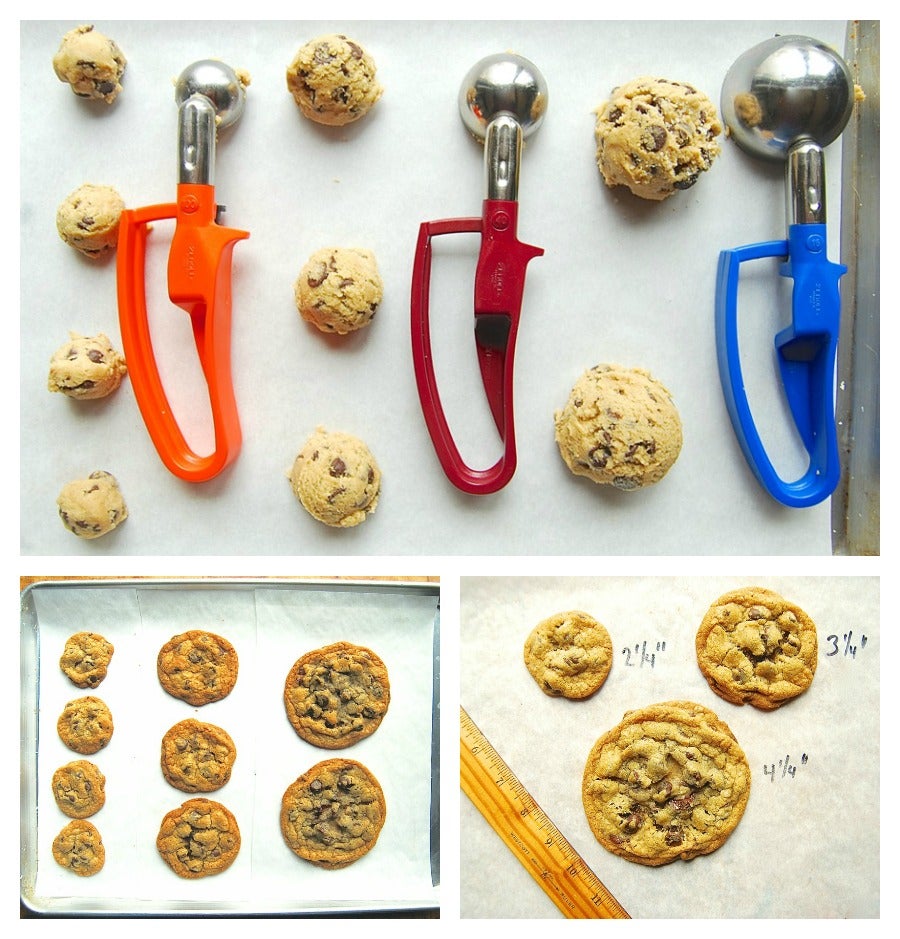
Cooky Dough Dispensing Using Scoops
"Cookie Scoop Sizes" and "Uses for Cookie Scoops"
inform for flexibility in using scoops for various cooky sizes, and for
more uses than just cookies. These sites' info don't totally coincide
with each other. For instance, my cooky scoop holds 4 teaspoons dough;
the bowl diameter measures 1 3/8" diameter.
"Uses for Cookie Scoops"
indicates that #60 scoop's volume is 1 tablespoon and bowl diameter is 1
3/8", and #50 scoop volume is 4 tsp and bowl diameter is 1 5/8". OTOH, "Uses for Cookie Scoops"
doesn't list #50 size, but lists #60 cookie scoop as holding 1
tablespoon and one teaspoon of dough, and the bowl diameter as 1 3/8".
I had long thought of my scoop as holding 1 1/2 T. One day I did a
test with mashed potatoes. Golly! The scoop level-filled one tablespoon
and one teaspoon! I can't get too excited. The difference of 1/2
teaspoon I can chalk up to imperfect leveling.
Additional Cooky Dough Dispensing Thoughts
Even with a reasonably convenient way to dispense dough with a scoop,
by the time I got to the oatmeal chocolate chip dough, I didn't look
forward to scooping more dense dough. I flattened this batch, then cut
it gently with a icing spatula. I shaped a few scraps together into scoopable dollops.
I mused a possible better way to cut for future dense cooky batches. I then recalled I had bought a device that resembled an ice tray.
The plan would be to spray oil into the pan's parts, flatten the
dough into the pan, and press the divider into the dough. I could then
separate the rectangular shapes from the pan and distribute them into
cooky pan. Not sure I'd try baking an entire batch without considering
dough amounts and baking times.
Anomalous Brown Sugar
I have had the same container of dark brown sugar for what seems like
several years. I think it's made its appearance in several blog article,
particularly in the method of resoftening. I think I have it down now.
For that matter, when I started this oatmeal recipe, I became
apprehensive that I didn't have enough on hand. The "brick" weighed 9.3
ounces. My recipe needed 1 1/3 cups.
After I did the brown sugar resoftening process (microwave "brick"
with water till crumbly), I was surprised I had leftover sugar after I
packed the needed amount. The "Convert Cups of Sugar to Ounces" calculator showed that if I had been short, it wouldn't have been by much!
I have something of a love-hate relationship with brown sugar. Baked
stuff does seem to taste better with it than with white sugar. And I
have run across info that says brown sugar helps make for soft cookies.
Yum! However, I hate that it gets bricky!
Maybe mylar food bags can help keep the brown sugar soft, but I'm not
sure I'd buy in quantity like I see for sale. (I thought about mylar
bags because my Ozeri scale came with a couple of small,
wierdly-new-to-me bags, which I researched, discovering they seem hugely available.)
Almost 10 years ago, I blogged "Simplest Scratch Oatmeal Cookies".
At that time, I included a few images, not having learned to make
movies yet. My methodology was simpler but more labor intensive.
Back then, I used a manual pastry blender, and
measuring-tablespoon-and-rubber-spatula method to dispense the dollops.
This time, I used a tilt-head mixer, helpful for saving on elbow grease,
and a cooky scoop for dispensing most of the dollops. (For the
chocolate chip batch, I took a shortcut, flattening the dough, then
dividing it with an icing spatula for most of the dollops.)
This oatmeal cooky recipe uses the minimal amount of ingredients, for
those who want a nekkid cooky that has lots of oatmeal. The ingredients
are simple—oatmeal, flour, baking soda, oil, eggs, and brown sugar. As a
bonus, I include information for resoftening a brown sugar brick into
its spoonable form.
Because I like chocolate chips in many of my cookies, I split the
dough into two parts, plain oatmeal in one batch, and addition of four
ounces of chocolate chips in the other batch. Tasty results, somewhat
delicate. The yield was 25 for each batch. (Deviating from only
scooping when dolloping the chocolate chip batch probably affected the
number of cookies.)
Chocolate chips in 25 cookies: ¾ C (4 oz) contains 806 C/Cup for 604
among 25 cookies, so, 24 additional calories each chocochip oatmeal
cooky. 88 + 24 → 112 C. No sodium.
Bottom line: Oatmeal-only cookies, 88 C each; oatmeal chocochip cookies, 112 C each
View the video
for detailed info and process to bake the two kinds of oatmeal cookies.
The process shown is not real-time, but you can see visual changes to
the ingredients over time—mainly the dough increasingly dense. So glad
to have my Cuisineart tilt-head mixer!
Note: Oops, I forgot to mention the oven temperature. Preheat oven
350, maybe near the end of dough mixing time(s). Baking time is about 10
minutes per batch.
How low effort are these cookies? Only four ingredients, for
starters. The cake mix itself conveniently includes the flour, sugar,
and leavening. (I prefer yellow cake mix because of the psychological
color of eggs and butter, but other mixes also work.) You mix eggs and
oil together, mix in the powder, and fold in the chips. Dispense, bake,
cool.
The video shows still images and clips for the steps. Note: The
cookies are doable using a pastry blender, but a tilt-head mixer cuts
down on elbow grease.
One instruction I've seen in many cooky recipes is chilling the
dough, from an hour to a few days. Fuggetaboutit for my recipe! Another
skippable item is parchment paper. Cake mix cookies have never stuck to
my baking pans, except once when I tried using a Trader Joe's cake mix.
One other item I took a leap of faith in skipping--pressing the dough
dollops flat, sometimes using fingers, other times using a glass.
Without extra help, the dollops (using 1 1/2 T cooky scoop, level fill)
expanded and spread during baking, but not too wide.
Dough Dispensing
A cooky scoop works same as a spring-release ice cream scoop, but
faster than tablespoon-and-spatula method of scoop cough with one hand
and push with spatula using the other hand.
After I had baked the cookies, I searched on the web for fast dollop dispensing. "The fastest way to scoop drop cookies"
showed me that I've been really pokey. When she used two spoons, she
dispensed 15 cookies in 1:34. When she used a 1-teaspoon cooky scoop,
she dispensed 15 in 54 seconds. BTW, she shows her 1-teaspoon baked
cooky as a 2 1/4" wide. My baked cookies were about as wide, but taller,
I think. YMMV.
My smoothing dough against a spatula to flatten the dough before
dispensing was slow. Method 1 (using side of bowl for flattening dough)
in "How to Scoop Cookie Dough"
shows a more streamlined method. Method 2 is much slower with 2nd hand
handling. Useful info is seeing that the dough handler uses food gloves,
which seems to help keep fingers dough-free.
The yield was 40 cookies. Tasty, soft, chewy! I wondered why they
were perfect for softness and chewiness, compared to some of my other
chocolate chip cooky variations. The web listed several results WRT
chewy cookies. One suggested ingredient was cornstarch. Not much, but
enough to affect dough. "From What Does Cornstarch Do in Cookies? (Plus Simple Substitutes to Use in a Pinch)":
Cornstarch isn’t used as a thickening agent in cookies, but
it does have a very important purpose. When a recipe calls for
cornstarch, it’s basically going to be there to help provide structure.
... Certain types of cookies are meant to be very chewy, and cornstarch
is a common ingredient in those.
The cake mix box did list cornstarch. I also recall a trend awhile
back of cake mix companies touting the addition of pudding mix. A main
ingredient of pudding is cornstarch. Another ingredient some sites list
for chewy cookies is brown sugar. The box did not list that. Thus, I
infer that the cornstarch contributed to the texture.
My profession had been technical writer/editor. Through TheWriteJob clublet (blog at http://thewritejob.blogspot.com), I have been exploring my inner creative writing, which includes mostly language enlightenment, entertainment, and a-muse-meant. Over time, I have become more active with images and my YouTube channel.