Showing posts with label orb web. Show all posts

Sunday, February 25, 2018

Spider Silk Miscellany

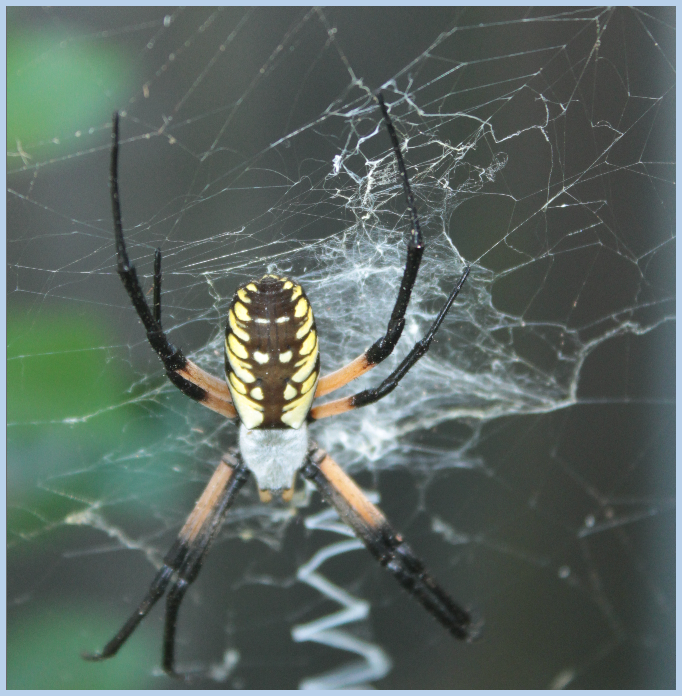
During my searches about argiope trifasciata (banded garden) spiders for "Argiope Trifasciata Spider--Final Bug Spotting of 2017" and "Argiope Trifasciata Spider--Doggone Buggone at 2018 Start", I collected information about spider silk, webs, stabilimenta, and Charlotte's web. IMHO, the most interesting information about spider silk is specialization. Spiders produce different silk for different purposes, coming from different "extruders" called spinnerets.

Spider Silk and Webs
From "How Do Spiders Make Silk?"
The silk that spiders produce is five to six times stronger than high-grade steel by weight, and is stronger than any known natural or synthetic fiber on Earth.
From "Smooth as Silk"
All spiders produce silk but not all spiders spin webs. Silk is used for climbing, to create webs, to build smooth walls in burrows, build egg sacs, and wrap prey. … Most spiders have four or more openings, or glands, on their abdomen called spinnerets. When the spider releases the silk, it looks like one thread but it is actually many thin threads that stick together. ... Larger spiders, like the huge bird eating spiders, can actually catch and subdue animals as large as bats, mice, fish, birds and even snakes with their strong webs.
From "Spider Webs"
Web-Spinning Spiders … know when prey is trapped on their web by detecting and reacting to the vibrations the line makes from their prey moving and trying to get free.

Spiders have seven pairs of silk spinning organs or glands called “spinnerets” located either in the middle or at the end of their abdomen. Each spinneret on the spider is different from the other and used for making several kinds of silk: …

Web-Spinning spiders only use the tips of their legs when creating their webs so that their body doesn’t come in contact with the web and get stuck.
From "8 Silkily Engineered Facts About Spider Webs"
The basic structure includes radial threads that extend out like wheel spokes from the center. Another set of threads spiral out in concentric circles. The silk used to construct these two parts of the web is actually produced by different glands, which is why one is sticky and the other isn’t.
From "9 Amazing Facts about Spider Silk"
while the spider is not the only animal that can produce silk, it is the only animal that can produce different types of silk for different purposes. They can produce fine threads (called gossamer) and thicker threads, as well as both sticky and non-sticky threads.
From "Spiderweb vs. Cobweb - What You Need to know"
COMPLETE SHOW NOTES for this episode found at http://askahousecleaner.com/spider-web-vs-cobweb/.
Charlotte's Web
From "Charlotte's Web - WHO IS CHARLOTTE?"
Charlotte is a "barn spider." Her scientific name (today) is Araneus cavaticus. Her ability to spin orb webs is one of Charlotte’s characteristics.
From "10 Things You Might Not Know About Charlotte’s Web"
E.B. White created beloved characters out of the most unlikely of animals—a runt of a pig named Wilbur and a spider named Charlotte, who weaves words in her web to save his life.
From "Why Spiders Decorate Their Webs"
White wrote Charlotte's Web after marveling at the intricate patterns in a spider's web in the barn on his Maine farm. While we've yet to discover a real spider capable of weaving "some pig" or "terrific" in silk, we do know of many spiders that decorate their webs with zigzags, circles, and other fancy shapes and patterns.

These elaborate web decorations are known as stabilimenta. A stabilimentum (singular) may be a single zigzag line, a combination of lines, or even a spiral whorl in the web's center. A number of spiders weave stabilimenta into their webs, most notably orb weavers in the genus Argiope. Long-jawed spiders, golden silk orb weavers, and cribellate orb weavers also make web decorations.
More About Stabilimentum
"stabilimentum, stabilimenta"

In the Identification section of "stabilimentum, stabilimenta" Info tab—"conspicuous structures of heavy silk found in the webs of some orb-weavers (Araneidae)."

Recent Spider News Odds and Ends
From "Spider drinks graphene, spins web that can hold the weight of a human"
The webbing was on par with bulletproof Kevlar in strength.
From "How One of the Fastest Spinning Animals Catches Its Prey"
Flattie spiders can strike at speeds up to 3,000 degrees per second. That means that in the time it takes you to blink your eyes once, they can complete three full rotations.
From "Part spider, part scorpion creature captured in amber"
two independent teams describe four 100-million-year-old specimens encased in amber that look like a cross between a spider and a scorpion.
From "Eighteen new 'pelican' spiders discovered in Madagascan rainforest"
Pelican spiders were first discovered in the mid-1800’s, embedded in a piece of amber from the Baltics.

An ordinary house spider’s body is divided in two parts: the abdomen behind and cephalothorax in front, where the eyes sit above the mouth … But a pelican spider has an elongated head with eyes on top, and a long neck like a giraffe. The mouth sits at the base of the long neck …

Monday, October 30, 2017

Argiope Aurantia Spider--Part 2, Post-Friday 13th Observations

My previous article "Argiope Aurantia Spider--Part 1, Friday 13th Visitor" is an introduction to a spider that we spotted in our photinias around 4 PM on Friday 13th. It had alien-face features on its back, with its large orb web and zigzag design. Took pix at varying angles for capturing features and web.

The next day around the same time, the scenery changed. The orb web was gone, seemingly replaced by a bridge-like structure between two taller plants. The spider was nowhere in sight. We thought maybe it might repair the web. From "Black-and-Yellow Argiope Spider", "Black-and-yellow argiope spiders often construct and repair their webs after dark". We decided to visit the area the next few days to observe additional changes. By the 16th (Monday), we took new pictures, trying to replicate some of the framings.

Between the 13th and 16th, I had researched the argiope aurantia spider. One unusual feature is its forming of one or more egg sacs, which occurs after orb web construction. We reviewed pix from the 13th. Aha! An egg sac already there! So, the spider had already set up a nursery even before we'd spotted her and orb web on the 13th.


Unfortunate that we have only one pic from 13th with egg sac. However, we have several pix from 16th that show it. See composite for its relative location.


They also show the different web structure and lack of spider. (On the 13th, orb web.)


On the 16th, the bridge-like web spanned two taller plants, as though a possible dismantling of the orb web. As really amateur observers, we speculated that the spider might have wrecked the orb web deliberately and departed.


Maybe the web clump centered between the taller plants might distract predators' eyes away from the egg sac, positioned at the leftside plant.

Friday 27th morning, we noticed that the bridge-like web was no more, speculating that the previous night's winds overcame it. Oh, well. In any case, the egg sac remains! Bug Eric's article "Spider Sunday: Black and Yellow Argiope" provides information about sequence of events about egg sac(s).
Once mated, a female produces one or more egg sacs, each about the size of a large marble, and covered in tough, papery silk. Inside are 300-1,400 eggs. The eggs hatch in late autumn or early winter, but the spiderlings do not exit the egg sac. Instead, they go into diapauses, a dormant state with lowered metabolism. They emerge the following spring and reach adulthood by late summer. Various parasites and predators can take their toll on the egg sacs and spiderlings, however.
One video that shows an egg-sac creation is "Argiope Aurantia Making Egg Sac Complete (Time Lapse 6500%)". The video owner's description mentions "8 hours of video compressed to around 7 minutes". Exhausting, yet fascinating! A related video "Garden Spider and her egg sac" shows the spider working on her egg sac in the garden, something we ourselves missed seeing.

Speaking of video, I pondered over citing videos in my previous argiope aurantia spider article "Argiope Aurantia Spider--Part 1, Friday 13th Visitor". I decided to save video links for this article (Part 2).

For short but succinct video info about the spider, view "Black and Yellow Argiope Spider Documentary.m4v".

Take a closer look at argiope aurantia spider web-building:
  • "Argiope aurantia "Writing Spider" builds web."
    ("An hour and twenty minutes of the work of an Argiope Aurantia spider building its web is compressed to only three minutes ten seconds in this back-yard video."
    This video contains additional textual commentary.
  • "Argiope Aurantia Making Web Close-up HD"
    ("Notice how the Argiooe [sic] aurantia spider uses each leg to measure out the threads. Also notice how she uses her third pair of legs to cut the scaffolding thread!")
    This video show excellent views of spider's underside pattern (ventral view) as it weaves the web. Note the underside pattern we captured in our own pic.

Thursday, October 26, 2017

Argiope Aurantia Spider--Part 1, Friday 13th Visitor

On Friday the 13th, we got trees trimmed. While looking around mid-afternoon at the newer photinias from July last year, we spotted a yellow and black spider and its good-sized "orb" web. The design on the spider's back resembled a combination of alien faces and loving cup handles. Including the legs, the spider looked to be at least two inches end to end. (We were so fascinated by the size, the dorsal yellow and black design, and the vertical-facing zigzag near its head).

I posted to my LinkedIn feed and a listserve for ID help. A day later, I received corroborating info—a mouthful of a name—argiope aurantia spider.

"Argiope aurantia (Black and Yellow Garden Spider)"
Argiope is Latin for “with bright face” (Cameron 2005); aurantia, in Latin, is an adjective meaning “orange-colored.” … Body length (excluding legs) of adult female ranges from 14-28 mm; adult males range from 5-8 mm.
"Black-and-Yellow Argiope Spider"
Largest size spider in Galveston-Houston region. Females ? to 1? inches (19-28 mm). Males 1/4" to 3/8" (5-9 mm) … These spiders prefer sunny places with little or no wind to build their webs. Once they find suitable sites, they will stay there unless the web is frequently disturbed, or they can't catch enough food. Black-and-yellow argiope spiders often construct and repair their webs after dark. Their orb webs can be up to 2 feet in diameter and are very complex.


Bugguide.net is my normal go-to site for bugs. I noticed that both Spiders.us and Bugguide.net state that body lengths exclude legs.

At "Species Argiope aurantia - Black-and-Yellow Argiope", size information "female: 14-25 mm … male: 5-6 mm (sizes do not include legs)" helped nudge me to rethink my initial observation comment about size. Thus, I modified an image for scaling the body against a measuring stick, which came to 13/16" (.8125"). At 20.64 mm, the spider is definitely in the large female size range. No peewee male here!


Dorsal Designs Galore!

The designs resemble a combination of stacked alien heads and loving cup handles similar to close-up near the top of the article. See if you agree.

At Spiders.us
At Bugguide.net
This article (Part 1) is primarily an introduction to our Friday the 13th argiope aurantia spider visitor, primarily the fascination over the physical scenery. "Argiope Aurantia Spider--Part 2, Post-Friday 13th Observations" describes how the scenery changed or didn't change when we looked a mere 24 hours later. Although the post-Friday 13th pix are from Monday 16th, they actually reflect the scenery from mid-afternoon Saturday 14th until maybe early Friday 27th.