Showing posts with label garden spider. Show all posts

Wednesday, January 31, 2018

Argiope Trifasciata Spider--Doggone Buggone at 2018 Start

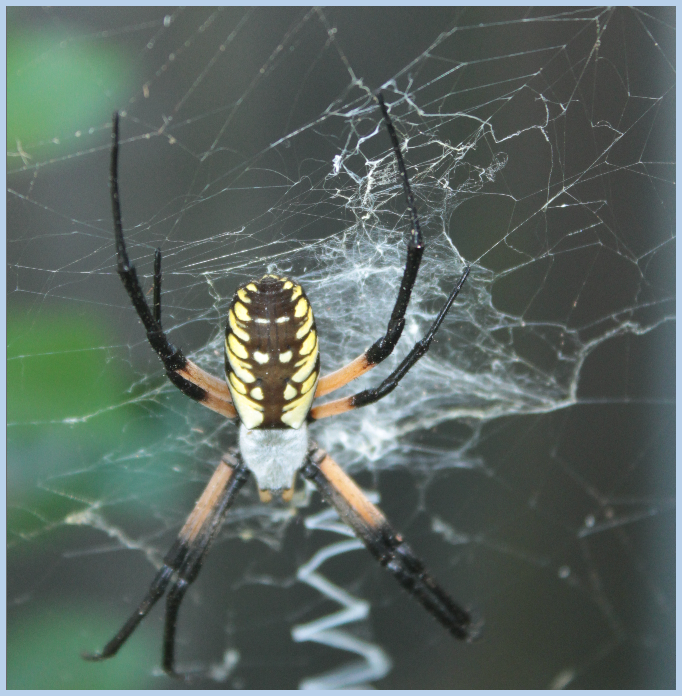
Tch! On the last day of 2017, I took pix and video of an argiope trifasciata spider. (For background, read "Argiope Trifasciata Spider--Final Bug Spotting of 2017".) The next morning, I went to the web; she was nowhere to be found. Over the next few days, we’d peered into the plant—no sign of the spider, nor indicators of web disturbances, nor egg sac.

I’m guessing that the spider did not undergo a "normal" life cycle. From BugwoodWiki's “Banded Garden Spider”:
The overwintering stage is the eggs, which are protected within an egg sac attached to vegetation. Upon hatch in spring the spiderlings disperse, … Adult males begin to appear in late July and females shortly afterwards. The males wander while the females remain within a web. Mating occurs in the latter half of the summer and females produce egg sacs, … Freezing temperatures kill off all remaining spiders at the end of the season and they have a one year life cycle.
I’m going out on a limb here. The case for the spider to not having been there in the summer and fall is lack of any egg sac since having spotted her on New Year’s Eve. I propose that the weather, fast approaching freezing, resulted in lack of prey or male, possibly (probably?) influencing her to abandon her web.

I gleaned the following temperature info from December 30 through January 3 results, using Weatherunderground's Wundermap for my area:

December 30 temps—high in low 60s at noon, temp 49ish around 8 PM when we spotted the spider.
December 31 temps—40 at AM start, 37ish around 8 AM when I took pix of the spider, gradual temp drops.
January 1 temps—mid-20s at AM start, less than 30 throughout the entire day and evening.
January 2 temps—lower than 30 throughout the entire day and evening.
January 3 temps—20s at AM start, climbing to 30s around 9 AM, climbing near 60s around 4 PM, then cooling down as evening progresses.

I speculate that the spider constructed the web during reasonable temperature, before the freezing temperature set in and that lasted a few days. During the freeze, prey maybe didn't approach the web (unwittingly or not); thus, no food for the spider. No male argiope trifasciata spider approached the web for mating; thus, no need for the female to create an egg sac.

A few successive days of looking at the plant and noting the intact web, I sensed the female abandoned the web. I ruled out the possibility of a predator making a meal of the spider. I think a struggle would have resulted in the web being wrecked.

One other oddity: The orb web did not have a stabilimentum (elaborate web decoration) as I've noticed in several other images of female argiope trifasciata spider webs. The lack of stabilimentum might have indicated the stoppage or interruption of the spider's "housekeeping setup" process. Read more about stabilimenta.

Curious about doing your own weather timeframe lookup? Start at https://www.wunderground.com/wundermap.
  1. Confirm or click All Layers > Weather Stations > Temperature / Wind.
  2. At the search field, enter your city of interest, then enlarge the view to the scale you want.
  3. Scroll to the area of interest. (The results might be slow to arrive.)
  4. Click a number. When the inset window opens, click Visit local weather page for [your locale].
  5. At the new window, scroll down to the weather history options. The first option is interval, the default being daily. You can set for larger intervals or customize for date range. View graph or table.
  6. The newer window has an enlargeable inset map with additional station numbers you can click and find similar information.

Thursday, January 25, 2018

Argiope Trifasciata Spider--Final Bug Spotting of 2017

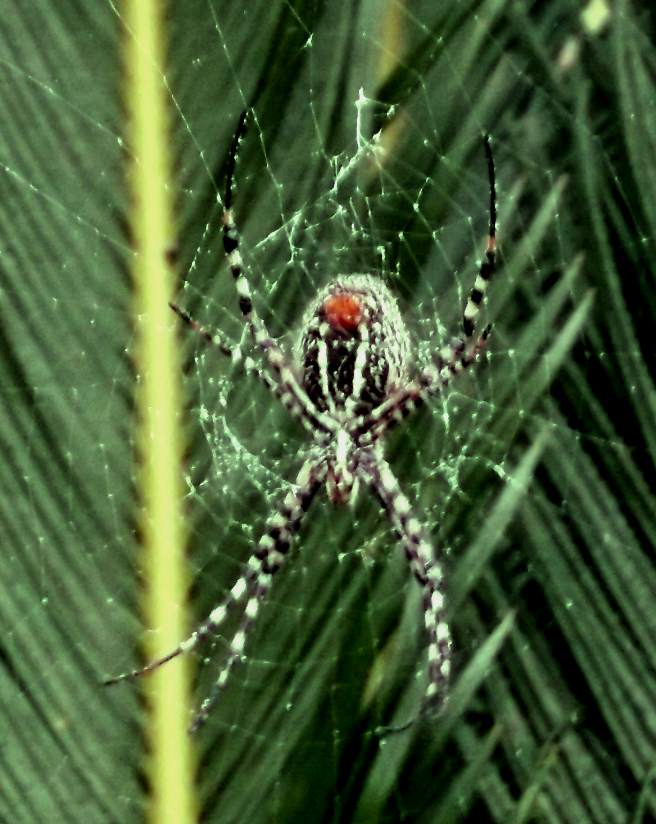
The spider that I spotted in the morning of December 31, 2017 is in the same spider family and genus as argiope aurantia spider, which I wrote about in "Argiope Aurantia Spider--Part 1, Friday 13th Visitor" and "Argiope Aurantia Spider--Part 2, Post-Friday 13th Observations". The pixstrip images show the palm plant that this article’s spider was in, a peer into the plant, and larger views of the spider and inside of the plant. Click for a really close look of the spider and its spinnerets.

In my excitement over the spider’s striking looks facing me, I overlooked going around the palm plant for photographing or recording the spider's opposite side. In my quest for finding the spider's ID, I spotted various images that matched my best picture, which turned out to be the ventral view of an argiope trifasciata spider. Fortunately, I found some websites that show both ventral AND dorsal views. What a contrast!

In InsectIdentification’s “North American Spiders List”, I picked options at the bugfinder section at the bottom for general bug characteristics. The hits helped narrow down candidate bugs of various creepy crawly types.

I finally found the banded garden spider to be my model spider, but it was a roundabout way of finding the prospect. A helpful site was dPestSupply’s information section and picture for “Banded Garden Spider” (argiope trifasciata). (Coincidentally, just below the banded spider section was information and picture of a black-and-yellow garden spider (argiope aurantia), the one I wrote about in October.)

I found my way to InsectIdentification’s “Banded Garden Spider” page. Click the fourth and fifth thumbnails for viewing fill-the-screen closeups. The latter image very closely resembles my closeup near the top of this article.

As I dug deeper into the spider’s information, I found more corroborating information about the dorsal and ventral views.

BugwoodWiki’s “Banded Garden Spider” website provides basic information and images.
The banded garden spider (Figure 1 and 2) is a large species, with a generally ovoid form and bright markings. Mature females may be 13-14.5 mm when fully extended and the carapace of the body typically between 5-6.5 mm in length.

The banded argiope is an orbweaver spider that produces its large concentrically patterned web in areas of tall grass and shrubby vegetation. The web is sticky and strong, capable of holding fairly large and active insects such as wasps and grasshoppers.

Mating occurs in the latter half of the summer and females produce egg sacs, which have a general shape of a kettle drum. Freezing temperatures kill off all remaining spiders at the end of the season and they have a one year life cycle.
Fletcher Wildlife Garden (FWG) gallery at "Orb Weaver spiders (Araneidae)" shows a gallery of spiders in the family of orb weavers, including the argiope trifasciata spider (this article) and previous month's article about argiope aurantia spider.

View "Banded argiope (Argiope trifasciata), top side" (dorsal) and "Banded argiope (Argiope trifasciata), underside" (ventral). Another ventral view image shows an oval outline and arrow that identify the spinnerets.

A YouTube video "Argiope trifasciata (Banded Garden Spider) - catching a grasshopper" shows the spider in action, rotating itself several times, displaying its dorsal and ventral sides. Note the dorsal side's horizontal bands (invoking thoughts of Jupiter's cloud bands), and the ventral side's two prominent vertical bands with the red spinneret section as the spider maneuvers, wrapping its prey for later consumption.

Curious about the argiope garden spider for similarities and differences? Visit Bugguide's "Genus Argiope" taxonomy page. Also click Info and Images tabs.

Monday, October 30, 2017

Argiope Aurantia Spider--Part 2, Post-Friday 13th Observations

My previous article "Argiope Aurantia Spider--Part 1, Friday 13th Visitor" is an introduction to a spider that we spotted in our photinias around 4 PM on Friday 13th. It had alien-face features on its back, with its large orb web and zigzag design. Took pix at varying angles for capturing features and web.

The next day around the same time, the scenery changed. The orb web was gone, seemingly replaced by a bridge-like structure between two taller plants. The spider was nowhere in sight. We thought maybe it might repair the web. From "Black-and-Yellow Argiope Spider", "Black-and-yellow argiope spiders often construct and repair their webs after dark". We decided to visit the area the next few days to observe additional changes. By the 16th (Monday), we took new pictures, trying to replicate some of the framings.

Between the 13th and 16th, I had researched the argiope aurantia spider. One unusual feature is its forming of one or more egg sacs, which occurs after orb web construction. We reviewed pix from the 13th. Aha! An egg sac already there! So, the spider had already set up a nursery even before we'd spotted her and orb web on the 13th.


Unfortunate that we have only one pic from 13th with egg sac. However, we have several pix from 16th that show it. See composite for its relative location.


They also show the different web structure and lack of spider. (On the 13th, orb web.)


On the 16th, the bridge-like web spanned two taller plants, as though a possible dismantling of the orb web. As really amateur observers, we speculated that the spider might have wrecked the orb web deliberately and departed.


Maybe the web clump centered between the taller plants might distract predators' eyes away from the egg sac, positioned at the leftside plant.

Friday 27th morning, we noticed that the bridge-like web was no more, speculating that the previous night's winds overcame it. Oh, well. In any case, the egg sac remains! Bug Eric's article "Spider Sunday: Black and Yellow Argiope" provides information about sequence of events about egg sac(s).
Once mated, a female produces one or more egg sacs, each about the size of a large marble, and covered in tough, papery silk. Inside are 300-1,400 eggs. The eggs hatch in late autumn or early winter, but the spiderlings do not exit the egg sac. Instead, they go into diapauses, a dormant state with lowered metabolism. They emerge the following spring and reach adulthood by late summer. Various parasites and predators can take their toll on the egg sacs and spiderlings, however.
One video that shows an egg-sac creation is "Argiope Aurantia Making Egg Sac Complete (Time Lapse 6500%)". The video owner's description mentions "8 hours of video compressed to around 7 minutes". Exhausting, yet fascinating! A related video "Garden Spider and her egg sac" shows the spider working on her egg sac in the garden, something we ourselves missed seeing.

Speaking of video, I pondered over citing videos in my previous argiope aurantia spider article "Argiope Aurantia Spider--Part 1, Friday 13th Visitor". I decided to save video links for this article (Part 2).

For short but succinct video info about the spider, view "Black and Yellow Argiope Spider Documentary.m4v".

Take a closer look at argiope aurantia spider web-building:
  • "Argiope aurantia "Writing Spider" builds web."
    ("An hour and twenty minutes of the work of an Argiope Aurantia spider building its web is compressed to only three minutes ten seconds in this back-yard video."
    This video contains additional textual commentary.
  • "Argiope Aurantia Making Web Close-up HD"
    ("Notice how the Argiooe [sic] aurantia spider uses each leg to measure out the threads. Also notice how she uses her third pair of legs to cut the scaffolding thread!")
    This video show excellent views of spider's underside pattern (ventral view) as it weaves the web. Note the underside pattern we captured in our own pic.

Thursday, October 26, 2017

Argiope Aurantia Spider--Part 1, Friday 13th Visitor

On Friday the 13th, we got trees trimmed. While looking around mid-afternoon at the newer photinias from July last year, we spotted a yellow and black spider and its good-sized "orb" web. The design on the spider's back resembled a combination of alien faces and loving cup handles. Including the legs, the spider looked to be at least two inches end to end. (We were so fascinated by the size, the dorsal yellow and black design, and the vertical-facing zigzag near its head).

I posted to my LinkedIn feed and a listserve for ID help. A day later, I received corroborating info—a mouthful of a name—argiope aurantia spider.

"Argiope aurantia (Black and Yellow Garden Spider)"
Argiope is Latin for “with bright face” (Cameron 2005); aurantia, in Latin, is an adjective meaning “orange-colored.” … Body length (excluding legs) of adult female ranges from 14-28 mm; adult males range from 5-8 mm.
"Black-and-Yellow Argiope Spider"
Largest size spider in Galveston-Houston region. Females ? to 1? inches (19-28 mm). Males 1/4" to 3/8" (5-9 mm) … These spiders prefer sunny places with little or no wind to build their webs. Once they find suitable sites, they will stay there unless the web is frequently disturbed, or they can't catch enough food. Black-and-yellow argiope spiders often construct and repair their webs after dark. Their orb webs can be up to 2 feet in diameter and are very complex.


Bugguide.net is my normal go-to site for bugs. I noticed that both Spiders.us and Bugguide.net state that body lengths exclude legs.

At "Species Argiope aurantia - Black-and-Yellow Argiope", size information "female: 14-25 mm … male: 5-6 mm (sizes do not include legs)" helped nudge me to rethink my initial observation comment about size. Thus, I modified an image for scaling the body against a measuring stick, which came to 13/16" (.8125"). At 20.64 mm, the spider is definitely in the large female size range. No peewee male here!


Dorsal Designs Galore!

The designs resemble a combination of stacked alien heads and loving cup handles similar to close-up near the top of the article. See if you agree.

At Spiders.us
At Bugguide.net
This article (Part 1) is primarily an introduction to our Friday the 13th argiope aurantia spider visitor, primarily the fascination over the physical scenery. "Argiope Aurantia Spider--Part 2, Post-Friday 13th Observations" describes how the scenery changed or didn't change when we looked a mere 24 hours later. Although the post-Friday 13th pix are from Monday 16th, they actually reflect the scenery from mid-afternoon Saturday 14th until maybe early Friday 27th.