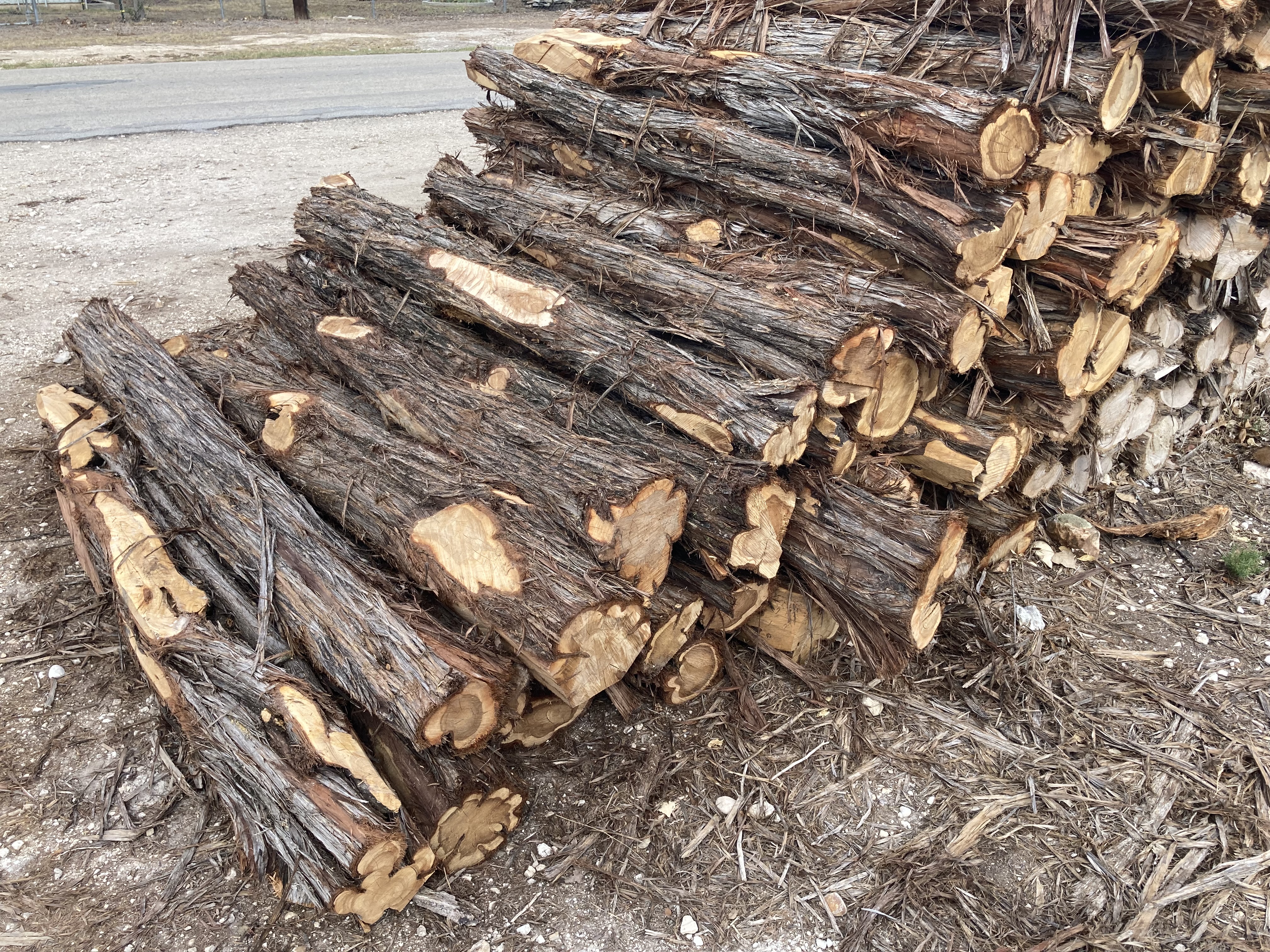
Upon moving in, the cedar trees numbered 11. Arborgeddon (in 2023)
wiped out maybe five. The last cedar became weakened maybe a year later;
it could fall and harm or worse in a bad moment. Got it cut and
removed mid-September.
The video revisits some memories of Arborgeddon damage. A segment
shows abbreviated cutting and removal of the last tree. Besides wanting
to document the majestic tree's demise, I wanted to closely view the
cedar stump surface.
Based on meandering to view previous cedar stumps, I wasn't sure what
the surface would look like. The center part is heartwood, prominently
"ringed" by the sapwood.(It measures about 9" x 12".) Anything about the
shape and colors remind you of anything? For more info about tree
anatomy that also mentions barks and cambium, with ID-labeled image,
visit "Anatomy of a Tree".
The irregular perimeter made me wonder how weak the trunk itself
might have been. That stump doesn't resemble the nearby one, also a
cedar. They both look like their trunks had been lacking in solid mass.
Visit my other articles and videos of cedars, now in the past. No
longer any cedars to hack at errant branches and their needly, junipery
foliage.
"See Dere Cedar Stumps, Plus One, Sizing Up" article | video
This topic is a followup to March's "See Dere Cedar Stumps" (article, video).
At that time, I noted nine cedar (ashe juniper) stumps. Six of those
trees got damaged and needed removing only last year because of
Arborgeddon in my area (article, video).
During a recent backyard weed-pull session, I saw that I overlooked
yet another cedar stump. I took a new set of pix. For good measure, I
used primarily an 18" transparent drafting scale and a wooden yardstick.
Previously, I used a metal tape measure that was unwieldy although
doable enough.
For this set of images, I emphasized ascending cut-surface spans,
scaling the images in reference to each other and also including span
dimensions. View the images from smallest to largest spans, which range
from just under 8" to almost 23". (The plus-one stump is mid-range
size—~12 1/4.) Note the stumps' irregular perimeters, and lack of
roundness and symmetry.
"Ashe Juniper"
mentions "easily recognized by its irregular shape, fluted, twisted
trunk". The site describes it in deeper detail for characteristics and
environs. Various images round out the info.
While recently pulling out spring weeds, I noticed some of the cedar
stumps didn't have round, smooth perimeters as I'd expect. Turns out
that all nine stumps looked different from typical cylindrical tree
trunks of live oak and Spanish oaks. Interestingly, these cross sections
also looked different from each other.
While poking around on the web, it turns out that these trees are
also known as ashe juniper trees. (A long time ago, I was told that
these trees were cedars.) I'm keeping the theme title, but keeping in
mind that the tie-in to junipers is the foliage.
Cedars and Junipers
The following resources indicate that the cedar tree and stumps in the backyard to be ashe junipers.
"Cedar vs. Juniper: Why we call it ‘cedar fever’ when cedar isn’t to blame"
focuses on "fever". The accompanying video provides good videocam
panning of the trees. About 15 seconds into video, the tree resembles
the lone remaining backyard "cedar" tree. Notable: "the tree was finally
formally identified as ashe juniper in 1932."
"How Austin’s most hated tree benefits humans and the environment"
states "Though not technically cedar, the Ashe Juniper trees have been
referred to as cedar since the first settlers arrived in Texas, and the
name stuck." The accompanying video shows several trees that resemble
the ones in my yard from pre-arborgeddon in 2023.
"Ashe Juniper" shows a good image of tree bark, accompanied by description that suits the cut-off trees well.
The tree is easily recognized by its irregular shape,
fluted, twisted trunk, and dark green foliage. ... Its bark is gray or
reddish-brown often with white patches. ... Another identifying
characteristic of the bark, especially on mature trees, is its shredding
into long narrow strips.
"CEDAR 101" explains mountain cedar as "technically, it is Ashe juniper (Juniperus ashei).
The name 'mountain cedar' comes from its visual similarity to Eastern
Red Cedar and its preponderance in the Hill Country, or Edwards Plateau
ecoregion, of Texas." The image of stacked logs provides various looks
of cross cut edges. The site describes how the lumber is sized and
graded for selling.
"Numerous Juniperus, but Neither Were Cedar!"
is longish and detailed. About 2:29 into the video, the narrator holds
up a small branch and states "This is an ash(e) juniper. This is the
most common tree in Austin."
"7 Types of Cedar Trees in Texas: Identification Guide (Chart, Pictures)"
provides info on seven types of cedar trees. I initially thought that
my cedars were alligator cedars. I changed my mind when I saw the bark
resembled organized mosaic tiles. BTW, the rock cedar (Juniperus ashei) apparently is another name for ashe juniper.
My profession had been technical writer/editor. Through TheWriteJob clublet (blog at http://thewritejob.blogspot.com), I have been exploring my inner creative writing, which includes mostly language enlightenment, entertainment, and a-muse-meant. Over time, I have become more active with images and my YouTube channel.