Sunday, July 31, 2016

Closeup of Molted Cicada Exoskeleton (and More Info)

Earlier this week, I spotted a sizable empty shell of a bug, maybe a beetle, I thought. It was about an inch tall, stuck to a corner of a porch column, seemingly hugging it, about three feet above the porch. It looked like all the innards might have been cleanly sucked out, maybe consumed by parasitic larvae, leaving only exoskeleton and maybe other chitin.

For a larger, unreduced image, click here.

Not being an entomologist or gardener who might know about bugs, I wondered how to get information about the shell's former occupant and how it departed. A Google image search yielded seemingly countless, overwhelming results.

I decided to turn to LinkedIn connections, and posted a pic and update, hoping to get someone to identify the item. I was in luck! Two people, John Rothgeb, and Steven Schwartzman, replied with great leadoff info.

From John, a declaration and web link: "Looks like cicadas or even a Giant cicada - http://texasento.net/Cicada.htm". The website images and first .wav file sent me off to Googling more info.

From Steve, a strongly specific term and also two links to blog articles he had written about cicadas himself:
The thing in your picture appears to be the exuviae of a cicada. That word is a Latin plural that entomologists use for the exoskeleton that an insect casts off as it grows from one stage into the next.

Here are a couple of instances from my blog:
https://portraitsofwildflowers.wordpress.com/2014/07/22/exuviae-2/
https://portraitsofwildflowers.wordpress.com/2011/07/18/exuviae/
A third LinkedIn connection declared the shell to be cicada. (Happily, LinkedIn networking can be fruitful for topics besides work, careers, and occupations. (My LinkedIn home page shows more number of views for the exoskeleton picture and inquiry than any other topic I've announced in recent memory.)

Besides increasing my curiosity about the animal, the terminology I was encountering sent me hunting down definitions and pronunciations for chitin and exuviae. Interestingly, the first "c" in cicada, according to both m-w.com and dictionary.com, is pronounced as an "s". I've heard people pronounce it as only a "ch" sound. And I myself pronounce it as "ch". BTW, those two dictionaries also provide long/short vowel pronunciation options of "i", and the first "a".

I have listed some links about cicadas, many of them YouTube videos that show cicadas molting.
Anyway, the bottom line about the clinging bug shell on the porch column: It's a castoff exoskeleton after a cicada molts and flies away, not shell remains after parasitic larva(e) dined on the insect. Coincidentally enough, a wasp that captures a cockroach for its larva's future food supply uses similar methodology as a wasp that targets cicada.

From "10 Facts about Cicada Killer Wasps"
  1. The adult female wasp will paralyze the cicada with her venomous sting.
  2. The wasp will carry the cicada to a burrow, where it will place the cicada.
  3. The wasp will lay an egg under the left or right second leg of the cicada.
  4. The egg hatches, and the larvae begins to eat the cicada, while taking care to keep it alive.
  5. Once the larvae [sic] has had its fill, it spins a cocoon, in which it will change into an adult wasp.
Such behavior looks similar to that of jewel-wasp-on-cockroach, in comparing information in "How a Wasp Turns Cockroaches into Zombies" of Scientific American.
venom compounds work fast, paralyzing the cockroach …
leads her victim to its final resting place …
Once inside her burrow, she attaches one egg to the cockroach's leg, then seals her offspring and the roach in.…
wasp larva hatches from its egg, its meal is ready to eat. And soon enough after that, a new wasp emerges from the burrow, leaving the roach carcass behind.
Note: The SA article states that the larva hatches and emerges as a wasp, omitting the details of how the larva becomes a wasp. The m-w.com site explains that the stage between larva and wasp is pupa, "usually enclosed in a cocoon or protective covering".

For more articles about cicadas, enter "cicada" in the search box at the upper left of this window. Or find and click "cicada" link at Partial Index of Keywords section (just below Popular Posts section).

Monday, July 4, 2016

EZ Mini M&M Confetti Cookies


My cake mix cooky recipe is the summer counterpart (summer-temperature tolerant) to my winter cake mix cooky recipe "Minty Choco Chip Cake Mix Cookies". I wanted to bake some cookies that have chocolate that melts in your mouth, not in your hand. I thought about M&M's, then remembered chomping on mini M&M's the previous Halloween. Then I thought such cookies would look even more festive, besides having the colorful candy shells, if I added jimmies.

Several mini M & M cooky recipes I ran across are scratch and require about 10 ingredients. Well, how about starting with the standard cake mix cookie process that requires only cake mix, oil, egg?

My method of cake mix for this recipe was using 1/2 box of chocolate cake mix and 1/2 box of Pillsbury Funfetti cake mix. The Funfetti powder contains 2 tablespoons of jimmies, so my half box contained one tablespoon.

If you want the milk chocolatey cooky effect without weighing out cake mixes, you can use a marble cake mix. Stir jimmies into the cake powder(s) before mixing up the batter.

My pixstrip shows the following image areas:
  1. Initial
    1. Implements
    2. Ingredients
    3. Partially mixed dough (wet ingredients, dry ingredients) and set-aside mini M&Ms
  2. Main mixing
    1. Mixed dough and and set-aside mini M&Ms
    2. Dough with mini M&Ms being poured
    3. Dough and mini M&Ms being stirred together
    4. Mixed dough
  3. Baking
    1. Raw dough in pan
    2. Baked cookies in pan, some being scooped and flipped onto cooling rack
    3. Cooled cookies
Implements
  • Small mixing bowl
  • Larger mixing bowl
  • Pastry blender
  • Spoon for measuring out cooky dough
  • Measuring cup
  • Spatula for scraping dough onto pan
  • Cooky pan(s)
  • Cooling rack for done cookies
  • Cooky spatula to lift and transfer baked cookies
Ingredients
  • 2 eggs
  • 1/3 cup oil
  • 1/2 box chocolate cake mix
  • 1/2 box Pillsbury Funfetti cake mix (or 1/2 box white cake mix and at least 1 tablespoon of jimmies)
  • 1/2 bag of mini M&Ms (~ 5 oz)
Instructions
  1. Preheat the oven to 325°.
  2. Combine the powders and jimmies.
  3. Combine the oil and eggs.
  4. Combine the wet ingredients into the dry ingredients. The dough will be thick.
  5. Stir the mini M&Ms into the dough. Slow and steady works.
  6. Use a round tablespoon to scoop the dough, and use the rubber spatula to shape.
  7. Drop the spoon's dough onto the cooky sheet. (For slightly flatter cookies, slightly flatten the shaped dough rounds with the spatula or the measuring cup.)
  8. Bake for about 12 minutes.
  9. Use the cooky spatula to lift and transfer the done cookies onto cooling rack.
The yield was 41 cookies, amounting to ~73 calories each. YMMV

Post-recipe Thoughts
The confetti part of the cookies was sparse. To give the cookies a more "celebratory" look in the future, I'd probably ensure three to four tablespoons of jimmies for each batch.

I had some boxes of cake mix on hand, so I measured and used half boxes, storing the other halves in the refrigerator. An easier process would be to use a marble cake mix and stir in jimmies into the powder. If you prefer a vanilla instead of summer-tolerant chocolate cooky, use just white or yellow cake mix, jimmies, and mini M&Ms.

July 12, 2016: I baked a second batch Sunday. This time, the 1/2 box of chocolate cake mix was Duncan Hines Classic Devil's Food Moist instead of Betty Crocker Super Moist Chocolate Fudge. Also, I added more jimmies—2 1/2 tablespoons, all that was left in my jar. The image on the left has the BC mix; the one one right has the DH mix and extra jimmies.
 I was surprised to see that the BC-mix cookies were much darker than the DH-mix ones. IMHO, the DH ones are closer to my idea of milk chocolatey cookies.

The yield for DH-mix cookies was 45, probably as a result of 1 1/2 tablespoons of additional jimmies, and variation of my cooky dough dispensing. I calculated DH-mix cookies to be about 71 calories each (BC-mix cookies, about 73 each.)

Thursday, June 30, 2016

Pronunciation Musements

Pronunciations of some English words can be unobvious or inconsistent, particularly when encountering the printed form for the first time. My article is primarily about consonant combinations ("consonant blends" and "consonant digraphs"), but also includes related information farther down. "Teaching Blends and Digraphs" differentiates the two combinations.
  • consonant blend—"two or more consonants are blended together, but each sound may be heard in the blend"
    Examples include bl, br, cl, cr, …
  • consonant digraph—"two consonants stand together to represent a single sound"
    Examples include sh, ch, th, …
Some Consonant Digraphs with Multiple Pronunciations
Three consonant digraphs that can be confusing for determining pronunciations are "ch", "th", and "gh". The examples I list are simple, but I'm sure less familiar words can cause pause.
Numerous words contain "gh", which most frequently don't seem to serve any phonetic purposes. "Laugh" sounds like three letters could take care of the spelling—"laf". Arthur Laffer of Laffer curve fame is a good example of using "laffer" phonetic spelling instead of "laugher".

No "gh" in Laffer Genealogy
My Google lookup session of Arthur Laffer meandered over his genealogy, which goes as far back as the 1600s (Joseph Laufer). His most recent ancestor that was a Laffer was Bartholomew (Bartol) Laffer. Bartholomew's father's surname was Lauffer (Christian Lauffer Sr.). Slogging through text, I encountered a piece of amusement—Peter Piper, not a picker of pickled peppers, apparently. Anyway, "gh" was never part of the surnames.

The site "words with the -gh- letter pattern" provides detailed guidelines and grouped examples about this consonant pair. Another site, with more historical background, is "Pronunciation: How did "gh" at the end of some words become an "eff" sound?"

"ph" Consonant Digraph
Closely related to "gh" digraph for "f" pronunciation is "ph" (examples: photo, phone). "Spelling the /f/ sound with ph" states "The /f/ sound is usually spelled with just f (or ff after a short vowel … but words from ancient Greek use ph." This site provides good lists of "ph" examples and contexts.

Aural Disconnect with Three Consonant Combinations
Two consonant blends and one consonant digraph have always struck me as sounding differently than graphically alleged—"tr", "dr", and "ch". As a native speaker of English, I always felt those combinations sounded like "tchr", "jr", and "tch", respectively. Try pronouncing "trap", "draw", and "choke", and consider if they sound like "tchrap", "jraw", and "tchoke". "How to pronounce the 'ch' sound" provides linguistic details about "ch".)

More Pronunciation Items
Some additional thoughts WRT pronunciations are a few words I've run across that sound differently than I thought they would.
  • cupboard—I was surprised it's pronounced "kub-ərd" instead of "cup-board".
  • drawer—jroor (C'mon. If you pronounce it as draw-er, it sounds like a non-English speaker pronunciation.)
  • iron—eye-yern (Does anyone pronounce it as "eye-ron"?)
More mystery of consonants and their pronunciations in words, depending on nearby letters—
  • g: g or j (gang, general)
  • c: s or k (ceiling, cake)
  • s: s or z (seek, bees)
  • f: f or v (off, of)
  • h: h or silent (honey, honest)
For a related article about "h", visit "Pronunciations Heck with Hermione and Homage".

Diphthong
Diphthongs and two-consonant digraphs have a similarity: two characters and formation of a single sound. "The Difference Between Digraphs and Diphtongs" states "digraphs are letters and diphthongs are sounds". More specifically, "a digraph is two letters that spell one sound.… A diphthong is one vowel sound formed by the combination of two vowel sounds."

Coincidentally, "diphthong" is a good example word having a pair of consonant digraphs. (BTW, interesting to see the "ng" sound represented by a hybrid symbol. View that symbol and rest of Merriam-Webster's pronunciation key.)

Short and Long oo
While perusing consonant digraphs, I ran across the expressions "short oo" and "long oo". I had not heard of long and short "oo" designations (typical for normal vowels) in my younger years. "Long Sounds of 'oo', Short vs. Long 'oo' Vowel Digraphs" provides word and sentence examples for contrast. For explanations of "oo" and other "o" sounds, visit the encyclopedia.com site.

Related: "Auther, Authur, Author, Other"

Thursday, June 23, 2016

Sprinkling Caraway Seeds for Quick Rye-ish Fix

A few weeks ago, I had a yen for rye bread. Being ignorant of rye bread dough, and seeing that caraway seeds always seemed to be in rye bread, I simply thought of these seeds as the add-in that makes rye bread rye bread.

I wondered why rye breads weren't called caraway seed breads. I wondered if one-syllable "rye" edged out three-syllable "caraway". Turns out that rye is its own item—a grass.

Numerous rye bread recipes call for both rye bread flour and white flour. Some recipes call for additional type(s) of flour. Almost all specify one or two tablespoons of caraway seeds. FWIW, my bottle of Morton & Bassett caraway seeds states a serving as 1/4 teaspoon of caraway seeds. Thus, I infer that each pound of bread should have 4 teaspoons of seeds.

Looking at several recipes for rye bread, which require more ingredients than I wanted to bother with, my eyes glazed over. Rather than pay a king's ransom for rye bread at the store, I decided on a cheapie, quick way to get a rye-ish fix—a jar of caraway seeds for sprinkling onto buttered carb delivery products (grin). Some suggestions:

With room-temperature bread, toasted bread, or toasted English muffin, spread butter or peanut butter on it, sprinkle seeds, and use the knife to pat the seeds down.

With a toasted English muffin, another suggestion is to sprinkle seeds, add shredded or sliced jack cheese, and microwave until the cheese melts. Melting cheese with added seeds works well also for crackers. If you spread butter or peanut butter on crackers, it's optional to use the knife to smear and "glue" the sprinkled seeds.

At the supermarket's spice aisle, I found caraway seeds from McCormick, McCormick Gourmet, and Morton & Bassett (no relationship to Morton of salt game). Tabulation of the three brands is as follows:
Brand Weight Price Price/
Ounce
McCormick   .9 $4.34 $4.82
McCormick
Gourmet
1.62 $3.78 $2.33
Morton &
Bassett
2 $6.42 $3.21

I'd have chosen McCormick Gourmet for best economy. However, the store displayed a coupon for $2 off for Morton and Bassett, reducing the price per ounce to $2.21. (Yay!) As the nutrition table states each serving as 1/4 teaspoon (.7 grams), about 81 total servings, I'd be shaking about 6 cents of seeds for each bread slice or muffin half. (FWIW, if the seeds were the density of water, the amount of servings would have been only 48 servings.)

While perusing the spice areas, I noticed that Morton &Bassett also sells whole cumin seeds, 2 ounces for $6.68, a smidge more than the normal price for caraway seeds. Cumin seeds are yummy with jack or cheddar cheese. One bread loaf came out divine when I mixed in cumin seeds and shredded cheddar.

Thinking about the caraway and cumin seeds, I recalled having bought something called kuminost cheese many years ago. Did not think to look at the list of ingredients, but associated the name with cumin. All-dictionary.com provides the following information:
Kuminost Cheese; Kumminost meaning in Cooking Dictionary
Danish semifirm mozzarella cheese made of entire or skimmed cow's milk, having either a natural or waxed rind and a pale yellowish to orange interior; flavored with cumin, caraway seed and clove. Kuminost is great in casseroles as well as for treats and sandwiches. Also called nokkelost.
Quickie DIY kuminost cheese sounds like a reason to buy cumin seeds and mozzarella or jack cheese on my next store trek. Maybe I'll skip the cloves, though. Hmmm, a flour tortilla rollup with cumin/caraway seeds and melted jack cheese sounds tempting.
Some websites about caraway seeds and rye:

Monday, May 30, 2016

Jacks Part 2

This article is the second half about jack(s). Read about jacked food, music (beyond the previous article's mention of "From a Jack to a King"), video media, and other scattered jacks. ("Jacks Part 1" centered around the name, children-item associations, and games.)

Jack Food and Related
Monterey jack cheese seems to be second to only cheddar as a popular cheese. (I hesitate to consider American and Velveeta to be in the same class.)
Around the 1700s, these monasteries around the Monterey region were making a semi-firm, creamy, mild flavoured cheese from cow’s milk which they aged for a little period. An American entrepreneur named David Jack realized its commercial value and started selling it all over California. The cheese came to be known as “Monterey Jack's” or “Jack's Monterey,” eventually acquiring the name Monterey Jack.
Anyone ever not eaten Cracker Jack snacks, otherwise called Crackerjacks? This product, and variations of spelling, are a food, an attribute (complimentary term), and movie. The food was immortalized in "Take Me Out to the Ballgame" in 1908.

A jack in the box is a toy, eatery, and movie. Although a jack in the box would be a "Kid Stuff" item that seems to belong in Jacks Part 1, I decided to write about it in Part 2 because of food.
A jack in the box toy is a spring-loaded toy with popup figure. Phrase Finder provides information about some unsavory associations.
Jack-in-the-box was variously a religious insult, a swindler, the Devil and an incendiary device - clearly a character not to be meddled with.
I'm guessing all American fast food diners know what a Jack in the Box (eatery) is. Not to sound like I'm plugging their offerings, but JITB has been serving breakfast during all their open hours long before McDonald's. As most with most fast food eateries, their offerings are deadly loaded with fat, sodium, or both. (Sigh.)
In 1951, a businessman named Robert O. Peterson opened the first Jack in the Box® restaurant in San Diego on the main east-west thoroughfare leading into city. Equipped with an intercom system and drive-thru window, the tiny restaurant served up hamburgers to passing motorists for just 18 cents, while a large jack-in-the-box clown kept watch from the roof.
Jack Animals
Three animals—one fictitious—have "jack" in their names.
Jack in Music and Video Entertainment
Jack is prominent in songs and video media.

 Mostly Music
This section is mostly about music oldies that have Jack in song titles, lyrics, or both. Although "From a Jack to a King" fits this section, it also fits well into Jacks Part 1 WRT to references to a playing card, in a romantic sense.
 Mostly Movies
This section is mostly about movies with Jack in titles, characters, or both.
Miscellaneous Jacks
"Jack" shows up in unusual contexts, sometimes in related, compound word forms.
  • Hijack, skyjack, carjack indicate stealing a vehicle by force, although some speculate the origin of hijack pertains to sneaking out of zinc ore, known as "jack", by miners. "Skyjack" does not seem to have retained popular use, and far fewer planes seem to be hijacked—maybe because of much tighter airplane boarding restrictions. For that matter, hijack seems more popular a term pertaining to changing of subjects in discussions among people.
  • A LoJack is recovery system for motor vehicles, laptops and similar devices.
  • "Jack of all trades" is an expression often accompanied by "and master of none")
  • "What is the difference between a connector, jack, plug, and port?" explains jack connector and other related items.
  • Read about the origin of the Union Jack name for the British flag.
  • Neatorama explains the origin of "you don't know jack". The article includes additional jack expressions, including reinforcement of some items I've previously mentioned.
Find more jack references at "The Phrase Finder" for "jack". Also visit Jacks Part 1. (Numerous well-known people are named Jack, and a few for Jackie, easily googlable for interested readers.)

Monday, May 23, 2016

Jacks Part 1

When I heard or read “jackpot” recently, it occurred to me that it was a strange word. Almost immediately afterward, I thought about “jack” as a frequently encountered word or name, something to write about.

"Where the Term 'Jackpot' Came From" explains the origin of the term and also hitting the jackpot. Incidentally, the “jack” part refers to the Jack rank of playing cards.

Behind the Name” explains the origin for Jack, the name.
Derived from Jackin (earlier Jankin), a medieval diminutive of JOHN. It is often regarded as an independent name. During the Middle Ages it was very common, and it became a slang word meaning "man". It was frequently used in fairy tales and nursery rhymes, such as 'Jack and the Beanstalk', 'Little Jack Horner', and 'Jack Sprat'.
I think it interesting about names Jack/John (English) and Jean/Jacques (French). However, Juan has no Spanish equivalent for Jack.

More Kid Stuff
Petra Turnbull writes about Jack and the Beanstalk symbolisms adding more information about additional story characters named Jack.
The name Jack is commonly used in fairy tales as a symbol for a clever but unreliable character who starts off poor and stupid with an unpromising future, but ends up rich and respected by using his wits. Other Jacks in fairy tales are "Jack the Giantkiller" who starts off as a poor farmer's son but cleverly tricks and slays giants and gets to marry an aristocrat, and "Lazy Jack" who does everything to avoid physical work, but still ends up rich through marriage. There is also a "Stingy Jack" who tricks the devil in Irish folk tales and ends up roaming the world, which is where "jack-o-lantern" is derived.
History.com and Pumpkin Nook contain more in-depth info about the jack o' lantern.

 Mother Goose Connections
Scroll to the poems section of Poetry Foundation to links for "Little Jack Horner", "Jack and Jill", and "Jack be Nimble". Click the following links for reading more context about the rhymes.
  • Little Jack Horner
  • Jack (and Jill)
    "Jack and Jill referred to are said to be King Louis XVI - Jack -who was beheaded (lost his crown) followed by his Queen Marie Antoinette - Jill - (who came tumbling after)."
  • Origins of Jack be Nimble (Some discussion about "Jumpin' Jack Flash" coming in "Jacks Part 2".)
 Not Mother Goose, but Well-Known Rhyme Anyway
A non-Mother Goose nursery rhyme is Jack Sprat, pertaining to a royal couple in the 1600s.

Jack(s) Games
A jack is prominent as a token in a child's game and also playing card.

 Jacks
Jacks is a child's game with rubber ball and spiky metal piece. Encyclopedia Brittanica provides an phonetic explanation for the pieces' term.
The name derives from “chackstones”—stones to be tossed. ... In the United States and Canada jacks is primarily a children’s game played with six to 12 or more six-pronged iron or plastic jacks and a small ball
 Jack as a Playing Card Figure
A jack is a face card in a deck of playing cards, ranking below queen and king.
  • According to "History of Blackjack",
    The game was still termed ‘21’ when it gained popularity in Nevada in 1931 as the State first chose to make gambling legal. To draw more people to the game, some casinos then offered a special bet: A hand featuring either of the black jacks (the Jack of Spades or that of Clubs) plus the Ace of Spades would pay 10-to-1 odds on the lucky player’s bet.
  • "Why are Jacks Called Jacks?" provides some background about the jack and relationship to knave.
    Originally, in England, the court cards were called king, queen and knave, with knave being the now-defunct term for a male servant. Card game books still referred to the knave in the 3rd quarter of the 19th century. …The word jack also had 'a common man' as one of its meanings.
  • A New Yorker cartoon has the image of a jack fulfilling a role as another jack.
  • A very popular older song was "From A Jack To A King" by Ricky Van Shelton. It used references to playing cards to convey love conquest.
Jacks Part 2 includes more jacks-related items of song, video media, food, and miscellaneous.

Friday, April 29, 2016

Taking a Gander at Geese

Geese are interesting in looks, group traveling, and involvement in language. Two common goose types I'd run across during googling have been Canada goose (multicolor) and snow goose (predominantly white). Google results for "goose" yield numerous hits for Canada geese first, which surprised me, as I tend to think of the snow goose as my archetype—white body with orange bill and legs.

Ever see a formation of geese in flight? Such a v formation is a beautiful sight to behold. View flights on YouTube.

An Everyday Mysteries webpage explains why geese fly in formation—energy conservation and visual group member tracking. View "Why Do Geese Fly in a 'V' Formation? - Don't Be Dumb" for a video explanation.

Merriam-Webster shows various noun definitions, with two different plural forms, and use as transitive verb.
plural geese \'ges\
  1. a : any of numerous large waterfowl (family Anatidae) that are intermediate between the swans and ducks and have long necks, feathered lores, and reticulate tarsi
    b : a female goose as distinguished from a gander
  2. : SIMPLETON, DOLT
  3. plural gooses : a tailor's smoothing iron with a gooseneck handle
  4. plural gooses : a poke between the buttocks
Well, the definition sent me scurrying to looking up other terms pertaining to fowl—feathered lores and reticulate tarsi.
  • From Birdspix (about white-winged parakeet)—
    feathered lores (the part of the face between the eye and the beak)
  • From Glossary of Avian External Anatomy
    Tarsi: plural of tarsus
    Tarsus: lowest segment of leg, before toes
    Reticulate: with small netlike scales (tarsus)
In Merriam-Webster's section for students, it included some information regarding physical features and size comparison—
"a waterbird with webbed feet that is related to the smaller duck and the larger swan"

Goose-featured Expressions
Merriam-Webster's page for "goose" shows a wealth of expressions
"Gander" is not a term as widely used as "goose". This is one instance that a female species noun "goose" (for better or worse) is more common than the adult male noun "gander". And the verb "gander" is not remotely related to the verb "goose"—"'take a gander' means to look".

Remember Jack and the Beanstalk? Remember if the fowl that lays golden eggs? The answer to whether the fowl that lays golden eggs is a goose or hen is in a Yahoo q/a. The best answer also includes information about "killing the goose that lays the golden eggs".

Additional sources of expressions with "goose", apparently widely used are as follows:

loosey goosey
very loose or relaxed
goose step/goosestep/goose-step
1 a marching step of some infantries in which the legs are swung high and kept straight and stiff.
2 a military exercise in which the body is balanced on one foot, without advancing, while the other foot is swung forward and back.
Related: A Wikihow websote includes instructions and images to properly goosestep, along with cautions when exercising. Interesting statement: "In the United States, Goosestepping is often associated with Nazism, which may offend some people. This association is usually not made in other countries".

I visualize "loosey goosey" and "goosestep" as contrasts in restful relaxation vs. rigidly rhythmic motion.

Goosebumps are skin features, but, additionally, a 2015 movie based on a series of books. Per Scientific American:
tiny elevations of the skin that resemble the skin of poultry after the feathers have been plucked. … caused by a contraction of miniature muscles that are attached to each hair
Gooseneck definitions depend on context and possible accompanying terms, as in the following examples:
Did you know that groups of geese have three different collective nouns? TheAlmightyGuru's Animal Collective Nouns webpage differentiates as follows:
Flock (General)
Skein (Flight)
Gaggle, Herd, Corps (Ground)

Weird Plurals—wonder why the plural of moose is not meese?
goose geese
moose moose

Visit Meme Center's Goose memes for goose phrases, accompanied by images and videos.

Mother Goose, Father Goose, and Granny Goose
Run across these named geese? Actually, Mother Goose is better known for many familiar children's rhymes, such as "Jack and Jill", "Baa, Baa, Black Sheep", and "Sing a Song of Sixpence". Father Goose was a 1964 Cary Grant movie. As for Granny Goose, the fame was in potato chips; the TV commercial lives on in YouTube.

Saturday, April 9, 2016

Pizza Boxes Part 2

Last month, Pizza Boxes Part 1 focused mostly on non-pizza box use and Bahtinov masks for astronomy. The box needed to be sturdy and spacially efficient for an item that was round and shallow.

The mask measured 10.5" diameter. I wondered if a box for a 10" pizza would be big enough. In researching pizza boxes, I found lots of available pizza box sizes, constructions, quantity purchase options, and dimensions. Couponabox box dimensions show a consistent 1/8" extra for length and width—example, 10" (26cm) box measures 10 1/8 x 10 1/8 x 1 1/4. Thus, a box for a 10" pizza would too small for the mask.

Pizza Box Terminology and Considerations
  • Couponabox provides extensive information about box sizes, standard container paper availability, corrugated-cardboard construction (E and B “flutes”), boxcar shipping container lots, and bulk packaging over various sizes and quantities.
  • Argrov Box provides extensive basics about boxes—measurements, construction, and styles. Illustrations enhance the terms and descriptions.
  • Talk Packaging goes into great detail about mechanical designs, box strengths, and dimensions.
Brown Kraft and White Standard Boxes

Green Packaging Group states that two standard colors come with corrugated cardboard—“white and natural Kraft which is essentially brown”.

More details from Talk Packaging:
Fourdrinier Kraft Liner – “Fourdrinier” is the name of the man who invented the machine on which the liner is made. “Kraft”, the German word for strength, is attributed to the strength applied to pulp, paper, or paperboard produced from wood fibers by the sulfate process. The Kraft liner is produced from a high percentage of pinewood (softwood) fibers which imparts toughness as softwood fibers are longer in length than hardwood fibers and allows for a greater interlocking effect.
Corrugated (Cardboard) Flutes

RSD Creative Packs explains corrugated cardboard construction for strength—use of arches. “Generally the larger flute profiles give greater vertical strength and cushioning. The smaller flutes help enhance graphic capabilities while providing greater structural integrity.” Couponabox’s standard pizza boxes table shows that smallest boxes use only E flutes, largest boxes use only B flutes, and “middle” sizes have both flute configurations available.

Argrov Box provides additional details about the role of flutes for strength in its Box Strength topic and illustration:
A corrugated sheet consists of two major components - linerboard and medium. Linerboard is the flat paper that covers both sides of the sheet and the medium is the “fluted” or arched paper found between both liners. The flute, when anchored to the linerboards with a starched-based adhesive, resists bending and pressure from all directions. When placed vertically on its ends, the flutes form vertical columns, capable of supporting considerable amounts of weight.
Pizza Box Ordering, from Small Scale to Boxcar Shipping Containers

Uline’s pizza boxes webpage shows options to buy bundles of 50 boxes (flat, unfolded) a pack.

For massive buys, Couponabox lists 20 ft and 40 ft HQ for their pizza box boxcar shipping containers. The SOE Source Transport Information topic shows tables and illustrations for boxcar shipment options. The table layout makes it easy to compare dimensional differences among 20 ft, 40 ft, 40 ft HQ, and 45 ft HQ boxcars.

The SOE site also lists “FCL” (full container load). How to Export Import explains FCL and LCL (less container load), which pertain to cargo loads and are commonly used terms in the export/import business.

Regarding FCL,
If an exporter has goods to accommodate in one full container load, he books an FCL Difference between LCL and FCL copy (Full Container Load) to stuff his cargo. In an FCL cargo, the complete goods in the said container owns by one shipper. …

Under an LCL cargo, where in a shipper does not have enough goods to accommodate in one full container, he books cargo with a consolidator to console his goods along with goods of other shippers. It’s possible that US does not need to import pizza boxes, the terminology and definitions were of interest as I landed on various webpages about pizza boxes.
Pizza Items of Interest

Pizza Statistics
Total number of pizza’s sold in the U.S. each year 3 billion
Total number of pizza’s sold worldwide each year 5 billion
Pizza Fun Facts
top 5 pizza sales days are:
Super Bowl Sunday, New Year's Eve, Halloween, The night before Thanksgiving, & New Year's Day
Super Bowl 50: By the numbers - the wagers, the people, the wings and pizza
4.4 million: Pizzas ordered from Dominos, Pizza Hut and Papa John's during the big game
Pi Day 2016: History of the mathematical day and how it is celebrated
Pi Day is largely observed in the US on 14 March to celebrate the mathematical constant π (pi) since 3, 1, and 4 are the first three significant digits – which also represent the 14thday of the third month. Celebrations of the day coincide with Albert Einstein's birthday.
That Plastic Thing Inside Your Pizza Box Was Invented 30 Years Ago

WebStaurantStore Pizza Boxes, including the three-legged plastic stacker

Paper Box Chemicals No Longer Considered Safe by FDA for Contact With Food
FDA said it was going to ban three specific perfluoroalkyl ethyl types. … The perfluoroalkyl ethyl is used in food contact substances (FCSs) that act as oil and water repellants for paper and paperboard, which comes in contact with aqueous and fatty foods.

Pizza box YouTube videos
Silly Songs with Larry- Pizza Angel (do-wop singing style)

Friday, March 25, 2016

EZ Colorful Cupcake Topping


Bake your favorite cupcakes, then top with icing and colored sugars, rainbow jimmies, or nonpareils, or a combination. "Gluing" colored sugars onto glaze-topped cupcakes results in festive-looking snacks that have less topping than those with swirly, buttercream mounds of frosting.

The pixstrip shows the following image areas:
  1. Cupcakes, topping ingredients, implements
  2. Glaze items
    1. Ingredients and implements
    2. Vanilla poured into pan with water in it
    3. Powdered sugar mixed into pan (3 successive images)
  3. Glazing and sugaring process
    1. Applying glaze to cupcake (I applied glaze with spoon instead of dipping cupcake top because of the cake crumbliness.)
    2. Moving color sugar-coated cupcake to rack
    3. Placing done cupcake onto pan
  4. Topped cupcakes on plate
Implements (for Topping the Cupcakes)
  • Cup for powdered sugar
  • Measuring spoons
  • Small, shallow pan for mixing the glaze
  • Fork for mixing glaze ingredients
  • Shallow bowls or saucers for colored sugars (I used 6" paper plates that I folded for pouring sugars back into their jars.)
  • Pan or rack for cupcakes
  • Spoon for distributing glaze on cupcakes if necessary (Fetched when the dip-cupcake-into-glaze attempt worked poorly.)
Ingredients
  • Cupcakes
    12 baked cupcakes (I used half recipe of yellow cake mix and blended in 3 tablespoons of rainbow jimmies.
  • Glaze ingredients (I used 1/2 recipe for simple powdered sugar glaze.)
    • 1 C powdered sugar
    • 1 1/2 tbsp water
    • 1/4 tsp vanilla
  • Colorful sugars (suggestions as follows)
    • Colored sugars
    • Rainbow jimmies
    • Nonpareils (I skipped.)
    • Other
Note: The amount of glaze is for 12 cupcakes (a half-box recipe for standard cake mix powder, which contains approximately 15 or 16ish ounces.) Double the amount of glaze ingredients if you plan to decorate 24 cupcakes.

Instructions
  • Bake or obtain a dozen cupcakes. (Suggestion: For more colorfulness, fold in 3 tablespoons of rainbow jimmies into the batter.) After baking, remove the cupcakes onto a cooling rack.
  • Make the glaze. (I used a fork to stir the water and 1vanilla into a shallow pan, then stirred in the powdered sugar.)
  • Dip tops of cupcakes onto the glaze, lightly dip them onto sugars, and set them rightside up onto the rack.
Post-recipe Thoughts
I will never, ever again use the Duncan Hines Classic Butter Golden cake mix. With my first half-box batch, I filled 12 oil-sprayed cupcake wells as I normally do. The baked cakes had encroached the top of the pan, resulting in "muffintop" looks. They were difficult to extract from the pan. Many partially crumbled.

With the second half-box batch, I sprayed oil more generously, and poured the batter over 16 wells. After baking, the cakes looked like they hardly rose. Moreover, they were also difficult to extract. The prominent fail part was trying to hold a cake in preparation to dipping it into the glaze. It was as fragile as a cornbread muffin, making it necessary to improvise and smear the glaze. In any case, the results were pretty ugly.

FWIW, the recipe calls for soft butter instead of oil, and less than half of the usual amount of water. The beating instructions required 30 seconds for initial blending, like "normal" cake instructions. However, it required 4 minutes of medium beating instead of the "normal" 2 minutes on high. The batter was very thick, and messy to distribute.

Visit my YouTube video to see more details of this recipe's process.

Related Articles

Wednesday, March 16, 2016

Pizza Boxes Part 1

I’m guessing that way more than 99% of pizza boxes function as containers for pizza. Afterward, the boxes get tossed in the trash. (A recycle advisory says to not recycle them because grease and food contaminate the boxes. A few might serve as overnight leftover pizza containers, then tossed out.

Pizza Box Uses Besides for Pizzas
I can think of three additional purposes for pizza boxes (brand spankin’ new, however), of which I’ve used for two purposes in the past.
  • Container for a pizza jigsaw puzzle (similar to some Zazzle images)
  • Storage for a Bahtinov mask, my more recent pizza box use. Some masks are professionally manufactured, some are DIY and might or might not include an embroidery hoop, as the image at the top of the article.
  • If unfolded, a surface for a partially assembled jigsaw puzzle. To make it a corral for transporting a puzzle to another tabletop, fold and tape some edges to form walls.
Note: Typical pizza places probably sell three to five different pizza sizes, so you can pick your suitable box size.

Products that are Called Pizza Boxes
Some products are referred to as pizza boxes because of shape similarities, often box-like with matching length by width and short height.
Wending from Bhatinov Focusing Mask to Pizza Box
We recently made a Bhatinov focusing mask, which included lots of tedium in gingerly and accurately cutting slots. To protect the finished mask and its embroidery hoop, I thought a pizza box, with its stiff corrugated cardboard structure, would be perfect for storage.

After measuring the mask with hoop (about 10.5" diameter), I poked around the web for pizza box info. (Read nitty gritty details about boxes in Pizza Boxes Part 2.) Anyway, we bought a new 12" pizza box for 25¢ while buying an extra large pizza to go.

Those who are interested in astronomy and astrophotography and want to know more about Bhatinov focusing masks can start with some resources as follows:

Monday, February 29, 2016

Ankle Warmers--Reclaim and Repurpose Sock Tubes


In cold weather, sometimes long pants don't keep you warm at the ankles and parts of the shins. Ankle warmers provide a second-layer accompaniment to other socks if you're not wearing boots or high-top shoes. (Slippers or shoes already keep the feet warm.)

Got worn out socks, say, athletic or thick dress socks? Do they have worn out toes or heels? Maybe the Achilles part just above the heel? Chances are good that the part NOT worn out are the tube part, often referred to as "crew" or "cuff". The part that I'm referring to for reclaiming starts at just above the start of the heel the top of the sock.

A few weeks ago, I went to an outdoor event for several hours. Although I bundled up in several layers, my ankles felt really cold. The coldness continued even during the heated car ride that lasted for over an hour. Recalling that I had run across some worn socks that I'd forgotten about and kept, I decided to create some ankle warmers with the still-usable (and cute!) crew tops, which I can wear for future cold stays.
I also remembered that I still have some other socks with thinning toes and soles. This article shows how to create ankle warmers—gathering items, cutting the tube parts, and stitching, as the pixstrip images indicate. View my YouTube video to watch the step-by-step process.

Socks Preparation
  1. Find two socks that you definitely no longer wear because they're worn out.
  2. Cut off tube parts just above the heels.
  3. Turn tubes inside out, then fold about 3/4" at cut end parts.
Sewing
  1. Prepare a large-eye needle with doubled-over thread and knotting the ends together.
    For visual contrast, I'm using a contrasting color twine-ish thread.
  2. For each tube (as in diagram), sew stitches in line with the tube (crew "lines") direction (about 1/2" long and 3/16" apart).
    The reason to stitch in the same direction as the tube is that the additional thread length allows for stretching the tube around the heel and up part of the leg.
  3. Reload the needle as often as necessary till finished stitching.
    The closest basic stitch type I'm using is a whip stitch, but offset from images I've seen. Per Sidney Eileen's article about whip stitch as a basic medieval hand stitch,
  4. It is extremely handy for tacking things, hems, and for seams where you want to preserve bias stretch.
  5. Turn the tubes right side out and try them on. You'll appreciate the additional warmth during cold times!
Reuse! Recycle! Repurpose!

Sunday, February 14, 2016

Those Two-Tone Confetti Cupcakes

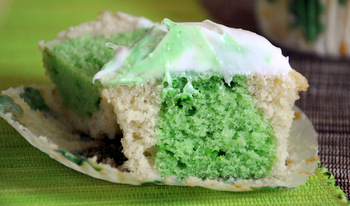
This article is one of my rare ones about food that is more analysis than recipe. Last month, I made Cinnamon Two-Tone Cupcakes with 1/2 box of yellow cake mix, using Wilton two-tone cake inserts. I observed that the interior columns of the cakes were blobby. This time, for the other half box, instead of a cinnamon and nutmeg mix for the interior part, I used 3 tablespoons of rainbow jimmies.

This batch came out worse looking than the cinnamon ones. The interior "columns" seem to have clumped together, some pooling at the bottom. The (confetti) jimmies look smeary after baking. I'm thinking that the combination of moistness and baking temperature partly dissolves those decorations. (A magnified pic in Confetti Cupcake Bites shows the same kind of smeariness.)

Icing

I used 1/2 recipe for simple powdered sugar glaze, omitting the vanilla. I used a fork to stir 1 1/2 tablespoons of water into a container with 1 cup of powdered sugar. With the cupcakes bunched together on the cooling rack atop a baking pan, I poured the glaze onto the cupcakes.

I had set the iced cupcakes in refrigerator for an hour or so, then "sugared" them up as follows:
  1. Poured some red-color sugar on a saucer. (Happy Valentine's Day today!)
  2. Placed each cupcake upside down onto the sugar and rotated the cake to coat its top.
  3. Placed each of the cakes right side up.
Note: The image at the top of the article shows some cupcakes with glaze only and others with glaze and red sugar.

Post-batch Thoughts

 Batter Process
For the time I spent on dispensing the batters into the Wilton inserts and achieving the blobby, bland-looking baked results, I would not make the confetti version again. (If making confetti cupcakes, blend in maybe 5 to 6 tablespoons of jimmies into one batter bowl, foregoing Wilton cupcake inserts.)

The cinnamon two-tone cupcakes, although blobby, show visual contrast and taste really good. The image at page 31 of https://app.box.com/s/r62gd7ax0ctgjcw9os6bih5ic1z12vva shows more details than the image in the cinnamon cupcake article.

 Cake Topping Process
For future cupcake icing projects, I would pour the icing in small, tight circles or dip the tops of the cakes into the icing container. And I'd sugar them immediately instead of waiting till later. Why not coat with frosting?
  • I don't have any canned frosting in the house and don't want to buy any.
  • I have loads of powdered sugar I want to use up but don't want to make frosting using perishables like butter and milk.
  • I want to use up some of the many colored sugars I have in the pantry.

Saturday, January 30, 2016

Some Lyrical Blasts from the Past

YouTube playlist for this article,
playlist compilation article


In the distant past, I actually memorized some oddball sequential utterances of some lyrics. However, I think about other sequences—mostly names of locations—that I seem unable to memorize. Little wonder I had not seriously gone into acting or singing, which require seemingly innate talents to memorize and recite.

Learning weirdly nonsensical utterances are kinda embarrassing to admit to. Anyone else? Example songs include "Hooked on a Feeling" (Blue Swede, 1974), "Wanna Be Startin' Something" (Michael Jackson, 1982), "Witch Doctor" (Alvin and Chipmunks, 1958), and "Good Morning Starshine" (Oliver, 1969).

Hooked on a Feeling (Blue Swede)
The link is a two-fer, with lyrics in the video. Dig the chant part!
Ooga-Chaka Ooga-Ooga
I read more information about "Hooked on a Feeling", most recently about it being in the Guardians of the Galaxy movie. BJ Thomas released his own version in the late 60s, although YouTube listings don't show any live performances that old. Watch an undated and more recent performance.

Wanna Be Startin' Something (Michael Jackson)
Lyrics excerpt
Ma Ma Se,
Ma Ma Sa, Ma Ma Coo Sa
Ma Ma Se, Ma Ma Sa,
Ma Ma Coo Sa
[Repeat/Fade-Out]
Actually, the lyrics to the rest of the song are loads plentiful. About all I could remember are the song title and "You're a Vegetable". (I had no nope of memorizing the entire song!)

Witch Doctor (Alvin and Chipmunks)
Lyrics excerpt
Ooo eee, ooo ah ah ting tang
Walla walla, bing bang
Ooo eee, ooo ah ah ting tang
Walla walla, bing bang...
Ooo eee, ooo ah ah ting tang
Walla walla, bing bang
Ooo eee, ooo ah ah ting tang
Walla walla, bing bang
In my web searches, I ran across a different "Witch Doctor" version. The only similarity is the song title.

Good Morning Starshine (Oliver)—a big hit from the musical Hair
Lyrics excerpt
Gliddy glub gloopy nibby nabby noopy
La la la, lo lo
Sabba sibbi sabba nooby aba naba
Lee lee, lo lo
Tooby ooby wala
Nooby aba naba…
Early morning singin' song
Another Hair song comes to mind for memorization efforts—the actual "Hair" song, which has loads of adjectives and phrases WRT to hair. Love the song, can't memorize much of it to save my life, even though it has no utterances like Starshine does. Not sure I could sing "Hair" well even with karaoke lyrics to look at.
Lyrics excerpt
I want it long, straight, curly, fuzzy
Snaggy, shaggy, ratty, matty
Oily, greasy, fleecy
Shining, gleaming, streaming
Flaxen, waxen
Knotted, polka-dotted
Twisted, beaded, braided
Powdered, flowered, and confettied
Bangled, tangled, spangled, and spaghettied!

Let it fly in the breeze
And get caught in the trees
Give a home to the fleas in my hair
A home for fleas
A hive for bees
A nest for birds
Now to segue into other songs that I have lyrics memorization issues with. Although "Hallelujah" doesn't require much lyrics memorization, the rhythm and pitch are killers! Watch the Mormon Tabernacle Choir performance.
Memorization difficulties for me include lyrics with series of items.

Surfin' USA (Beach Boys, 1963)
Lyrics excerpt
You'd catch 'em surfin' at Del Mar
Ventura County line
Santa Cruz and Trestle
Australia's Narrabeen
All over Manhattan
And down Doheny Way

Haggerties and Swamies
Pacific Palisades
San Onofre and Sunset
Redondo Beach L. A.
All over La Jolla
At Wa'imea Bay.
Heart of Rock and Roll (Huey Lewis and the News, 1983)
Lyrics excerpt
New York, New York, ...
LA, Hollywood, and the Sunset Strip ...
DC, San Antone and the Liberty Town, Boston and Baton Rouge
Tulsa, Austin, Oklahoma City, Seattle, San Francisco, too ...
In Cleveland
Detroit!!
Vogue (Madonna, 1990)
Lyrics excerpt
Greta Garbo, and Monroe
Deitrich and DiMaggio
Marlon Brando, Jimmy Dean
On the cover of a magazine

Grace Kelly; Harlow, Jean
Picture of a beauty queen
Gene Kelly, Fred Astaire
Ginger Rodgers, dance on air

They had style, they had grace
Rita Hayworth gave good face
Lauren, Katherine, Lana too
Bette Davis, we love you
Note: I looked up about six lyrics sites, and they all misspell Deitrich, which should be Dietrich.

Extreme Memorization and Delivery Performances
Watch astounding memorization, harmonization, and mashups in Straight No Chaser's "12 Days of Christmas". Read the lyrics, which are interesting for capably presenting numerous simultaneous singing parts.

Watch Weird Al's "White and Nerdy", his parody of Chamillionaire's "Ridin' Dirty". Lyrics to both songs are very taxing to the brain for their tempo and quantity. Notice visual similarities between the videos. (As a Weird Al fan, I especially appreciate his cultural references and also cameos by the comedy duo, Key and Peele, and Donny Osmond.)

"Life is a Rock" (Reunion), to me, is the King Kong of memorization impossibility that has lots of names and references—too numerous to list. Furthermore, the delivery is EXTREMELY fast. Visit the collage and the screen lyrics versions.

Mumbly Deliveries
I feel less inclined to learn lyrics to "mumbly" song deliveries. To me, one particular song stands out for mumbliness—both popular versions of "Louie, Louie". Contrast Kingsmen and Paul Revere and Raiders versions. For eyeball and ear convenience, read the screen lyrics while listening.

Two versions of "Gimme Some Lovin'" contrast in lyrics deliveries. Steve Winwood, who sang the Spencer Davis Group version, belts it out passionately, but the Blues Brothers enunciate great! (Watch both the SDG and the BB version.) BTW, the BB version is a clip from the movie.

Tiptoeing
I briefly considered titling my article "Tiptoeing Thru Some Blasts from Past Lyrics", which would have taken me far from my intended topic of lyrics WRT memorization. However, I do want to share the obvious tiptoe blast from past—"Tiptoe Through the Tulips". Amazingly, Tiny Tim's version is nearly 50 years old (1968). An older version is in the Golddiggers of Broadway movie (1929). BTW, my tiptoeing in Tiny Tim YouTube territory took me to an entertaining video of him performing "Do Ya Think I'm Sexy" on the Johnny Carson Show.

Thursday, January 21, 2016

Cinnamon Two-Tone Cupcakes


Around Thanksgiving, I went to Michael's and spotted an intriguing Wilton gadget for making two-tone cupcakes. The design is for making two-tone cupcakes—"Fill the inner portion of the insert with one flavor or color of batter and the outer ring with another". I bought one that day, and another one a few days later, both times using a 50% off coupon. Grand total came to $7.00 + sales tax.

Before trying out the gadgets, I decided to look up info and recipes. Did I get an eyefull. Lots of complaints!
  • Messy!
  • Time consuming!
  • While pulling up gadgets,
    • Batter stuck to gadgets before falling from gravity, resulting in a gloppy mess. (I'm thinking surface tension because of viscosity.)
    • The batter that stuck to the gadgets would also pull up paper liners.
    • Misalignment of inner ring and outer ring of gadgets resulted in batter seeping from one area to another.
With all those complaints in mind and some commenters' suggestions, I hoped to avoid sorry pitfalls. I made sure to include the following actions in the recipe:
  • Spraying oil into the Wilton gadgets and cupcake pan before pouring the batter in.
  • Omitting paper liners in the pan wells.
  • Initially pouring a small layer "outer" area batter into pan before placing Wilton gadgets. Doing so was intended to prevent breach between contrasting batters.
  • Carefully pouring batters by using small measuring cups that have little spouts. (Some bakers suggested piping the batters, but I consider the step to be extra work and wasting bags.)
Cinnamon seems to be a common flavor for cinnamon rolls, coffee cakes, and some muffins, but not so much for cakes and cupcakes. I did run across recipes for dozen-quantity muffins that called for cinnamon and nutmeg. And the pans were standard 12-well cupcake pans. Thus, my recipe has a not-so-common cake flavor (using 1/2 box of cake mix) and instructions for using Wilton two-tone cupcake inserts.

Video-recording the recipe process was a new experience for me. Generating the YouTube video and subsequent .pdf file were even more adventuresome. A future blog article will be about having used Microsoft Movie Maker, Acoustica (audio editor), and Irfanview (graphics editor) WRT to the video and secondary files.

As has been my tradition with recipes, I include a pixstrip, this one showing the following image areas:
  1. Implements
  2. Ingredients
  3. Spray oil with pan and Wilton gadgets
  4. Mixed cake batter, with cinnamon and nutmeg beside it
  5. Blending of cinnamon and nutmeg into the smaller bowl batter
  6. Dispensing of batters into the pan with Wilton gadgets(combo image)
  7. Removal of Wilton gadgets before placing the pan in oven
  8. Baked cupcakes
  9. Iced and some sliced-open cupcakes
Implements
  • Electric mixer
  • Mixing bowls
  • Measuring cups
  • Measuring spoons
  • Rubber spatula(s)
  • Cupcake pan
  • Wilton cupcake insert (I used two.)
  • Cooling rack
  • Butter knife or similar for removing cupcakes from pan
Ingredients
  • 1/2 box cake mix—white, yellow, vanilla to contrast with cinnamon/nutmeg
  • ingredients for half-box recipe, using the box info for guide
    • eggs
    • cooking oil
    • water
  • 1 teaspoon cinnamon
  • 1/2 teaspoon nutmeg
  • spray oil
  • icing or some other cupcake topping (I used a freebie Wilton decorating icing. I've provided links to alternative toppings at the bottom of the article.)
Instructions (Have the cake mix box handy!)
  1. Preheat the oven (350°).
  2. Prepare baking pan and Wilton gadget(s) with spray oil.
  3. Weigh 1/2 box of cake mix powder, and prepare the batter as instructed on the box.
  4. Pour 1/3 of the batter into a smaller bowl, and blend the cinnamon and nutmeg in. (Initially, I tapped and mixed a little of the cinnamon and nutmeg into the batter before divvying it into two portions.)
  5. Pour a small layer of "outer" batter into each cupcake well.
  6. Place gadget(s) into wells and dispense inner batter, then outer batter. Lift gadget(s) and place into wells needing filling. Repeat this step until finished.
  7. Remove the gadget(s). Place rack in oven and bake for about 18 minutes. YMMV
  8. Test cupcakes for doneness with toothpick.
  9. Remove the pan of baked cupcakes and place on cooling rack. Run a knife along the edges for loosening them.
  10. Decorate as desired.
Post-recipe Thoughts
Despite my oil-spraying of my cupcake pan and the Wilton inserts, the center cupcake columns looked blobby, and seemed more voluminous than the "outer" cupcake parts. I was surprised that they more resembled the globby one at Baking Bites than other nice and straight ones.

The next time I make two-tone cupcakes, I'll spray more oil, and I'll try using rainbow jimmies for the center columns. (2/19/2016—Baked a batch. Read "Those Two-Tone Confetti Cupcakes" for my results assessment.)

Nutrition: The cake mix box states 260 calories (prepared) for each serving, 10 servings a box. So, the cupcakes are about 110 calories each, plus an additional ~40 for the sorta light smear of Wilton icing. (Sigh, I miss the recent olden days when cake mix weighed 18.25 ounces and served 12 instead of the current 15.25 ounces for 10 servings. Grrr! Reduction by ~16%, jeopardizing *FORMERLY RELIABLE* results and yields.)

Alternates to cupcake toppings (viewed by me for possible future use), in two cases, part of main sweets recipes: